

Grey-cheeked Bulbul vs Puff-throated Bulbul
Alophoixus tephrogenys versus Alophoixus pallidus
Play a quiz with Grey-cheeked Bulbul and Puff-throated Bulbul
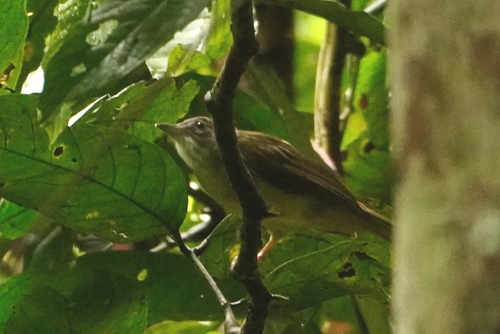 Grey-cheeked Bulbul
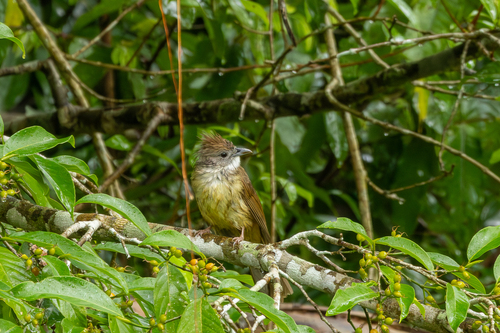 Puff-throated Bulbul
In short
The most reliable field mark to separate Grey-cheeked Bulbul from Puff-throated Bulbul is the throat: Puff-throated Bulbul shows noticeably puffy, white throat feathers, while Grey-cheeked Bulbul lacks this feature. Additionally, Puff-throated Bulbul has olive upperparts and yellow underparts, contrasting with the more subdued tones of Grey-cheeked Bulbul. Both species are similar in size and shape, and their ranges overlap in Southeast Asia, so careful attention to throat and underpart color is essential. Sexes are alike in both species, so these marks work year-round and for all ages where adult-like plumage is present.
Identification tips
- Throat feathers: Puff-throated Bulbul has distinctive puffy, white throat feathers that are obvious in the field; Grey-cheeked Bulbul lacks this feature and instead has a greyish cheek.
- Underpart color: Puff-throated Bulbul shows yellow underparts, though not as bright as White-throated Bulbul; Grey-cheeked Bulbul's underparts are more subdued and lack strong yellow tones.
- Upperpart color: Puff-throated Bulbul has olive upperparts, which may contrast with the generally duller, less olive-toned upperparts of Grey-cheeked Bulbul.
- Bill, iris, and feet: Puff-throated Bulbul has a brown iris and bill, and black feet. These features are not described for Grey-cheeked Bulbul, so use with caution.
- Sexes and ages: Both species are sexually monomorphic (males and females look alike), and there is no mention of age-related differences in field marks, so the main plumage features are reliable year-round.
- Flight and wing pattern: No distinctive flight or wing pattern differences are described for either species, so do not rely on these in quick fly-by views.
- Size: Both are large bulbuls; Puff-throated Bulbul is specifically 23 cm, but this is not a reliable field mark due to overlap.
- Habitat overlap: Both can be found in similar forest types in Southeast Asia, so do not use habitat alone to separate them.
- Confusion with White-throated Bulbul: Puff-throated Bulbul is similar to White-throated Bulbul but with duller underparts; be careful not to confuse these three species if all are present.
- Context: If you see a bulbul with a strikingly puffy white throat, favor Puff-throated Bulbul; if the face is more uniformly grey and the throat is not puffy, consider Grey-cheeked Bulbul.
- Bill and feet color: If you get a close look, check for the black feet and brown bill/iris of Puff-throated Bulbul, but remember these are subtle and may not always be visible.
- No strong seasonal or sex-based variation: The main field marks are consistent throughout the year and across sexes in both species.
- When in doubt: Focus on the throat and underpart color as your primary clues, as these are the most reliable and visible in the field.
- No distinctive vocal differences provided: Do not rely on voice for separation unless you have local experience or further information.
- Photograph for confirmation: If possible, take a photo of the throat and underparts to confirm identification later, especially if the puffy throat is not obvious in the field.
Size
Both species are large bulbuls, with Puff-throated Bulbul specifically noted as 23 cm long. There is no direct measurement for Grey-cheeked Bulbul in the provided notes, but the two are generally similar in size and bulk. Size alone is not a reliable separator in the field between these two.
Plumage
No age-specific wing or flight pattern differences are described for either species, so separation relies on plumage details visible when perched. Puff-throated Bulbul stands out with its puffy white throat feathers, which are prominent in all plumages and ages. Its upperparts are olive, and the underparts are yellow, though described as duller than the similar White-throated Bulbul. Grey-cheeked Bulbul, by contrast, lacks the puffy white throat and instead has a greyish cheek and generally more muted coloration overall. Both sexes look alike in both species, so these marks are always relevant.
Behaviour
No behavioral differences are described in the provided notes. Both species are typical bulbuls in their habits and are likely to be encountered in similar forested environments.
Habitat
Both species occur in Southeast Asia, with Grey-cheeked Bulbul found from the Malay Peninsula to the Greater Sunda Islands, and Puff-throated Bulbul more broadly in Southeast Asia. Grey-cheeked Bulbul is specifically noted in subtropical or tropical moist lowland and montane forests, while no further habitat detail is given for Puff-throated Bulbul. In practice, both can be found in similar forest types, so habitat is not a strong separator.
Grey-cheeked Bulbul · Puff-throated Bulbul · My Tricky Birds