

Greenish Yellow-Finch vs Saffron Finch
Sicalis olivascens versus Sicalis flaveola
Play a quiz with Greenish Yellow-Finch and Saffron Finch
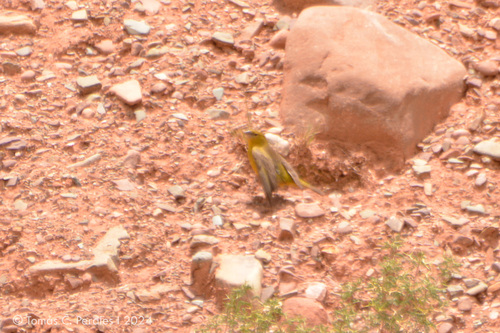 Greenish Yellow-Finch
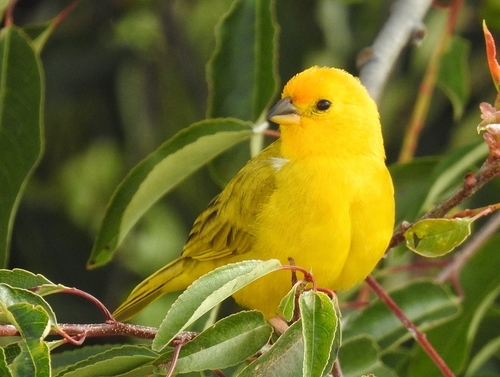 Saffron Finch
In short
To separate Greenish Yellow-Finch from Saffron Finch, focus first on habitat and altitude: Greenish Yellow-Finch is a high-Andean species, while Saffron Finch is widespread in lowland and foothill open areas. Both are yellowish finches in the same genus, but Saffron Finch is typically brighter and more saturated yellow, especially in adult males, whereas Greenish Yellow-Finch shows a duller, more olive-yellow tone. Structural differences are subtle, but Greenish Yellow-Finch is slightly heavier. If you encounter a yellow Sicalis in shrubby, high-altitude Andean terrain, it is far more likely to be Greenish Yellow-Finch; in lowland or urban areas, Saffron Finch dominates. Immature and female birds of both species can be confusing, so context and overall color saturation are key.
Identification tips
- Habitat and elevation: Always check your location. Greenish Yellow-Finch is a high-Andean species; Saffron Finch is a lowland bird of open and semi-open areas. If you are above treeline or in shrubby high-altitude terrain, Greenish Yellow-Finch is much more likely.
- Overall color saturation: Saffron Finch (especially adult males) is a vivid, saturated yellow, sometimes with orange on the head. Greenish Yellow-Finch is duller, with a greenish or olive-yellow wash.
- Head color: Look for orange or deep yellow tones on the head of Saffron Finch males; Greenish Yellow-Finch lacks this, remaining more uniformly olive-yellow.
- Underparts: Saffron Finch usually has cleaner, brighter yellow underparts. Greenish Yellow-Finch is more muted and olive below.
- Upperparts: Greenish Yellow-Finch shows a greenish or olive cast to the upperparts, while Saffron Finch is more uniformly yellow.
- Sex and age variation: Females and immatures of both species are duller, but the Saffron Finch usually retains a brighter yellow below than Greenish Yellow-Finch of the same age/sex.
- Urban/anthropogenic settings: Saffron Finch is common in towns, gardens, and fields, often near people. Greenish Yellow-Finch avoids such areas, preferring wild, shrubby slopes.
- Geographic range: Saffron Finch has a much broader South American range, including lowland Argentina, Brazil, and even introduced populations on Caribbean islands. Greenish Yellow-Finch is restricted to the central Andes.
- Behavior: Both species forage on the ground, but Saffron Finch is more likely to be seen in loose flocks in open areas.
- Subtle size difference: Greenish Yellow-Finch is slightly heavier, but this is not a reliable field mark without direct comparison.
- No strong wing pattern differences: There are no documented age-specific upperwing or flight pattern marks to separate these species in the field.
- Voice: No diagnostic vocal differences are provided in the sources; do not rely on song or call for separation.
- Seasonal context: Both species are resident in their respective ranges, so season is less important than habitat and location.
- Pitfalls with immatures: Young Saffron Finches may appear dull, but usually still show a brighter yellow below than Greenish Yellow-Finch.
- Checklist approach: If you see a yellow Sicalis in a lowland urban park, it is almost certainly Saffron Finch; if in high Andean shrubland, Greenish Yellow-Finch is expected.
Size
Greenish Yellow-Finch is marginally heavier (22.0g) than Saffron Finch (19.2g) [wikidata], but this difference is slight and not likely to be obvious in the field. Both species are similar in overall size and structure, with no strong differences in bill length or tail shape noted in available sources. Use size only as a supporting clue, not a primary field mark.
Plumage
No detailed age-specific wing or flight pattern differences are documented in the available sources; both species are generally yellowish finches, but Saffron Finch (especially adult males) is a much brighter, more saturated yellow, sometimes with orange tones on the head. Greenish Yellow-Finch is more subdued, with an olive-yellow or greenish cast overall. Females and immatures of both species are duller, but Saffron Finch typically retains a cleaner yellow below, while Greenish Yellow-Finch is more uniformly olive or greenish. In the absence of strong wing pattern differences, rely on overall color and context.
Behaviour
Both species are typical Sicalis finches, often seen foraging on the ground or in low vegetation. Saffron Finch is more likely to be seen in open, human-modified areas such as gardens, parks, and fields, sometimes in loose flocks. Greenish Yellow-Finch tends to favor shrubby, high-altitude environments and may be less confiding around people. Flight style is not described as a strong separator in the sources.
Habitat
Habitat is a key separator: Greenish Yellow-Finch is found in the central Andes of Argentina, Bolivia, Chile, and Peru, specifically in subtropical or tropical high-altitude shrubland and degraded forest [wikipedia]. Saffron Finch is widespread in lowland and foothill open areas outside the Amazon Basin, including urban and agricultural settings, and is absent from high Andes. If you are in high-elevation Andean shrubland, Greenish Yellow-Finch is expected; in lowland towns, fields, or gardens, Saffron Finch is far more likely.