

Green-throated Carib vs Grey Kingbird
Eulampis holosericeus versus Tyrannus dominicensis
Play a quiz with Green-throated Carib and Grey Kingbird
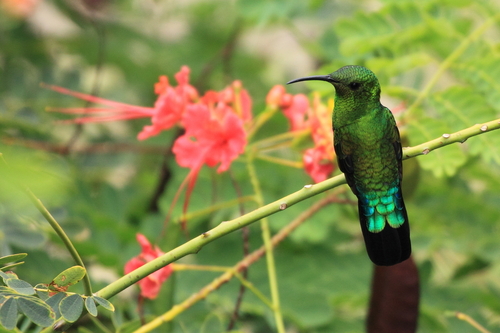 Green-throated Carib
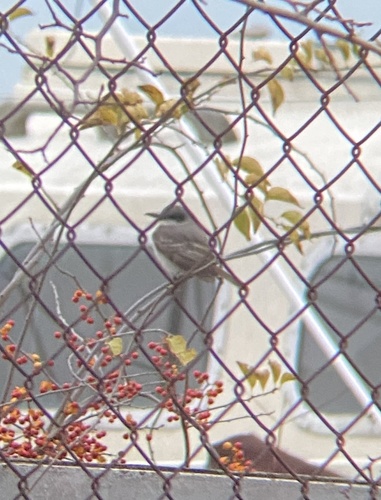 Grey Kingbird
In short
The most reliable field mark to separate Green-throated Carib from Grey Kingbird is overall structure and plumage: the carib is a small, compact, metallic-green hummingbird with a slender, decurved bill, while the kingbird is a much larger, robust flycatcher with a heavy, straight bill and gray-and-white plumage. Juvenile Grey Kingbirds may show rufous edges on the wings and tail, but even then, their size, upright posture, and flycatcher shape are unmistakable compared to any hummingbird. In flight or perched, the kingbird's pale underparts and gray upperparts contrast sharply with the carib's glossy green and black coloration. Bill shape and size are immediately diagnostic at any age or season. Confusion is most likely at a distance or in poor light, but direct comparison of size, structure, and color will resolve nearly all mix-ups.
Identification tips
- Size is the fastest check: Green-throated Carib is tiny (6.2 g), while Grey Kingbird is large and bulky (43.8 g). Even at a distance, the kingbird dwarfs the carib.
- Bill shape is diagnostic: Carib has a slender, slightly to strongly decurved bill (longer and more curved in females); kingbird has a thick, straight, heavy bill. This difference is obvious in any view.
- Plumage color: Carib is metallic green above with a bright green throat and black belly; kingbird is gray above, white below, with no green or metallic colors.
- Juvenile kingbird warning: Young kingbirds have rufous edges on wings and tail, but still show gray/white base colors and never any metallic green. Carib immatures look like duller adults, never showing rufous or pale underparts.
- Tail and wing structure: Carib has a short, dark blue-black tail and narrow, pointed wings; kingbird has a long, brownish tail and broad, rounded wings.
- Flight style: Carib hovers and darts, often feeding at flowers; kingbird flies with strong, direct wingbeats and perches upright to sally for insects.
- Perched posture: Kingbird sits upright and alert, often high and exposed; carib perches more horizontally, closer to vegetation.
- Facial pattern: Kingbird has a dusky mask through the eye and sometimes a concealed yellow crown stripe; carib lacks any mask or crown stripe.
- Underparts: Carib has a black belly and green vent; kingbird is white below with a grayish chest.
- Habitat context: Carib is usually near flowers and low vegetation; kingbird prefers open areas, wires, and treetops.
- Vocalizations: Carib gives sharp, simple 'chup!' notes; kingbird's loud, rolling trill 'pipiri, pipiri' is distinctive.
- Sex differences: Female caribs have a longer, more curved bill and slightly duller green; kingbird sexes are similar.
- Seasonal confusion: Both species are resident or common in their ranges, but only kingbird juveniles show rufous in wing/tail; carib never does.
- Lighting pitfalls: In poor light, carib's tail may appear black; kingbird's brownish tail and gray upperparts remain non-iridescent.
- Behavioral cues: Kingbird may be seen mobbing larger birds; carib defends flower patches and rarely interacts with larger birds.
Size
Green-throated Carib is dramatically smaller, weighing about 6.2 g and measuring 10.5–12 cm in length [wikidata, wikipedia]. In contrast, Grey Kingbird is a large passerine, about 43.8 g and 23 cm long—almost four times the mass and twice the length of the carib. The kingbird's bulk, long tail, and robust body are obvious even at a distance, while the carib is tiny, delicate, and compact. This size difference is so extreme that even a brief binocular view should make confusion unlikely.
Plumage
- Juvenile/immature Grey Kingbird: Young kingbirds have rufous edges on the wing coverts, rump, and tail, which can add a warm tone to their otherwise gray and white plumage. This is never shown by Green-throated Carib at any age.
- Adult Green-throated Carib: Both sexes are metallic green above with a bright green gorget, black belly, green vent, and a dark blue (appearing black) tail. Females are slightly duller and have a longer, more curved bill. No white or gray underparts are present at any age.
- Adult Grey Kingbird: Gray upperparts, brownish wings and tail, white underparts with a grayish chest, and a dusky mask through the eye. A concealed yellow crown stripe is present but rarely visible. No metallic colors or green are present. The kingbird's plumage is always matte and pale compared to the glossy, dark carib.
- In flight: The kingbird shows broad, rounded wings and a long tail, while the carib's wings are narrow and pointed, typical of hummingbirds.
Behaviour
Green-throated Carib hovers while feeding at flowers and often makes rapid, darting flights; it may defend flower patches, especially males. Grey Kingbird perches upright on exposed branches or wires, sallying out to catch insects in typical flycatcher fashion. Kingbirds aggressively mob larger birds and are conspicuous in their territorial defense, while caribs are more focused on defending nectar sources. The carib's flight is rapid and hummingbird-like, while the kingbird's flight is direct, with strong, steady wingbeats.
Habitat
Both species can be found in human-modified habitats, but their preferences differ: Green-throated Carib frequents gardens, second growth, and vegetation near homes, especially where flowering plants are abundant. Grey Kingbird prefers open areas with scattered trees, edges, and wires, often seen in coastal or suburban settings. The kingbird is more likely to be seen perched high and conspicuously, while the carib is usually closer to flowers and lower vegetation.
Voice
Green-throated Carib gives sharp 'chup!' or 'chuwp!' calls, and may produce rattles or wing whirs during disputes. Grey Kingbird has a loud, rolling trill 'pipiri, pipiri,' which is distinctive and the origin of many local names. The kingbird's call is much louder and more complex than the carib's simple, sharp notes.