

Green Hylia vs Tit-hylia
Hylia prasina versus Pholidornis rushiae
Play a quiz with Green Hylia and Tit-hylia
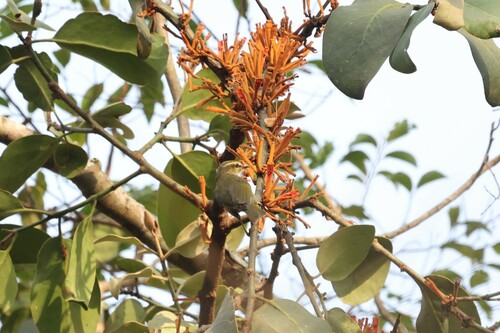 Green Hylia
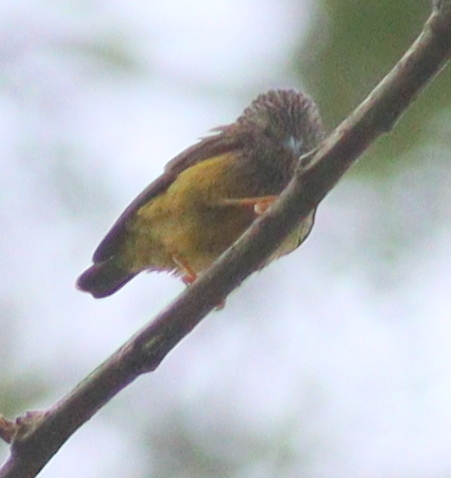 Tit-hylia
In short
To separate Green Hylia from Tit-hylia in the field, focus first on overall coloration and size: Tit-hylia is much smaller and shows a distinctive combination of heavy brown streaking on a pale buff head and chest, with a bright yellow belly and orange legs, while Green Hylia is a plain olive-green bird with dark eyes and feet. Juvenile Tit-hylias are less colorful but still show some streaking, unlike the uniformly greenish Green Hylia. Structure and jizz also help: Tit-hylia is notably tiny, even compared to the already small Green Hylia. Both species may be found in similar rainforest habitats, so visual clues are more reliable than context. Voice can help if heard well, as Green Hylia gives clear two-note whistles or dry rattles, while Tit-hylia is less well described vocally.
Identification tips
- Size: Tit-hylia is extremely small (5.2 g), noticeably smaller than Green Hylia (11.6 g). If the bird appears almost kinglet- or goldcrest-sized, suspect Tit-hylia.
- Plumage - Head and Chest: Tit-hylia always shows heavy brown streaking on a pale buff head and chest. Green Hylia is plain olive-green with no streaking anywhere.
- Plumage - Underparts: Tit-hylia has a bright yellow belly and rump, sharply contrasting with its streaked upperparts. Green Hylia is olive-green or olive-grey below, never yellow.
- Leg Color: Tit-hylia has bright orange legs, which can stand out in good light. Green Hylia has olive-green feet, blending with its overall coloration.
- Bill and Eye: Green Hylia has a black bill and dark brown irises; Tit-hylia's bill and eye color are not highlighted as distinctive, but the contrast with its pale face may help.
- Juvenile Plumage: Young Tit-hylias are less colorful and less streaked, but still show some streaking and a hint of yellow below. Juvenile Green Hylia is as plain as the adult.
- No Wing Pattern Marks: Neither species has a distinctive wing or flight pattern described, so rely on perched views for ID.
- Voice: If you hear a clear, two-note whistle or a dry rattle, it's Green Hylia. Tit-hylia's song is not well described, so absence of these calls may point to Tit-hylia, but silence is not diagnostic.
- Habitat: Both occur in similar rainforest habitats; do not use habitat alone for separation.
- Behavior: Tit-hylia's tiny size may make it seem especially delicate or prone to getting caught in spider webs. Green Hylia is more robust.
- Sex and Age: No sexual dimorphism in either species; males are slightly larger in Green Hylia, but this is not field-diagnostic.
- Subspecies Variation: Green Hylia subspecies differ in throat and belly color (olive-green vs. white-grey), but neither shows the streaked/yellow pattern of Tit-hylia.
- Context: If you see a very small, streaked, yellow-bellied bird in the rainforest, it's Tit-hylia. If the bird is plain olive-green, it's Green Hylia.
- Common Pitfall: Do not mistake a dull juvenile Tit-hylia for Green Hylia; even young Tit-hylias show some streaking and yellow, never the uniform green of Green Hylia.
- Mixed Flocks: Both may join mixed-species flocks in the canopy; use size and plumage, not flock composition, for ID.
Size
Tit-hylia is dramatically smaller than Green Hylia: adult Tit-hylia averages just 5.2 g, making it possibly Africa's smallest bird, while Green Hylia is nearly twice as heavy at 11.6 g. In the field, Tit-hylia appears tiny, almost kinglet-like, and may seem delicate or even vulnerable (sometimes getting caught in spider webs). Green Hylia, though small, is more robust and noticeably larger when seen side by side or with experience. Both are small, but Tit-hylia's size is striking and diagnostic.
Plumage
Plumage is the most reliable separator. Tit-hylia of all ages shows a pale buff head and chest with heavy brown streaking, and from the lower breast to the rump is bright yellow. Its legs are bright orange, and even juveniles, though duller and less streaked, retain some of this pattern. Green Hylia, by contrast, is a uniform olive-green above and below, with dark brown irises, a black bill, and olive-green feet. There is no streaking or bright yellow on Green Hylia at any age. Subspecies of Green Hylia differ slightly in throat and belly color (olive-grey vs. white-grey), but never approach the Tit-hylia's bold streaks or yellow underparts. No age-specific wing or flight pattern marks are described for either species, so perched views are key.
Behaviour
Both species are active, insectivorous, and forage in the forest canopy or understory. Tit-hylia's tiny size means it sometimes gets caught in spider webs, highlighting its delicate structure. Green Hylia is a canopy insectivore as well, but is somewhat more robust and less likely to appear as fragile. There is no strong behavioral separator, but Tit-hylia's extreme smallness and tendency to forage in very fine branches or even near spider webs can be a clue.
Habitat
Both species overlap widely in West and Central African rainforests, often in the same general areas. Green Hylia is a forest generalist, using the understory and mid-stratum of moist forest, while Tit-hylia is also a rainforest specialist. Habitat alone is not diagnostic, as both can be found in similar contexts. However, Green Hylia may be slightly more tolerant of disturbed or secondary forest than Tit-hylia, but this is not a reliable field mark.
Voice
Green Hylia is well known for its clear, pure, two-note whistles ("kee kee") and dry rattling calls ("trrit trrrit"). Its song is variable in frequency depending on habitat and background noise, but the two-note whistle is distinctive. Tit-hylia's vocalizations are not well described in the available sources, so voice is only useful if you hear the classic Green Hylia whistle or rattle. If you hear a pure, repeated two-note whistle, Green Hylia is likely; otherwise, rely on visual marks.