

Green-backed Trogon vs Guianan Violaceous Trogon
Trogon viridis versus Trogon violaceus
Play a quiz with Green-backed Trogon and Guianan Violaceous Trogon
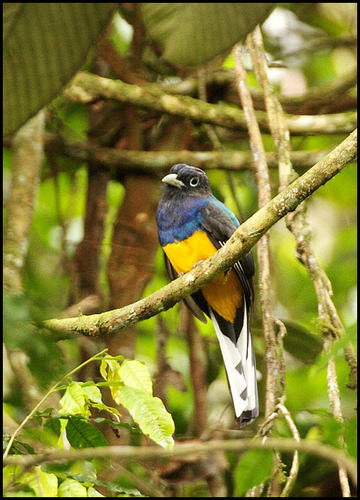 Green-backed Trogon
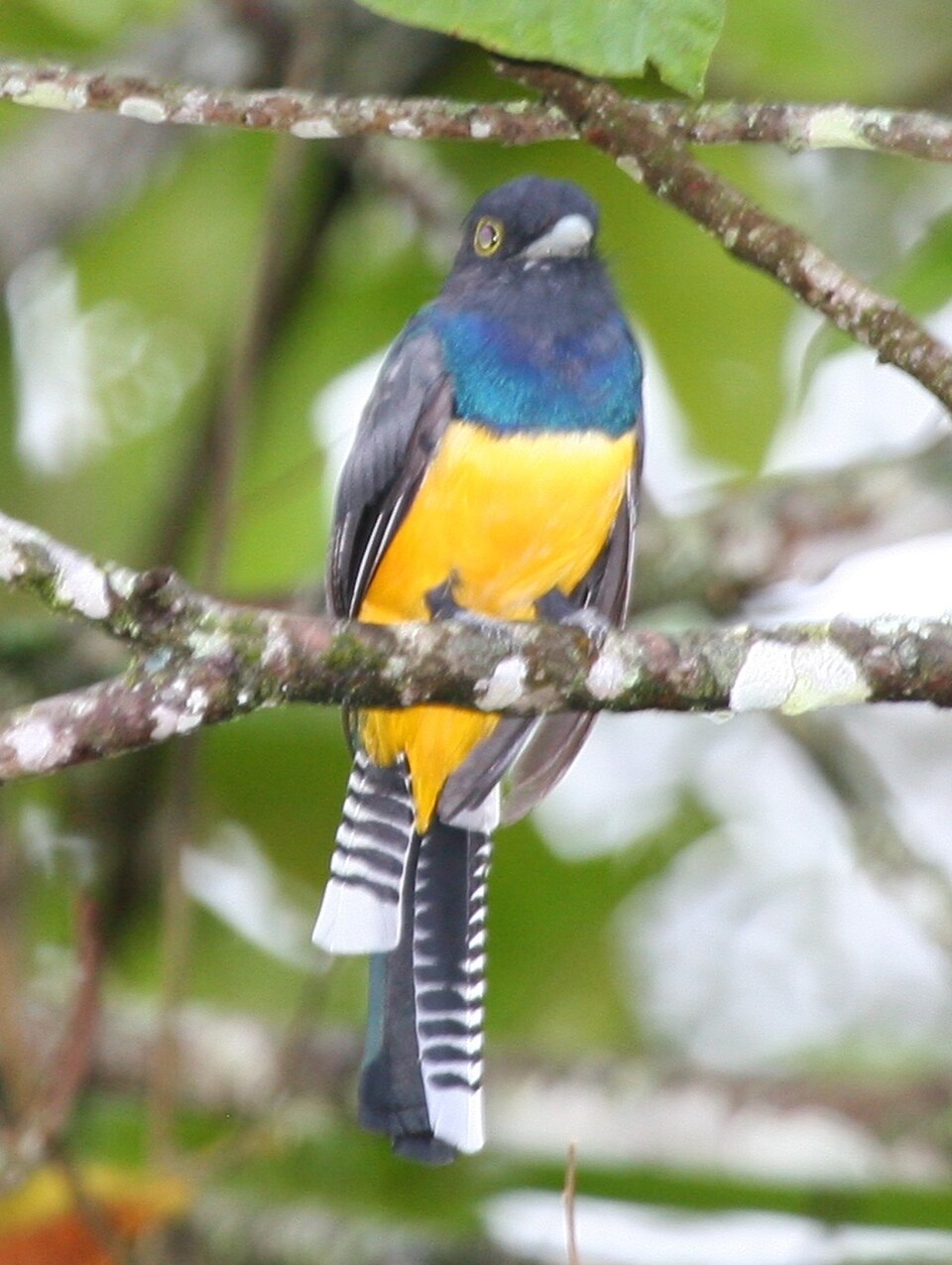 Guianan Violaceous Trogon
In short
The most reliable field mark to separate Green-backed Trogon and Guianan Violaceous Trogon is the undertail pattern in adults: Green-backed Trogon males show a black-and-white undertail with broad black bases and broad white tips/edges, while Guianan Violaceous Trogon males have fine black-and-white barring and wide white tips. Females of both are grayish above, but differ in tail barring and eye-ring color. Green-backed is also noticeably larger and bulkier, with a complete pale blue eye-ring (male), compared to the smaller Guianan Violaceous Trogon with a yellow eye-ring (male). Juvenile plumages are less well described, but adult wing and tail patterns remain the most practical field marks. Both species are sexually dimorphic, so be sure to consider sex when comparing plumages.
Identification tips
- Undertail pattern in males (adults): Green-backed Trogon shows broad black bases and broad white tips/edges to each undertail feather; Guianan Violaceous Trogon has fine black-and-white barring and wide white tips. This is the single most reliable mark for adult males.
- Undertail pattern in females (adults): Green-backed female has black-and-white barring mainly on the outer webs of each tail feather; Guianan Violaceous female has barring on the sides of the undertail and a less contrasting pattern. Look for the distribution of barring and the presence of broad white tips (Guianan) versus more extensive black (Green-backed).
- Eye-ring color (adults): Green-backed male has a complete pale blue eye-ring; Guianan Violaceous male has a pale yellow eye-ring. Female Green-backed also has a blue eye-ring, while Guianan female's is yellow or incomplete with white arcs above and below the eye.
- Size and structure: Green-backed is noticeably larger (28–30 cm vs 23–25 cm) and bulkier. If seen together or with experience, this can be a helpful clue, but beware of distance and posture effects.
- Head and breast color (males): Green-backed male has a dark blue (almost blackish) head and upper breast; Guianan Violaceous male has a violet-blue head with a black mask and throat, and a narrow white breast band. This band is absent in Green-backed.
- Back color (males): Green-backed male has a green back; Guianan Violaceous male has metallic green upperparts but a violet-blue tail and head, creating a more contrasting look.
- Belly color: Both have yellow underparts, but Green-backed's is more orange-yellow, while Guianan's is bright yellow in males and duller yellow with gray wash in females.
- Wing pattern: Both have dark wings with white markings, but Green-backed's are black vermiculated with white, while Guianan's appear dark gray-brown (male) or thinly but densely barred (female). This is subtle and not always reliable in the field.
- Facial pattern (females): Guianan Violaceous female has white arcs above and below the eye, absent in Green-backed. Use this in good light and close views.
- Juvenile plumage: Juvenile Guianan Violaceous males have browner wings and less white on the undertail than adults; juvenile Green-backed is not described, so use caution with young birds.
- Song: Green-backed's song is slower, with notes that accelerate; Guianan's is a rapid series of hollow whistles. Use with caution unless familiar with both.
- Habitat: Both occur in humid tropical forests and can overlap in range, so do not rely on habitat alone unless you are outside the overlap zone.
- Behavior: Both perch upright and are reluctant to fly; behavior is not a strong separator.
- Sexual dimorphism: Both species are strongly sexually dimorphic; always consider sex when comparing plumages, especially for undertail and facial patterns.
- Pitfalls: Poor light can make the Green-backed's blue head appear blackish; beware of this when using head color as a mark. Tail pattern and eye-ring color are more reliable in such conditions.
Size
Green-backed Trogon is the larger species, measuring 28–30 cm in length, while Guianan Violaceous Trogon is 23–25 cm. The Green-backed is also likely heavier, though only the Guianan's mass is given (38–57 g). In the field, Green-backed often appears bulkier and longer-tailed, which can help in direct comparison if both are seen together or with experience.
Plumage
-
Juvenile/immature plumages: Juvenile Guianan Violaceous Trogon males have browner wings and less white on the undertail than adults, but otherwise resemble adults. Juvenile females are similar to adult females. Juvenile Green-backed Trogon is not described in detail, but adult-like patterns are likely to appear early.
-
Adult males: Green-backed Trogon males have a dark blue (almost blackish) head and upper breast, green back, orange-yellow underparts, and a black-and-white vermiculated wing. Their undertail is diagnostic: each feather has a broad black base and a broad white tip and edge. The eye-ring is complete and pale bluish. Guianan Violaceous Trogon males have a violet-blue head with a black mask and throat, metallic green upperparts, a narrow white band across the breast, and bright yellow underparts. Their undertail shows fine black-and-white barring and wide white tips (not broad black bases). The eye-ring is pale yellow.
-
Adult females: Both are gray above and below, but Green-backed Trogon females have a complete pale blue eye-ring and a tail with black-and-white barring mainly on the outer webs. Guianan Violaceous Trogon females have a yellow eye-ring (incomplete in some), white arcs above and below the eye, and the tail underside appears barred on the sides. Their belly is duller yellow with a gray wash on the flanks.
-
Wings: Both species' wings appear dark with fine white markings, but Green-backed's are described as black vermiculated with white, while Guianan's are so finely barred that they appear dark gray-brown (male) or thinly but densely barred (female).
Behaviour
Both species perch upright and motionless, typical of trogons, and are reluctant to fly far. Green-backed Trogon is noted as especially frugivorous and less likely to join mixed-species flocks than other trogons, including Guianan Violaceous. Both have broad bills and weak legs, reflecting their arboreal habits. In flight, both are fast but not long-distance fliers; their jizz is similar, so behavior is not a strong separator.
Habitat
Green-backed Trogon is widespread in the Amazon rainforest, Guiana Shield, Trinidad, and the Atlantic Forest of eastern Brazil, and is typically the commonest trogon in its range. Guianan Violaceous Trogon is found in Brazil, French Guiana, Guyana, Suriname, Trinidad, and Venezuela. Their ranges overlap in parts of northern South America and Trinidad. Both prefer humid tropical forests, so habitat is not a strong separator unless you are outside the overlap zone.
Voice
Green-backed Trogon's song is a series of about 20 'cow' notes, starting slow and accelerating, slower than the white-tailed trogon and higher-pitched than the black-tailed trogon. Guianan Violaceous Trogon gives a long series of rapid, hollow, downslurred whistles ('kyu-kyu-kyu-kyu-kyu'). The Green-backed's song is slower and less rapid than the Guianan's. Calls are not well described for Green-backed, but Guianan gives rolling chattering calls. Song pace and tone can help, but are subtle and require experience.
Green-backed Trogon · Guianan Violaceous Trogon · My Tricky Birds