

Greater Blue-eared Starling vs Cape Starling
Lamprotornis chalybaeus versus Lamprotornis nitens
Play a quiz with Greater Blue-eared Starling and Cape Starling
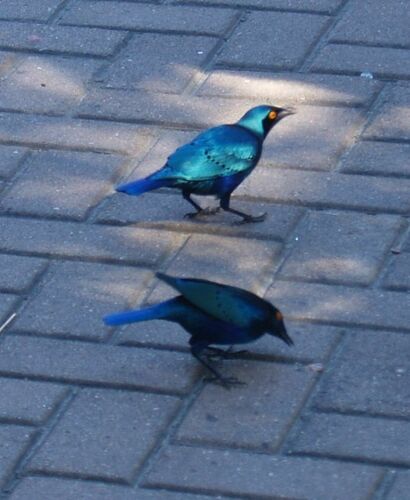 Greater Blue-eared Starling
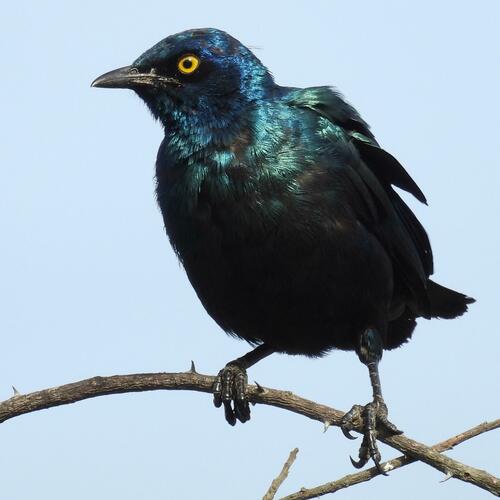 Cape Starling
In short
The most reliable field mark between Greater Blue-eared Starling and Cape Starling is the extent and tone of blue on the underparts: Greater Blue-eared Starling shows a deep blue belly that extends forward of the legs, while Cape Starling is more uniformly glossy and lacks this sharply demarcated blue belly. Both are glossy, yellow-eyed starlings of open habitats, but Cape Starling is larger, longer-tailed, and more uniformly colored, with a greener tone to the upperparts. Juvenile Greater Blue-eared Starlings are much duller below, with blackish brown underparts, while Cape Starling immatures are not described as having such a strong contrast. Structure and tail length can help in perched birds, but the underpart color and gloss pattern are most useful. Both species are gregarious and often found together, so careful attention to these subtle differences is needed.
Identification tips
- Underpart color (adults): Greater Blue-eared Starling has a deep blue belly that extends forward of the legs, creating a strong contrast with the rest of the body. Cape Starling is more uniformly glossy below, lacking this sharply demarcated blue belly.
- Juvenile plumage: Juvenile Greater Blue-eared Starling is much duller, with blackish brown underparts contrasting with glossy upperparts—a strong separation from Cape Starling juveniles, which are not described as having such dark bellies.
- Ear patch: Greater Blue-eared Starling shows a distinct blue ear patch, while Cape Starling's ear coverts are darker but not as sharply blue.
- Overall gloss: Cape Starling is more evenly glossy, with a blue head and greenish-blue upperparts, while Greater Blue-eared has a more varied gloss with blue-green and purple-blue tones.
- Tail length: Cape Starling is longer-tailed and appears more elongated when perched; Greater Blue-eared Starling is shorter-tailed and more compact.
- Size: Cape Starling is slightly larger and heavier, but this is subtle and best used in direct comparison or mixed flocks.
- Wing and tail color (subspecies): Some Cape Starling subspecies have greener wings and tail, and the inner vanes of the secondaries may be matt black, but this is subtle and not always visible.
- Iris color: Both species have bright yellow or orange eyes in adults, so this is not a useful separation.
- Habitat context: In southern Africa, Cape Starling is more likely in suburban gardens and parks, while Greater Blue-eared prefers open woodland, but both overlap widely.
- Flocking behavior: Both species are gregarious and often mix, so behavior is not a reliable separator.
- Vocalizations: Calls are variable and overlapping; Greater Blue-eared's nasal "squee-ar" may help, but Cape Starling's warbling and mimicry are not distinctive enough for separation in the field.
- Feeding behavior: Both species feed on the ground, sometimes on livestock, and take similar foods; this does not help with identification.
- Season and sex: Both species are similar in both sexes and year-round; no seasonal or sexual dimorphism aids identification.
- Pitfalls: In mixed flocks, focus on the extent of blue on the belly and the evenness of gloss; beware of dull juveniles, especially Greater Blue-eared, which can appear much less glossy below.
- When in doubt: Use a combination of belly color, tail length, and overall gloss pattern, and try to see multiple individuals for comparison.
Size
Cape Starling is slightly larger and longer overall (about 25 cm and 88–100 g) compared to Greater Blue-eared Starling (22 cm and 85.8 g). The difference is more apparent in the field by Cape Starling's longer tail and slightly bulkier build, but both are medium-sized starlings and can appear similar in mixed flocks. The size difference is subtle and not always reliable on lone birds.
Plumage
Juvenile Greater Blue-eared Starlings are distinctly duller than adults, with blackish brown underparts that contrast with the glossy blue-green upperparts; this is a strong mark for separating young birds, as Cape Starling juveniles are not noted to show such dark, contrasting bellies. Adult Greater Blue-eared Starling has a glossy blue-green body, a blue ear patch, and a purple-blue belly with the blue extending forward of the legs. In contrast, Cape Starling adults are more uniformly glossy, with a blue head, darker ear coverts, and greenish-blue upperparts, but without the sharply defined blue belly. Cape Starling's gloss is more even, and the underparts do not show the deep blue extension of Greater Blue-eared. Subspecies of Cape Starling may show greener wings and tail, but the inner vanes of secondaries can be matt black in some forms. Both species have bright yellow or orange irises in adults.
Behaviour
Both species are highly gregarious, forming large flocks and often associating with each other and other starling species. They forage mainly on the ground, sometimes perching on livestock to feed on insects or ectoparasites. Both are omnivorous, taking insects, fruit, and occasionally nectar. Their social behavior and feeding habits are very similar, and not useful for field separation.
Habitat
Greater Blue-eared Starling ranges widely across sub-Saharan Africa, including eastern and northeastern South Africa, and is common in open woodland. Cape Starling is more restricted to southern Africa, including South Africa, Namibia, Botswana, and adjacent regions, and is found in woodlands, bushveld, savannah, and suburban areas. In southern Africa, both species overlap in open habitats, but Cape Starling is more likely in suburban parks and gardens, while Greater Blue-eared is more typical of open woodland. However, both can be found together in mixed flocks in open country.
Voice
Greater Blue-eared Starling's most familiar call is a nasal "squee-ar," with a range of musical or grating notes. Cape Starling has a lengthy warbling song and is known for imitating environmental sounds. Both can be noisy and variable, and their calls are not always diagnostic in the field, especially in mixed flocks.
Greater Blue-eared Starling · Cape Starling · My Tricky Birds