

Great Black Hawk vs Harris's Hawk
Buteogallus urubitinga versus Parabuteo unicinctus
Play a quiz with Great Black Hawk and Harris's Hawk
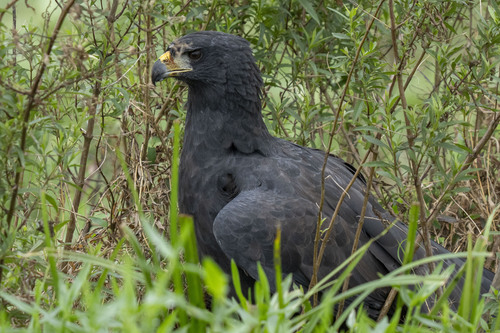 Great Black Hawk
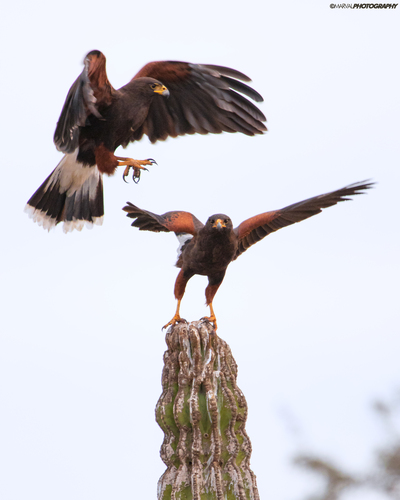 Harris's Hawk
In short
The most reliable field mark between Great Black Hawk and Harris's Hawk, especially for immature birds in flight, is the tail and wing pattern: Great Black Hawk juveniles show a tail with multiple dark and dusky bars, while juvenile Harris's Hawks have a paler tail band and a distinctive pale panel on the outer wing. Adults of both are mostly dark, but Great Black Hawk is larger, with broader wings and a short white tail with a broad black tip, while Harris's Hawk adults show chestnut shoulders and thighs and a white base and tip to the tail. Structure and size also help: Great Black Hawk is bulkier with broader wings and a heavier bill. Voice and habitat are less likely to help unless you are in the far north (where Great Black Hawk is a vagrant).
Identification tips
- Juvenile tail pattern: Great Black Hawk juveniles show a tail with multiple black and dusky bars; Harris's Hawk juveniles have a paler tail band and less extensive barring. Check the tail in flight or when perched.
- Juvenile underwing and body: Juvenile Harris's Hawk is much paler below, heavily streaked with buff or white, and shows a pale panel on the outer wing (whitish primaries except at tips). Great Black Hawk juveniles are darker, with buff underparts and dark spots, lacking the pale wing panel.
- Adult tail pattern: Great Black Hawk adults have a short tail that is white with a broad black tip (single broad white band). Harris's Hawk adults have a tail with both a white base and a white tip, separated by a broad dark band; the white is more extensive, especially in P. u. harrisi.
- Adult plumage: Great Black Hawk adults are almost entirely black with no chestnut tones. Harris's Hawk adults have rich chestnut on the shoulders and thighs, which is visible both perched and in flight.
- Size and structure: Great Black Hawk is larger, bulkier, and has broader wings and a heavier bill. Harris's Hawk is smaller and more slender, with proportionately longer tail and wings (especially in P. u. unicinctus).
- Leg and cere color: Both species have yellow legs and cere, so this is not a useful separator.
- Flight jizz: Great Black Hawk appears heavy and broad-winged in flight, with slow, deep wingbeats. Harris's Hawk is more agile and less massive, often seen gliding or soaring with wings held flat.
- Group behavior: Harris's Hawk is often seen in groups or pairs, sometimes with three birds at a nest. Great Black Hawk is solitary.
- Habitat: Harris's Hawk prefers open, arid, or semi-arid habitats with scattered trees or cacti. Great Black Hawk is a bird of humid forests and river edges; in the US, it is only a vagrant.
- Vocalization: If you hear a distinctive piping 'ooo-wheeeeee' call, it's Great Black Hawk. Harris's Hawk calls are not described here.
- Subspecies variation: If you see a Harris's Hawk with a patterned and lighter underwing (not solid dark), it may be P. u. unicinctus, but all Harris's Hawks have chestnut shoulders and thighs and a white base and tip to the tail.
- Plumage pitfalls: Immature Harris's Hawks can look very different from adults, being much paler below and with pale wing panels; do not confuse these with the darker, more uniformly marked Great Black Hawk juveniles.
- Geographic context: If you are outside the Neotropics and see a large, all-dark hawk, Harris's Hawk is far more likely unless you have a known vagrant Great Black Hawk.
- Perched view: Look for chestnut on the thighs and shoulders for Harris's Hawk; Great Black Hawk will lack any warm tones and appear all black with a white tail band.
- When in doubt: Focus on tail pattern and presence/absence of chestnut tones for adults, and on underwing and tail pattern for juveniles. These are the most reliable field marks in all conditions.
Size
Great Black Hawk is noticeably larger and heavier than Harris's Hawk. The Great Black Hawk measures 56–64 cm in length and weighs about 1.1 kg, making it bulkier and more imposing in flight or perched. Harris's Hawk is smaller, with an average adult mass of 843.7 g. In the field, Great Black Hawk will look broader-winged and more robust, while Harris's Hawk appears more medium-sized and less massive.
Plumage
- Juvenile/immature birds in flight:
- Great Black Hawk juveniles are dark brown above with spotting and streaks, buff underparts with dark spots, and a tail with several black and dusky bars. Their wings are broad and mostly dark, lacking obvious pale panels.
- Juvenile Harris's Hawks are much paler below, heavily streaked with white or buff, and in flight show buffy underwings with brown streaking. The primaries are whitish except at the tips, creating a pale panel on the outer wing, and the tail band is paler than in adults.
- Adults:
- Great Black Hawk adults are almost entirely black, with a short tail that is white with a broad black tip. The bill is black, and the legs and cere are yellow. No chestnut tones.
- Harris's Hawk adults are dark brown to blackish overall but have rich chestnut on the shoulders and thighs, and the tail has a white base and tip (the white bands are broader in the northern subspecies, P. u. harrisi). The underwing is completely dark in mature P. u. harrisi, but patterned and lighter in P. u. unicinctus. No all-black birds with a single white tail band.
Behaviour
Harris's Hawk is famous for cooperative hunting and often seen in small groups, sometimes with three birds at a nest. Great Black Hawk is typically solitary. Harris's Hawk may be seen perching together or hunting in tandem, while Great Black Hawk is usually alone and more secretive. Both perch conspicuously, but Harris's Hawk is more likely to be seen in open country or perched on cacti.
Habitat
Great Black Hawk is a species of humid forests, river edges, and wooded areas in the Neotropics, rarely wandering north (vagrant in the US). Harris's Hawk prefers open, arid habitats: scrub, savanna, and desert, often with scattered trees or cacti. If you are in dry, open country, Harris's Hawk is much more likely; Great Black Hawk is a rare vagrant in the US and never expected in desert or arid scrub.
Voice
Great Black Hawk has a distinctive piping call described as 'ooo-wheeeeee.' Harris's Hawk's calls are not described in the notes, so voice is only helpful if you hear the Great Black Hawk's unique call.