

Great Black-backed Gull vs Slaty-backed Gull
Larus marinus versus Larus schistisagus
Play a quiz with Great Black-backed Gull and Slaty-backed Gull
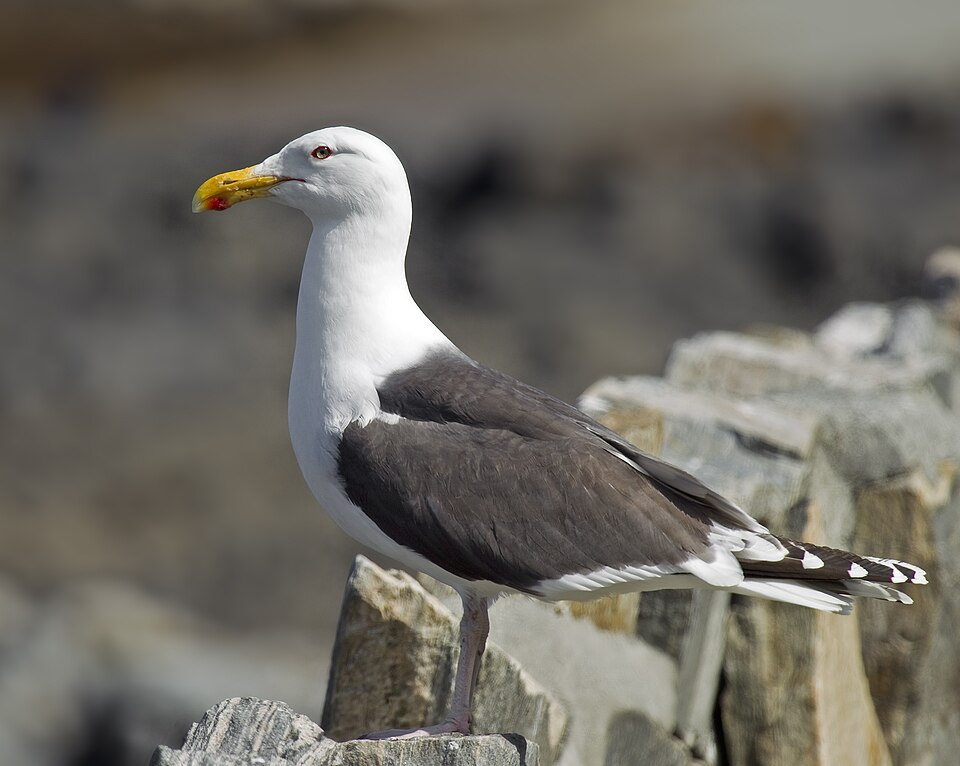 Great Black-backed Gull
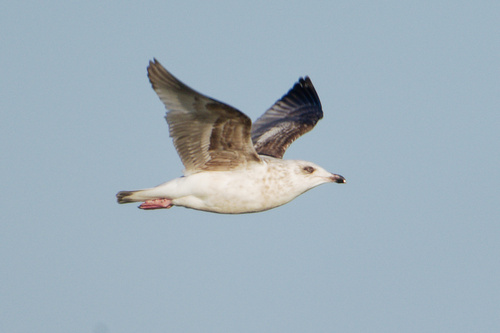 Slaty-backed Gull
In short
Juvenile and immature Great Black-backed Gulls (GBBG) show a bolder, more checkered upperwing and tail pattern than Slaty-backed Gulls (SBG), whose immatures are paler and more like Herring Gull. Adult GBBG is the only very large North Atlantic gull with jet-black upperwings and back, while adult SBG has a slightly paler, slaty-gray back and a diagnostic 'string of pearls' white pattern on the wing in flight. GBBG is bulkier and longer-legged, with a heavier bill and a deeper, more resonant voice. Both are large, white-headed gulls with pink legs, but careful attention to wing pattern, structure, and mantle shade will separate them in all plumages.
Identification tips
- Juvenile/immature upperwing and tail pattern: GBBG immatures have bold, checkered black-brown upperparts and a white tail with zigzag barring and a strong, broken black band—very distinctive in flight. SBG immatures are paler brown, less crisply marked, and closely resemble Herring Gull, lacking the bold checkering and tail pattern of GBBG. This is the most reliable mark for non-adults.
- Adult upperwing and back color: GBBG adults have jet-black upperwings and back, the darkest of any North Atlantic gull. SBG adults are slightly paler, with a slaty-gray mantle and back. In direct sunlight, GBBG will always look blacker.
- Adult wing pattern in flight: SBG adults show a broad white trailing edge to the wing and a 'string of pearls'—a row of white crescents along the mid-primaries, plus large white mirrors on the outer primaries (p9, p10). GBBG adults have less extensive white on the wing, lacking the string of pearls, and the trailing edge is not as broad or crisp.
- Leg color and structure: Both species have pink legs, but GBBG's legs are longer and more robust, while SBG's are shorter and give the bird a pot-bellied, squat appearance when perched.
- Bill structure: GBBG has a thicker, heavier, more powerful bill, often appearing massive even at a distance. SBG's bill is large but less imposing.
- Eye and orbital ring: SBG adults have yellow eyes with purple to deep pink orbital skin, which can be visible at close range. GBBG's eye color is not specifically diagnostic in the sources.
- Overall size and jizz: GBBG is the largest gull, always appearing bulkier, longer-legged, and more imposing than SBG. SBG is still large but more compact and pot-bellied.
- Behavior: GBBG is often dominant, aggressive, and predatory, sometimes seen hunting or pirating from other birds. SBG is not notably aggressive.
- Voice: A deep, booming, cow-like 'kaa-ga-ga' call points to GBBG; SBG's voice is not distinctive.
- Habitat and range: In the North Atlantic, a very large, black-backed gull is almost certainly GBBG. SBG is rare in this region and more expected in the northwest Pacific; always consider local abundance.
- Confusion with Herring Gull: SBG immatures are easily confused with Herring Gull, not GBBG, due to their paler, less patterned plumage. GBBG immatures are much darker and more contrasting.
- Seasonal changes: Both species take several years to reach adult plumage, but GBBG's transition is slower and remains darker longer. SBG immatures become paler more quickly.
- Perched vs. in flight: Many key marks (wing pattern, trailing edge, string of pearls) are most visible in flight. When perched, rely on mantle shade, leg length, and overall size.
- Pitfalls: Do not rely solely on size unless birds are side by side. Lighting can affect mantle shade; always look for the string of pearls (SBG) or jet-black upperwings (GBBG) in good light.
- Sex and age: No strong sexual dimorphism; all age comparisons above apply to both sexes.
Size
Great Black-backed Gull is the largest gull in the world, noticeably bulkier and heavier than Slaty-backed Gull. GBBG averages larger in length, wingspan, and mass (GBBG: up to 2 kg [wikipedia], SBG: 1.05–1.7 kg [wikipedia]). GBBG has a more robust, powerful build, longer legs, and a thicker, more imposing bill. SBG is still a very large gull but appears more compact, with a shorter tarsus and a pot-bellied look. In direct comparison, GBBG will always look the more massive and imposing bird.
Plumage
- Juvenile/First-year: GBBG juveniles are boldly checkered black-brown above, with a white tail base marked by zigzag bars and a strong, broken black band near the tip. Their wing coverts and flight feathers are dark, and the overall effect is high-contrast and striking. SBG immatures are paler brown, less crisply marked, and closely resemble Herring Gull immatures; their upperwing is less checkered and lacks the strong tail band and zigzag pattern of GBBG.
- Second/Third-year: GBBG immatures remain darker and more contrasting, with a dirtier, streakier look as they approach adulthood. SBG immatures continue to look paler and less patterned, with a more uniform brownish tone.
- Adult: GBBG adults have jet-black upperwings and back, with white head, underparts, and tail. SBG adults have a slightly paler, slaty-gray back and wings, with a broad white trailing edge to the wing and a distinctive 'string of pearls' (white crescents) along the mid-primaries in flight. SBG also shows large white mirrors on p9 and p10. Both have pink legs, but SBG's are shorter and the bird appears more pot-bellied.
Behaviour
GBBG is a highly aggressive, dominant gull, often behaving more like a raptor—actively hunting, pirating, and even killing other birds, including adult waterfowl and seabirds. It is often seen intimidating or displacing other gulls and seabirds. SBG is less aggressive and not known for the same predatory behavior; its feeding and interactions are more typical of large gulls. GBBG's dominance is often apparent at carcasses or among mixed gull flocks.
Habitat
GBBG breeds and winters along North Atlantic coasts and islands, favoring rocky shores, harbors, and urban waterfronts. SBG breeds in the northwestern Pacific (northeastern Palearctic) and is rare in the Atlantic; it is most often encountered as a vagrant in North America, especially on the Pacific coast, and is less likely in typical GBBG haunts. If seen together, context favors GBBG in the North Atlantic and SBG in the northwest Pacific, but vagrancy is possible.
Voice
GBBG has a deep, resonant, 'laughing' call (kaa-ga-ga), with the first note sometimes drawn out and almost cow-like—distinctly deeper than most gulls. SBG's voice is not described in detail in the sources, but it is not noted as particularly deep or diagnostic. If you hear a very deep, booming gull call, GBBG is more likely.
Great Black-backed Gull · Slaty-backed Gull · My Tricky Birds