

Great Barbet vs Ayeyarwady Bulbul
Psilopogon virens versus Pycnonotus blanfordi
Play a quiz with Great Barbet and Ayeyarwady Bulbul
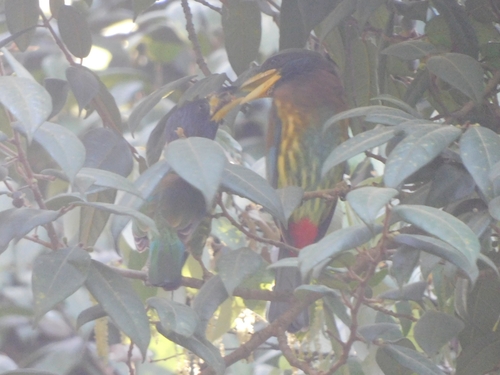 Great Barbet
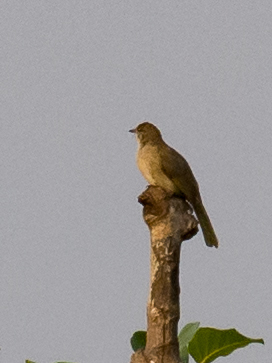 Ayeyarwady Bulbul
In short
The most reliable field mark to separate Great Barbet from Ayeyarwady Bulbul is sheer size and bulk: Great Barbet is a massive, heavy-billed bird, while Ayeyarwady Bulbul is much smaller and slimmer. Great Barbet shows a distinctive blue head and large yellow bill, with a green and brown-streaked body and a red vent, whereas Ayeyarwady Bulbul lacks these bold colors. In flight or perched, the barbet's size, thick bill, and colorful plumage are unmistakable compared to the much plainer, smaller bulbul. Habitat can also help: Great Barbet is found in high-altitude forests, while Ayeyarwady Bulbul is restricted to lowland forests in Myanmar.
Identification tips
- Size is the quickest check: Great Barbet is nearly ten times heavier than Ayeyarwady Bulbul. If the bird looks large and chunky, it's almost certainly the barbet.
- Bill structure: Great Barbet has a massive, thick, and long yellow bill, easily seen even at a distance. Ayeyarwady Bulbul's bill is slim and short, typical of insectivorous or frugivorous songbirds.
- Head color: The barbet's blue head is unique and diagnostic. No bulbul in the region shows blue on the head.
- Body coloration: Look for the barbet's green upperparts, brown and green-streaked underparts, and red vent. The bulbul is much plainer, lacking any blue, green, or red.
- Perched posture: Great Barbet sits upright and appears heavy, often high in the canopy. Bulbuls perch more horizontally and appear much lighter.
- Flight jizz: The barbet's flight is slow and direct, matching its bulk. Bulbuls are quicker and more erratic in flight.
- Habitat context: Great Barbet is found in high-altitude forests, especially in the Himalayas and Southeast Asia. Ayeyarwady Bulbul is only in lowland forests of Myanmar. Altitude and range can rule out one or the other.
- Vocalizations: A loud, deep, repetitive call points to Great Barbet. Bulbul calls are softer and less resonant.
- Group size: Barbets are usually solitary or in pairs; bulbuls often form small groups.
- Seasonal confusion: Both species are resident, so season is not a strong separator, but nesting barbet pairs may be more vocal in spring and summer.
- Sex and age: No strong sexual dimorphism or age-specific field marks are described for either species, so all ages and sexes of Great Barbet remain much larger and more colorful than any Ayeyarwady Bulbul.
- Pitfalls: In poor light, the barbet's colors may look dull, but the size and bill remain obvious. Bulbuls never show a blue head or red vent.
- Feeding behavior: Barbets often feed on large fruits and may be seen hammering at branches; bulbuls pick smaller fruits or insects more delicately.
- Nest site: If you see a bird entering a tree hole, it's likely a barbet; bulbuls nest in open cups.
- Overlap: There is little to no range overlap; if you are outside Myanmar lowlands, Ayeyarwady Bulbul is very unlikely.
Size
Great Barbet is dramatically larger than Ayeyarwady Bulbul. The barbet reaches 32–35 cm in length and weighs 192–295 g, making it the largest Asian barbet [wikipedia]. In contrast, Ayeyarwady Bulbul weighs only about 33 g [wikidata] and is a typical medium-sized bulbul. This size difference is obvious both in the hand and in the field, especially when seen side by side or compared to familiar species. The barbet's bill is also much thicker and longer, contributing to its robust appearance.
Plumage
No age-specific wing or flight pattern marks are described for either species, so focus is on adult plumage. Great Barbet is strikingly colorful: adults have a blue head, large yellow bill, green upperparts, brown and green-streaked underparts, and a red vent. This combination of blue, green, and red is unique in the region. Ayeyarwady Bulbul, by contrast, is much more subdued, lacking any blue, green, or red in its plumage. The bulbul's colors are not detailed in the sources, but as a typical Pycnonotus bulbul, it is expected to be mostly brownish or olive above, with paler underparts and no strong head or vent coloration. The barbet's bold patterning is visible both perched and in flight, while the bulbul remains plain throughout the year.
Behaviour
Great Barbet is often seen perched high in the canopy or flying between large trees, moving deliberately and often calling loudly. Its heavy build and large bill give it a slow, purposeful jizz. Ayeyarwady Bulbul, like other bulbuls, is more active and agile, flitting through foliage and often seen in pairs or small groups. The bulbul's lighter build and more erratic movements contrast with the barbet's bulkier, slower behavior.
Habitat
Great Barbet inhabits forests up to 3,000 m in the Himalayas and Southeast Asia, favoring higher elevations and mature woodland [wikipedia]. Ayeyarwady Bulbul is endemic to Myanmar and restricted to subtropical or tropical moist lowland forests [wikipedia]. Thus, location and altitude are strong clues: seeing a large, colorful barbet in montane forest points to Great Barbet, while a small, plain bulbul in lowland Myanmar forest is likely Ayeyarwady Bulbul.
Voice
Great Barbet has a very loud, far-carrying territorial call described as 'kay-oh,' a harsh alarm 'keeab,' and a repetitive 'piou-piou-piou-piou' [wikipedia]. These calls are deep and resonant, matching the bird's large size. No vocal details are given for Ayeyarwady Bulbul, but bulbuls typically have softer, more melodious or chattering calls, never as loud or resonant as the barbet's. If you hear a deep, booming call, suspect Great Barbet.