
Goldcrest vs Eurasian Nuthatch
Regulus regulus versus Sitta europaea
Play a quiz with Goldcrest and Eurasian Nuthatch
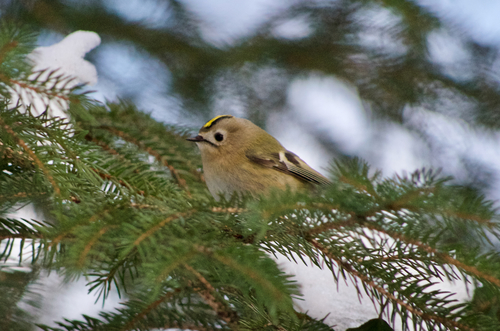 Goldcrest
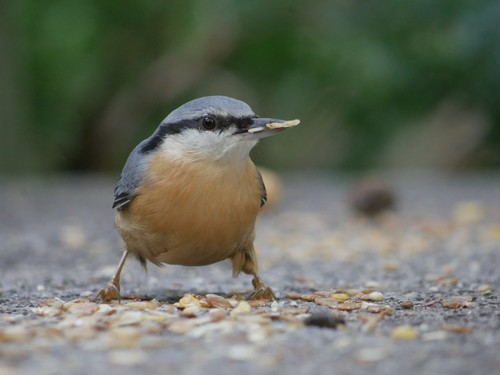 Eurasian Nuthatch
In short
The most reliable field mark to separate Goldcrest from Eurasian Nuthatch is the Goldcrest’s tiny size and plain, round-faced appearance with a bright yellow (or orange-yellow in males) crown stripe, compared to the Nuthatch’s much larger, chunky build, long pointed bill, and bold black eyestripe. Goldcrests are restless, olive-green birds with two white wingbars and no strong face pattern, while Eurasian Nuthatches are blue-grey above, white below with orange flanks, and always show a strong black eyestripe through the eye. Juvenile Goldcrests lack the colored crown but still have a plain face, whereas even young Nuthatches show the eyestripe. In flight or perched, the Nuthatch’s short tail and pointed head contrast with the Goldcrest’s rounder, more delicate jizz. If you see a tiny, plain-faced sprite in conifers, it’s a Goldcrest; a larger, blue-grey bird creeping headfirst down a trunk is a Nuthatch.
Identification tips
- Size is the fastest check: Goldcrest is tiny and delicate; Eurasian Nuthatch is much larger and chunky. If you see a bird that looks smaller than a wren, it’s not a Nuthatch.
- Face pattern: Goldcrest always has a plain face with no eyestripe, just a bright crown stripe (yellow or orange-yellow). Eurasian Nuthatch always has a strong black eyestripe through the eye, contrasting with white cheeks and throat. This is true for all ages and sexes.
- Crown color: Adult male Goldcrests have a yellow crown with an orange center; females have all-yellow crowns. Juveniles lack the colored crown but still have a plain face. Nuthatch never shows a colored crown stripe.
- Wingbars: Goldcrest has two neat white wingbars on olive wings; Nuthatch lacks distinct wingbars, with blue-grey upperparts instead.
- Bill shape: Goldcrest’s bill is tiny, thin, and black; Nuthatch’s is long, strong, and pointed, suited for probing bark.
- Tail shape and length: Goldcrest has a short, rounded tail; Nuthatch’s tail is also short but appears squarer and is not used for support on trees.
- Underparts: Goldcrest is buff-white below, sometimes with a slight olive wash. Nuthatch is white to buff below with rich orange flanks and a clear color contrast between throat/cheeks and flanks.
- Upperparts: Goldcrest is olive-green above; Nuthatch is blue-grey above.
- Behavior: Goldcrests are restless, often hovering and flitting at branch tips, especially in conifers. Nuthatches move with deliberate hops, often headfirst down trunks, and rarely hover.
- Flight style: Goldcrest’s flight is fluttery, with frequent hovering; Nuthatch’s is fast, direct, with wings closed between beats and a pointed head.
- Habitat preference: Goldcrests favor dense conifers and higher canopy; Nuthatches prefer mature deciduous trees and are often seen on trunks and large branches.
- Vocalizations: Goldcrest’s song is high and thin, often overlooked; Nuthatch is loud and vocal, with repeated 'dwip' calls.
- Juvenile confusion: Even juvenile Nuthatches show a black eyestripe and blue-grey upperparts, while juvenile Goldcrests are plain-faced and olive, lacking the colored crown.
- Mixed flocks: Goldcrests often join mixed flocks of tits and other small birds; Nuthatches are more solitary or in pairs.
- Perching posture: Goldcrests perch upright, often among foliage; Nuthatches are often seen clinging to bark, sometimes upside down or headfirst down a trunk.
Size
Goldcrest is by far the smallest European bird, weighing only 4.5–7.0 g and measuring 8.5–9.5 cm in length. In contrast, Eurasian Nuthatch is much larger and heavier, at 14 cm long and about 23 g in mass. The Nuthatch’s wingspan (22.5–27 cm) is nearly double that of the Goldcrest (13.5–15.5 cm). In the field, this size difference is immediately obvious when both species are seen near each other or compared to familiar surroundings.
Plumage
- Juvenile/first-winter: Juvenile Goldcrests lack the colored crown but are otherwise similar to adults, with duller olive upperparts, two white wingbars, and a plain face. Juvenile Nuthatches resemble adult females, with a duller blue-grey back, paler underparts, and always a black eyestripe. No age of Nuthatch is plain-faced like Goldcrest.
- Adults: Adult Goldcrests show a yellow crown stripe (orange-centered in males, yellow in females), bordered by black, and a plain olive face. Two white wingbars are always present. Eurasian Nuthatch adults have blue-grey upperparts, a bold black eyestripe, white throat and cheeks, and orange flanks. Their underparts are white to buff, depending on subspecies and sex. The Nuthatch’s bill is long and strong, while Goldcrest’s is tiny and fine.
- In flight: Goldcrest’s flight is whirring and fluttery, with frequent hovering; Nuthatch’s flight is fast, direct, with wings closed between beats and a pointed head profile. No distinctive upperwing pattern in either species is described for field separation beyond the Goldcrest’s white wingbars.
Behaviour
Goldcrests are extremely active, constantly flitting, hovering, and creeping through foliage, often high in conifers. They rarely pause for long and may hang upside down or hover at branch tips. Eurasian Nuthatches move with short, deliberate hops along trunks and branches, often headfirst down tree bark, and do not use their tails for support. Nuthatches are less restless than Goldcrests and are usually seen singly or in pairs, often at lower levels on trees. Goldcrests are much more likely to be seen in mixed flocks or high in the canopy.
Habitat
Goldcrests are most often found in coniferous or mixed woodland, especially spruce or fir, but can also occur in gardens with suitable trees. Eurasian Nuthatches are found in a wide range of woodlands, especially mature deciduous forests, parks, and large gardens with old trees. While both can occur in overlapping habitats, Goldcrests favor dense conifers and higher canopy, whereas Nuthatches prefer broad-leaved trees and are more often seen on trunks and large branches.
Voice
Goldcrest’s song is a series of high, thin notes, higher-pitched than most other small birds, but not particularly loud. Eurasian Nuthatch is much more vocal, with a repeated, loud 'dwip' call and various whistles and trills. In the field, the Nuthatch’s calls are far more likely to draw attention than the Goldcrest’s subtle song.