

Glossy Ibis vs Northern Bald Ibis
Plegadis falcinellus versus Geronticus eremita
Play a quiz with Glossy Ibis and Northern Bald Ibis
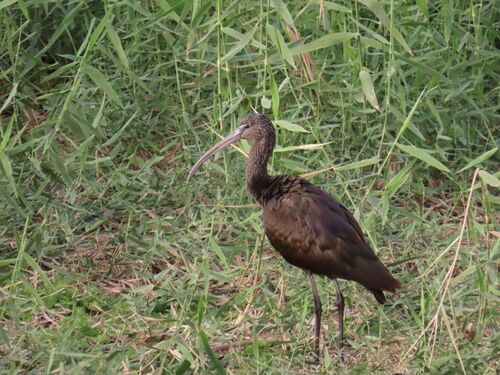 Glossy Ibis
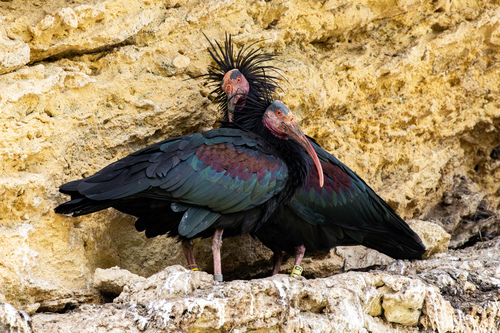 Northern Bald Ibis
In short
The most reliable field mark to separate Glossy Ibis from Northern Bald Ibis is the presence of an unfeathered, dull red face and head on the Northern Bald Ibis, versus the fully feathered dark face of the Glossy Ibis. In flight, Northern Bald Ibis shows a bulkier, stockier profile with less rounded wings, a shorter neck, and legs that do not project beyond the tail, while Glossy Ibis appears more slender with longer neck and legs that extend past the tail. Juvenile Glossy Ibis lacks the bald red face entirely, while young Northern Bald Ibis has a dark, feathered head but still shows a heavier structure. Plumage iridescence is present in both, but the Glossy Ibis is more chestnut in breeding season, whereas Northern Bald Ibis is more uniformly blackish with a bronze-green and violet sheen. Habitat and behavior also differ: Glossy Ibis is a wader of marshes and wetlands, while Northern Bald Ibis prefers dry, rocky, or open grassland areas and rarely wades.
Identification tips
- Bald red face and head (Northern Bald Ibis): The only species in this pair with a completely unfeathered, dull red face and head as an adult. Glossy Ibis always has a feathered face, even in juveniles and non-breeding adults.
- Bill color and shape: Both have long, decurved bills, but Northern Bald Ibis's bill is red (adults) and more robust, while Glossy Ibis's bill is brownish and more slender.
- Neck and leg projection in flight: Glossy Ibis flies with neck and legs fully outstretched, and the feet project well beyond the tail. Northern Bald Ibis has a shorter neck in flight and its feet do not project beyond the tail, giving a more compact look.
- Wing shape in flight: Northern Bald Ibis has less rounded wings and a stockier, more powerful flight style. Glossy Ibis appears more slender and graceful with longer, narrower wings.
- Plumage iridescence: Both species show iridescence, but Glossy Ibis is reddish-brown with green/bronze/purple sheen, especially in breeding season. Northern Bald Ibis is more uniformly black with bronze-green and violet gloss, lacking the chestnut tones.
- Juvenile confusion: Juvenile Glossy Ibis is dull brown with fine white streaks on the head/neck and always feathered-faced. Juvenile Northern Bald Ibis has a dark feathered head, pale bill, and grey legs, but is bulkier and darker overall. As it matures, the head becomes bald and red.
- Hind-neck ruff: Northern Bald Ibis adults have a wispy ruff on the hind neck, absent in Glossy Ibis.
- Leg color: Northern Bald Ibis has red legs (adults), while Glossy Ibis has red-brown legs.
- Habitat: Glossy Ibis is almost always in or near wetlands, marshes, or shallow water. Northern Bald Ibis is found in dry, rocky, or open grassland habitats, rarely in water.
- Behavior: Glossy Ibis wades and forages in shallow water, often in flocks. Northern Bald Ibis forages on dry ground, rarely wading.
- Perched posture: Northern Bald Ibis appears bulkier and more upright when perched, with a prominent bald head. Glossy Ibis is slimmer and more hunched.
- Size: Northern Bald Ibis is much larger and heavier; use this only with direct comparison or experience.
- Facial pattern: Glossy Ibis may show a narrow white facial band in breeding adults, but it is subtle and never as striking as the bald red face of Northern Bald Ibis.
- Vocalization: Not reliably diagnostic in the field, but Northern Bald Ibis may be heard giving guttural calls at colonies.
- Seasonal context: If seen in a wetland with other waders, Glossy Ibis is much more likely. If in a dry, rocky, or open area, especially near cliffs, Northern Bald Ibis is favored.
Size
Northern Bald Ibis is significantly larger and heavier than Glossy Ibis. Northern Bald Ibis measures 70–80 cm in length with a wingspan of 125–135 cm and weighs 1.0–1.3 kg, making it a robust, stocky bird. Glossy Ibis is mid-sized at 48–66 cm in length, wingspan 80–105 cm, and average mass of 633 g. In the field, Northern Bald Ibis will look bulkier and more imposing, while Glossy Ibis is noticeably slimmer and more graceful.
Plumage
- Juveniles and immatures: Juvenile Glossy Ibis is duller brown with fine white streaking on the head and neck, and always has a feathered face. Juvenile Northern Bald Ibis has a dark, feathered head (not yet bald), pale bill, and light grey legs, but is still bulkier and darker overall. As they mature, Northern Bald Ibis gradually loses head feathers and develops the characteristic red, bald face.
- Adults: Glossy Ibis in breeding plumage is reddish-brown with strong metallic green, bronze, or purple iridescence on the wings, and a subtle white facial border. Non-breeding adults and immatures are duller but retain the feathered face. Northern Bald Ibis adults are glossy black with bronze-green and violet sheen, a wispy hind-neck ruff, and a fully unfeathered, dull red face and head. The bill and legs are red in adults. The overall impression is much darker and less chestnut than Glossy Ibis.
Behaviour
Glossy Ibis is a classic wader, feeding in shallow water, often in flocks, and roosting communally in trees, sometimes far from feeding sites. They often fly in graceful V formations with necks outstretched. Northern Bald Ibis is non-wading, foraging in dry, open habitats for insects and small animals, and breeds colonially on cliffs or rocky ledges. In flight, Northern Bald Ibis is powerful but less graceful, with shallow, flexible wingbeats and a shorter neck projection. Their feet do not extend past the tail in flight, unlike Glossy Ibis.
Habitat
Glossy Ibis is found in freshwater or brackish wetlands, marshes, floodplains, and wet meadows, rarely venturing into dry or rocky areas. It strongly prefers areas with standing water and emergent vegetation. Northern Bald Ibis, in contrast, inhabits open grasslands, rocky mountains, and semi-deserts, often near running water but not in wetlands. It is rarely seen wading and is more likely to be found on dry ground or cliff ledges.
Voice
Northern Bald Ibis is mostly silent except at breeding colonies, where it gives guttural 'hrump' and high, hoarse 'hyoh' calls. Glossy Ibis is generally quiet, and no distinctive vocalization is noted for field separation between these two species.