

Glaucous Gull vs Slaty-backed Gull
Larus hyperboreus versus Larus schistisagus
Play a quiz with Glaucous Gull and Slaty-backed Gull
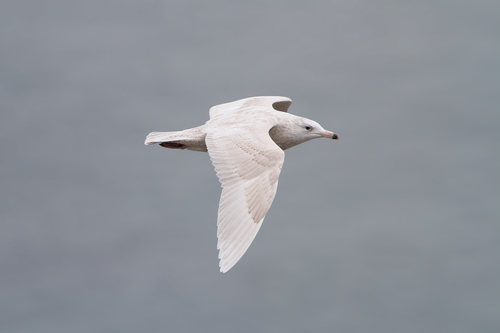 Glaucous Gull
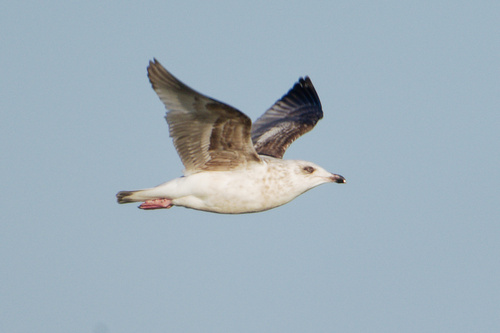 Slaty-backed Gull
In short
The most reliable field mark between Glaucous Gull and Slaty-backed Gull is the wing pattern: Glaucous Gull of all ages shows completely pale wingtips with no black, while adult Slaty-backed Gull has dark slaty-gray upperwings with blackish primaries and distinctive white 'string of pearls' spots along the trailing edge. Juvenile Glaucous Gulls are very pale overall, whereas immature Slaty-backed Gulls are brownish and more patterned. Glaucous is also bulkier and longer-winged, with a thicker bill. In flight or at rest, focus first on the absence (Glaucous) or presence (Slaty-backed) of dark in the wingtips and the overall paleness or darkness of the bird.
Identification tips
- Check the wingtips in all ages: Glaucous Gull never shows black in the wingtips or tail—adults and immatures are always pale. Slaty-backed Gull adults have blackish wingtips with large white spots ('mirrors') and a broad white trailing edge; immatures show dark primaries.
- Juvenile/immature overall color: Juvenile Glaucous Gulls are very pale grayish or creamy, often standing out in flocks of darker immature gulls. Immature Slaty-backed Gulls are brownish and patterned, not pale.
- Adult upperparts: Adult Glaucous Gulls are pale gray above, while Slaty-backed Gulls have a distinctly darker, slaty-gray back and wings.
- 'String of pearls' effect: Only Slaty-backed Gull adults show the 'string of pearls'—a series of white spots along the trailing edge of the wing, especially visible in flight.
- Bill structure: Glaucous Gull has a noticeably thicker, heavier bill than Slaty-backed Gull. Both have yellow bills with a red spot as adults, but Glaucous' bill is more robust.
- Legs: Both species have pink legs, but Slaty-backed's are shorter and the bird appears more pot-bellied.
- Size and bulk: Glaucous Gull is generally larger and bulkier, sometimes even heavier than Great Black-backed Gull, while Slaty-backed is large but not as massive.
- Head and eye: Slaty-backed Gull has yellow eyes with purple to deep pink orbital skin; Glaucous Gull's eye color is less distinctive in the notes.
- Juvenile bill color: Juvenile Glaucous has a pink bill with a black tip; Slaty-backed's immature bill is less distinctly described, but not noted as pink-based.
- Flight impression: In flight, Glaucous Gull looks pale and ghostly, with no black on the wings; Slaty-backed shows strong contrast between dark upperwings and white trailing edge.
- Tail: Both adults have white tails, but only Glaucous has no black anywhere in the tail or wings.
- Habitat context: Glaucous is more likely in high Arctic or subarctic settings, but both can occur together in winter coastal flocks.
- Vocalization: If heard, Glaucous Gull's call is a deep, laughing cry; Slaty-backed's voice is not distinctive in the notes.
- Comparison with other gulls: If you see a bird as large as Great Black-backed Gull but with pale wings and no black, it's likely Glaucous; if the upperparts are slaty and the wingtips are blackish with white spots, it's Slaty-backed.
- Beware of confusion: Immature Slaty-backed can look like immature Herring or Great Black-backed Gulls, but never as pale as Glaucous.
Size
Glaucous Gull is generally larger and heavier than Slaty-backed Gull, with a typical body mass around 1412.5g (and sometimes much heavier), and a length range of 55–77 cm versus Slaty-backed's 55–68.5 cm. Both have similar wingspans (Glaucous: 132–170 cm, Slaty-backed: 132–160 cm), but Glaucous tends to appear bulkier and more massive, especially in direct comparison. Bill and tarsus lengths overlap but Glaucous often shows a thicker, more powerful bill.
Plumage
- Juvenile/immature birds: Glaucous Gull immatures are very pale grayish overall, with pale upperwings and no black anywhere on the wings or tail. Their bill is pink with a black tip. In contrast, Slaty-backed Gull immatures are brownish and patterned, closely resembling immature Herring or Great Black-backed Gulls, and show dark in the primaries and more contrast in the upperwing.
- Adults: Adult Glaucous Gulls are pale gray above with white wingtips and tail, and a thick yellow bill. Slaty-backed adults have a dark slaty-gray mantle and upperwings, blackish wingtips with large white 'mirrors' (spots) on the outer primaries, and a broad white trailing edge to the wing ('string of pearls' effect). The bill is yellow with a red spot, and the legs are pink but shorter and the body more pot-bellied than Glaucous.
Behaviour
Both species are large, powerful gulls that can appear dominant in mixed flocks. Glaucous Gull often appears more massive and slow-moving, with a heavier, bulkier build and a thicker bill. Slaty-backed Gull is described as more stout and pot-bellied, with relatively short legs. In flight, Glaucous Gull's pale wings stand out, while Slaty-backed shows a striking contrast between its dark upperwings and white trailing edge.
Habitat
Both species are coastal gulls, but Glaucous Gull is more strongly associated with high Arctic and subarctic coasts and is often found in colder, more northerly environments. Slaty-backed Gull breeds in the northeastern Palearctic and wanders widely in winter, sometimes reaching coastal areas far from its breeding range. Both may be seen in mixed gull flocks, especially in winter.
Voice
Glaucous Gull gives a deep, 'laughing' call similar to Herring Gull but lower-pitched. No distinctive vocalization is noted for Slaty-backed Gull in the provided sources.