

Fulvous Whistling-Duck vs Yellow-legged Gull
Dendrocygna bicolor versus Larus michahellis
Play a quiz with Fulvous Whistling-Duck and Yellow-legged Gull
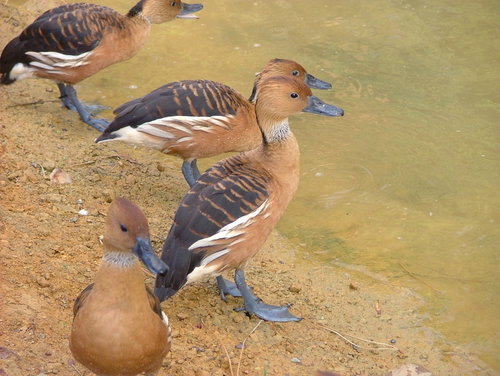 Fulvous Whistling-Duck
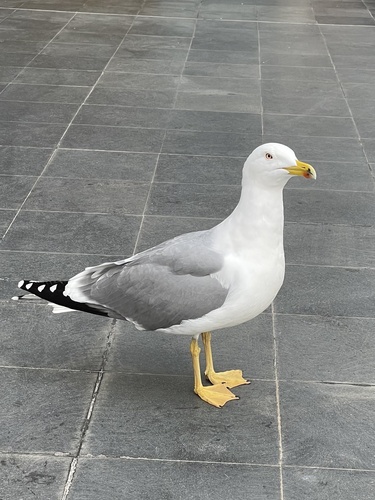 Yellow-legged Gull
In short
The most reliable separation in the field is overall structure and flight pattern: Fulvous Whistling-Duck is a long-legged, long-necked, reddish-brown duck with a white rump crescent and black tail in flight, while Yellow-legged Gull is a large, broad-winged gull with yellow legs, grey upperparts, and black-and-white wing tips. Juvenile and immature plumages are very different: young Fulvous Whistling-Ducks are duller brown with pale underparts, while first-year Yellow-legged Gulls are heavily patterned brownish-grey with a dark tail band and dark flight feathers. Bill shape and leg color are also key: the duck has a long, grey, flat bill and grey legs; the gull has a thick, hooked bill and yellow (adult) or pinkish (immature) legs. Habitat and behavior further separate them: Fulvous Whistling-Duck is a wetland specialist, often seen in dense vegetation or flying in loose flocks, while Yellow-legged Gull is a coastal and urban generalist, often soaring or loafing in open areas.
Identification tips
- Juvenile/immature wing and tail pattern: First-year Yellow-legged Gull shows a dark tail band, dark flight feathers, and mottled brown upperwings; Fulvous Whistling-Duck juveniles are much plainer, with uniform brown wings and a white rump crescent in flight. This is the most reliable mark for immatures.
- White rump crescent (all ages, duck): In flight, Fulvous Whistling-Duck always shows a white crescent across the rump and a black tail, never matched by the gull.
- Wing pattern (adult): Adult Yellow-legged Gull has black wingtips with small white spots and grey upperwings; Fulvous Whistling-Duck has brown upperwings with no white in the wing.
- Leg color: Adult Yellow-legged Gull has yellow legs (immatures pinkish-grey); Fulvous Whistling-Duck has grey legs at all ages.
- Bill shape and color: The duck has a long, flat, grey bill; the gull has a thick, hooked bill (yellow with red spot in adult, dark in immatures).
- Head and neck: Fulvous Whistling-Duck has a rich buffy head and neck with a dark stripe down the back of the neck; Yellow-legged Gull has a white or pale head (adult) or mottled brown (immature), never with a neck stripe.
- Crown color (juvenile): Juvenile Fulvous Whistling-Duck never has a blackish crown; Yellow-legged Gull immatures may appear darker-capped but are always much more patterned overall.
- Body shape and posture: The duck is long-necked, long-legged, and often stands upright; the gull is bulkier, shorter-necked, and stands more horizontally.
- Flight style: Fulvous Whistling-Duck flies with steady, shallow wingbeats and long legs trailing; Yellow-legged Gull soars and glides frequently, with broader wings and shorter legs.
- Habitat: Duck is almost always in or near dense wetland vegetation; gull is found in open areas, coasts, cities, and even inland rubbish tips.
- Voice: Duck gives a clear, whistling call; gull gives loud, harsh cries.
- Plumage color: Duck is overall reddish-brown with buffy tones; gull is grey and white as adult, brown and white as immature.
- Sex and age differences: Female Fulvous Whistling-Duck is slightly smaller and duller than male, but this is subtle; gulls show more obvious age-related plumage changes.
- Context: If seen in a flock of dabbling ducks, it's likely the duck; if among other gulls or scavenging, it's the gull.
- Pitfalls: Distant or backlit views can make the duck appear darker, but the white rump crescent and long neck/legs are still good clues. Immature gulls can be confused with other large gulls, but never show the duck's structure or flight style.
Size
Fulvous Whistling-Duck is a medium-sized duck, with an average body mass of about 682 g [wikidata]. Yellow-legged Gull is generally larger and heavier, with adults ranging from 550 to 1,600 g [wikipedia], and noticeably longer in total length (52–68 cm vs. 45–53 cm for the duck). In the field, the gull appears bulkier, with a longer wingspan (120–155 cm vs. 85–93 cm for the duck), broader wings, and a more robust build. However, some female gulls can approach the duck's size, so structure and proportions are more reliable than size alone.
Plumage
Juvenile and immature plumages are the most diagnostic:
-
Juvenile Fulvous Whistling-Duck is a duller, paler version of the adult, with buffy underparts and a generally uniform brown appearance. In flight, all ages show a distinctive white crescent across the rump contrasting with a black tail, and brown upperwings with no white in the wing. The crown is never blackish, and the neck has a dark stripe down the back [wikipedia].
-
First-year Yellow-legged Gull is much more patterned: brownish-grey overall with a paler head and underparts, dark flight feathers, and a well-defined black tail band. The upperwings are mottled, and the rump is pale. By second winter, the gull becomes paler below, but still shows patterned wing coverts and a black bill tip. Adults are grey above, white below, with black wingtips and yellow legs, and a red spot on the bill. In flight, adults show black primaries with small white spots, grey upperwings, and a white tail.
-
Adult Fulvous Whistling-Duck is rich reddish-brown with a buffy head and neck, dark brown flight feathers, and a white rump crescent. The bill and legs are grey. There is no black-and-white wingtip pattern as in the gull.
Behaviour
Fulvous Whistling-Duck is typically seen in or near dense wetland vegetation, often in pairs or loose flocks, and feeds by dabbling or grazing on plant material. In flight, it shows a straight-necked, long-legged silhouette, often with slow, shallow wingbeats. Yellow-legged Gull is much more versatile: it is often seen soaring, gliding, or loafing in open areas, including coasts, harbors, cities, and rubbish tips. Gulls are opportunistic, often scavenging or predating, and may be seen in large, noisy groups. The duck rarely ventures far from water or dense cover, while the gull is comfortable in a wide range of open habitats.
Habitat
Fulvous Whistling-Duck is a wetland specialist, found in tropical and subtropical regions, favoring shallow lakes, marshes, rice fields, and areas with dense aquatic vegetation [wikipedia]. It is rarely found away from water or in urban areas. Yellow-legged Gull, by contrast, is a generalist of Europe, the Middle East, and North Africa, found along coasts, inland lakes, rivers, cities, and even nesting on buildings or trees. If you see a bird in a city, on a rubbish tip, or soaring over open land, it is almost certainly the gull; a bird deep in a marsh or rice paddy is likely the duck.
Voice
Fulvous Whistling-Duck gives a clear, whistling 'kee-wee-ooo' call, heard both in flight and on the ground, and is generally noisy, especially at night. Quarrelling birds give a harsh, repeated 'kee.' The calls are distinctive and quite unlike any gull. Yellow-legged Gull gives typical loud, harsh gull cries and yelps, not whistling. If you hear a clear, musical whistle, it is the duck; if you hear raucous, laughing or screaming calls, it is the gull.
Fulvous Whistling-Duck · Yellow-legged Gull · My Tricky Birds