

Fairy Prion vs Fluttering Shearwater
Pachyptila turtur versus Puffinus gavia
Play a quiz with Fairy Prion and Fluttering Shearwater
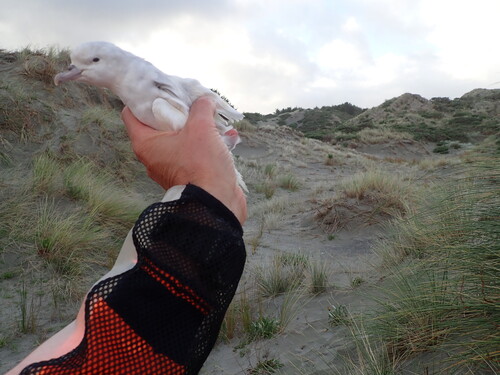 Fairy Prion
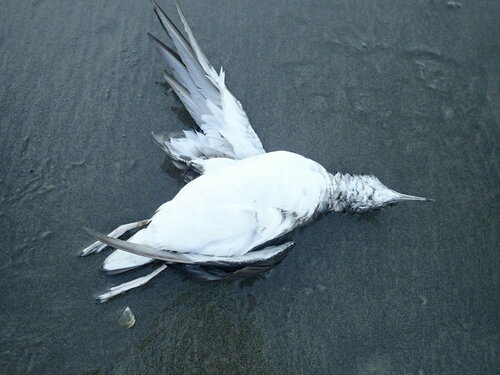 Fluttering Shearwater
In short
The most reliable field mark to separate Fairy Prion from Fluttering Shearwater is the upperwing pattern: Fairy Prion shows a blue-grey back with a bold dark 'M' marking extending across the wings to the wingtips, while Fluttering Shearwater has uniformly dark brown upperparts without any 'M' pattern. In flight, Fairy Prion appears paler and more silvery above, whereas Fluttering Shearwater is consistently dark above and white below, with a distinctive dark thigh patch visible on the underparts. Structure also helps: Fairy Prion is smaller, with a wedge-shaped tail and a short, pale blue bill, while Fluttering Shearwater is larger, with a fan-shaped tail, long dark bill, and pinkish-brown legs that often project beyond the tail. Both can be seen in similar oceanic habitats, but their flight style and wing pattern are the quickest ways to tell them apart.
Identification tips
- Upperwing pattern (all ages): Fairy Prion shows a blue-grey back with a bold dark 'M' marking across the upperwings to the wingtips; Fluttering Shearwater is uniformly dark brown above with no 'M' pattern. This is the single most reliable mark in flight.
- Tail shape: Fairy Prion has a wedge-shaped tail with a dark tip, while Fluttering Shearwater has a short, fan-shaped tail with mixed dark and white coloration.
- Bill color and shape: Fairy Prion has a short, pale blue bill; Fluttering Shearwater's bill is longer, thinner, and dark-colored.
- Legs and feet: Fairy Prion has blue legs and feet, which are rarely visible in the field. Fluttering Shearwater has pinkish-brown legs and feet with dark webs, and the feet often project beyond the tail in flight—a useful mark if seen.
- Underparts: Both are white below, but Fluttering Shearwater shows a dark thigh patch on the white underparts, visible in flight; Fairy Prion's underparts are clean white.
- Underwing: Fluttering Shearwater's underwing is mostly white with grey-brown axillaries; Fairy Prion's underwing is plain white, matching the body.
- Face pattern: Fairy Prion's face is pale with a blue-grey crown; Fluttering Shearwater's face and neck are grey-brown, fading to white below the eye, but this is subtle at sea.
- Flight style: Fairy Prion is more buoyant and glides more; Fluttering Shearwater flies low and fast with rapid wingbeats and short glides.
- Size and bulk: Fairy Prion is much smaller and lighter (139 g) than Fluttering Shearwater (243–302 g), which appears bulkier and longer-winged.
- Moult effects: Fluttering Shearwater in late summer to autumn may look paler and ragged above, but still lacks the 'M' pattern of Fairy Prion.
- Juvenile confusion: Juvenile Fluttering Shearwater looks like the adult but with paler wing covert edges; no age of Fluttering Shearwater shows an 'M' pattern.
- Feet projection: In flight, look for feet extending past the tail (Fluttering Shearwater only).
- Tail tip: Fairy Prion's tail is wedge-shaped with a dark tip; Fluttering Shearwater's is fan-shaped and mixed in color.
- Vocalizations: Only Fluttering Shearwater is likely to call at sea; if you hear the 'ka-hek-ka-hek' call, it's not a Fairy Prion.
- Habitat overlap: Both can be seen together at sea, so do not rely on location alone for identification.
Size
Fairy Prion is much smaller and lighter, with a body mass of about 139 g [wikidata], compared to the Fluttering Shearwater, which is significantly heavier (adult females average 302 g, males 243 g [wikipedia]). Fairy Prion is about 25 cm in length with a 56 cm wingspan, while Fluttering Shearwater is described as medium to small for a shearwater but is still notably bulkier and longer-winged than Fairy Prion. This size difference is often apparent when both species are seen together or with other seabirds for scale.
Plumage
Juvenile and adult Fairy Prion of all ages show blue-grey upperparts with a strong dark 'M' marking that extends from the back across the upperwings to the wingtips, and a wedge-shaped tail with a dark tip. The underparts are clean white. The bill is pale blue, and the legs and feet are blue. Fluttering Shearwater, by contrast, has uniformly dark brown upperparts, including the neck, wings, and tail, lacking any 'M' pattern. The face and neck are grey-brown, fading to white below the eye, and the underparts are white except for a conspicuous dark thigh patch visible in flight. The underwing is mostly white, but the axillaries (armpit area) are grey-brown. The tail is fan-shaped and short in flight, with mixed dark brown and white. During moult (late January to April), Fluttering Shearwater's upperparts fade to a paler, rusty brown and may appear ragged, but still lack any 'M' pattern. Juvenile Fluttering Shearwaters resemble adults but with paler wing covert edges.
Behaviour
Fairy Prion typically flies with a more buoyant, gliding flight and is often seen dipping to the water's surface to feed. Fluttering Shearwater has a low, fast, and determined flight style, characterized by rapid wingbeats interspersed with glides. In flight, the feet of Fluttering Shearwater often extend beyond the tail, a feature not seen in Fairy Prion. Both species feed at sea, but Fluttering Shearwater is more likely to be seen diving and swimming after prey, using its wings to propel itself underwater.
Habitat
Both species are pelagic and can be seen over open ocean, but their breeding ranges differ: Fairy Prion breeds on subantarctic and subtropical islands throughout the Southern Hemisphere, while Fluttering Shearwater is endemic to New Zealand and migrates to Australia and the Solomon Islands. At sea, their habitats overlap, so context is not always helpful for separation.
Voice
Fluttering Shearwater has a distinctive, disjointed flight call described as 'ka-hek-ka-hek-ka-hek,' usually given in flight. Fairy Prion is more often silent at sea, but at colonies may give soft cooing calls at night. Vocalizations are unlikely to be helpful for field separation unless birds are calling.