

Eurasian Oystercatcher vs Common Snipe
Haematopus ostralegus versus Gallinago gallinago
Play a quiz with Eurasian Oystercatcher and Common Snipe
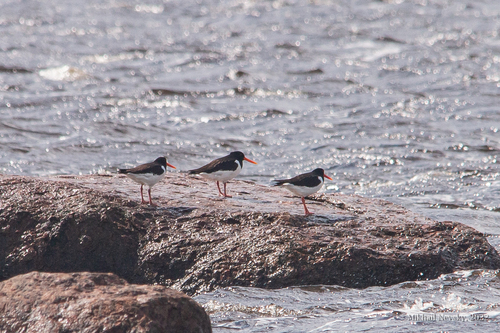 Eurasian Oystercatcher
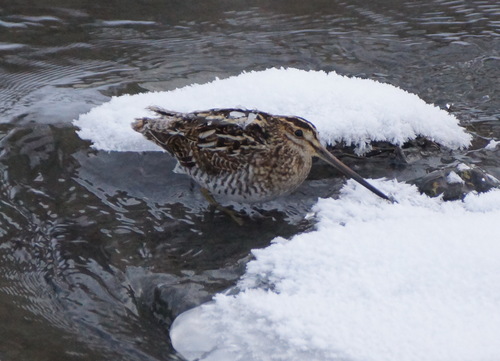 Common Snipe
In short
The most reliable field mark separating Eurasian Oystercatcher from Common Snipe is overall size and bold, contrasting plumage in flight: oystercatchers are much larger, with striking black-and-white wings and tail, while snipes are small, cryptically patterned, and show pointed wings with no bold white patches. Juvenile oystercatchers can show a white neck collar and duller bill, but remain much bulkier and more contrasting than any snipe. Bill shape is also instantly diagnostic: oystercatchers have a thick, long, straight orange-red bill, while snipes have a slender, straight, dark bill nearly as long as their body. In flight, oystercatchers are obvious and direct, while snipes flush with a zigzag, erratic flight and are much harder to see on the ground due to their camouflage. Voice and habitat also differ strongly, with oystercatchers being loud and coastal, and snipes shy, cryptic, and found in marshy or boggy ground.
Identification tips
- Size: Oystercatcher is much larger and bulkier than snipe—over four times the mass. Even at a distance or in flight, the size difference is obvious.
- Flight pattern and wing markings: Oystercatcher in flight shows bold white patches on the wings and tail, contrasting with black upperparts. Snipe has pointed wings with no white patches; flight is rapid and zigzagging, especially when flushed.
- Bill shape and color: Oystercatcher's bill is thick, long, and bright orange-red, used for smashing or prising open shells. Snipe's bill is long, slender, and dark, used for probing mud. Bill color is diagnostic at any age.
- Plumage contrast: Oystercatcher is sharply black above and white below; snipe is mottled brown with straw-yellow stripes and pale underparts, blending into marsh vegetation.
- Leg color: Oystercatcher has dull pink legs; snipe's legs are short and greenish-grey.
- Head pattern: Snipe shows a dark eye-stripe with pale stripes above and below; oystercatcher's head is plain black (adults) or brownish (juveniles) with no such facial stripes.
- Juvenile/immature marks: Young oystercatchers have a white neck collar and duller bill, but still show the large size and bold wing pattern. Juvenile snipes look much like adults—no bold white anywhere.
- Habitat: Oystercatcher is found in open, often coastal habitats; snipe is in marshes, bogs, and wet meadows with dense cover.
- Behavior: Oystercatcher is conspicuous, often seen walking openly and vocalizing. Snipe is secretive, flushes only when approached closely, and drops quickly back into cover.
- Vocalizations: Oystercatcher gives loud, repeated piping calls. Snipe is mostly silent except for a sharp 'scape' note when flushed or the display 'drumming' sound in spring.
- Perched posture: Oystercatcher stands tall and upright; snipe crouches low to the ground, often nearly invisible in vegetation.
- Group size: Oystercatchers may be seen in pairs or small groups, especially outside the breeding season. Snipes are usually solitary or in loose, scattered groups, rarely in the open.
- Sex and age: Oystercatcher sexes are similar, but females have a longer bill; this is rarely useful in the field. Snipe shows little sexual dimorphism.
- Seasonal changes: Oystercatcher may show a white throat collar in winter or as a juvenile; snipe's plumage is consistent year-round.
- Common pitfalls: Juvenile oystercatchers may appear browner and less contrasting, but their large size, white wing patches, and thick bill always separate them from any snipe. Snipe's cryptic plumage and zigzag flight are never matched by oystercatcher.
Size
Eurasian Oystercatcher is dramatically larger: body mass averages 518 g versus just 119.5 g for Common Snipe [wikidata]. Oystercatcher length is 40–45 cm with an 80–85 cm wingspan, dwarfing the snipe's 25–27 cm length and 44–47 cm wingspan [wikipedia]. Even at a distance, oystercatcher's size and bulk are unmistakable, while snipe appears small, compact, and delicate by comparison.
Plumage
- Juvenile/immature birds: Young oystercatchers are browner above, show a white neck collar, and have a duller bill, but still retain the bold black-and-white wing and tail pattern in flight. Juvenile snipes are similar to adults: cryptic brown above with straw-yellow stripes, pale below, and a dark eye-stripe; no bold white patches on wings or tail at any age.
- Adult breeding plumage: Oystercatcher adults are sharply black above and white below, with a broad white wing bar and white tail base visible in flight. Snipes remain mottled brown with yellowish stripes, pale underparts, and pointed wings with no bold white or black patterning. Snipe's upperwing is uniform and lacks any strong contrast.
- Winter plumage: Oystercatcher adults may show a white throat collar for a short period; immatures retain this longer. Snipe's plumage remains similar year-round, always cryptic and streaked.
- Bill color: Oystercatcher's bill is always strong orange-red, while snipe's is dark brown to blackish.
- Leg color: Oystercatcher has dull pink legs; snipe has short greenish-grey legs.
Behaviour
Oystercatchers are conspicuous, often vocal, and typically forage openly on beaches, mudflats, or gravelly islands, using their powerful bills to pry open molluscs or dig for worms. They walk with a purposeful gait and are rarely shy. Snipes are extremely shy and secretive, relying on camouflage and crouching low in dense marsh vegetation. When flushed, snipe explode from cover with a rapid, zigzag flight, quickly dropping back into cover. Oystercatchers take off with strong, direct flight and are much less likely to flush at close range.
Habitat
Eurasian Oystercatcher is mainly found in open coastal habitats: beaches, estuaries, and sometimes inland gravel islands. They are rarely seen in dense vegetation. Common Snipe, by contrast, is a bird of marshes, bogs, wet meadows, and tundra—always favoring soft, muddy ground with dense cover. Seeing a bird in open mudflat or shingle strongly favors oystercatcher; in a marshy, grassy, or boggy area, snipe is far more likely.
Voice
Oystercatcher is loud and vocal, with a distinctive, repeated piping call that carries over long distances. Snipe is mostly silent except when flushed (giving a sharp 'scape, scape' note) or during display flights, when males produce a unique 'drumming' or 'bleating' sound with their tail feathers (not their voice). Hearing a loud, piping call indicates oystercatcher; a sudden, sharp note on flushing or the distant sound of 'winnowing' in display points to snipe.