

Eurasian Green Woodpecker vs Black Woodpecker
Picus viridis versus Dryocopus martius
Play a quiz with Eurasian Green Woodpecker and Black Woodpecker
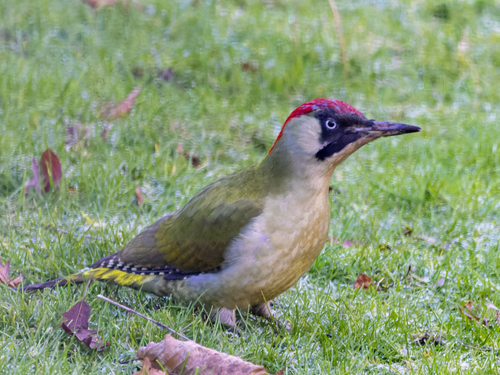 Eurasian Green Woodpecker
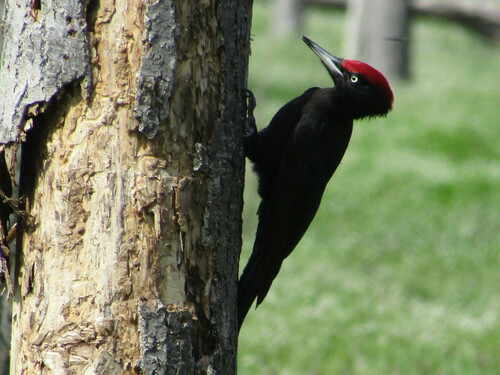 Black Woodpecker
In short
The most reliable field mark between these two is overall color: the Eurasian Green Woodpecker is bright green above with a yellow rump and red crown, while the Black Woodpecker is entirely black except for a red crown patch. Juvenile Green Woodpeckers are heavily spotted and streaked, unlike the more uniformly dark, dull juvenile Black Woodpecker. In flight, the Green Woodpecker shows an undulating, bounding flight and flashes of yellow on the rump, while the Black Woodpecker flies with slow, steady wingbeats and appears all black. Size is also a strong clue: the Black Woodpecker is much larger and bulkier than the Green Woodpecker. Vocalizations and facial patterns offer further separation if seen or heard well.
Identification tips
- Overall Color: Green Woodpecker is green above with a yellow rump; Black Woodpecker is entirely black except for the red crown. This is the fastest separation in most views.
- Juvenile Pattern: Juvenile Green Woodpeckers are heavily spotted and streaked, especially on the underparts and face. Juvenile Black Woodpeckers are plain, dull black with a duller red crown and pale throat, lacking any spots or streaks.
- Crown Pattern (Sex/Age): Adult male Green Woodpecker has a red crown and nape, with a black moustache stripe containing red; female has a solid black moustache. Black Woodpecker males have the whole crown red, females only the hindcrown. Juvenile Black Woodpecker has a duller, less extensive red crown.
- Facial Markings: Green Woodpecker has a black 'mask' around the eye and lores, and a contrasting pale eye. Black Woodpecker has no facial mask, just a black face with a red crown.
- Bill Structure: Black Woodpecker has a much longer, heavier, pale bill; Green Woodpecker's bill is shorter and less robust.
- Flight Style: Green Woodpecker flies with bounding, undulating flight (3–4 wingbeats then a glide); Black Woodpecker flies with slow, steady, unbroken wingbeats and keeps the head raised—no bounding.
- Rump Color in Flight: Green Woodpecker flashes a bright yellow rump in flight; Black Woodpecker's rump is black, blending with the rest of the body.
- Size and Jizz: Black Woodpecker is much larger, bulkier, and more powerful-looking, with a longer tail and bill. Green Woodpecker is smaller, more slender, and less imposing.
- Habitat Use: Green Woodpecker is often seen on the ground in open areas, lawns, or parkland; Black Woodpecker is almost always seen on tree trunks in mature forests.
- Vocalizations: Green Woodpecker gives a loud, laughing 'yaffle' and a noisy 'kyü-kyü-kyück' in flight; Black Woodpecker gives a sharp 'kree-kree-kree' and screech-like calls, never a yaffle.
- Drumming: Both species drum rarely, but if heard, Green Woodpecker's drumming is soft and fast; Black Woodpecker's drumming is not described as a field mark here.
- Sex Differences: For Green Woodpecker, check the moustache stripe: red center in males, all black in females. For Black Woodpecker, check the extent of red on the crown: full in males, hindcrown only in females.
- Perched Posture: Black Woodpecker appears long-necked, with a big head and bill, and sits upright on trunks. Green Woodpecker is more compact and often seen on the ground.
- Context: If seen in a large, mature forest with big dead trees, especially far from open ground, Black Woodpecker is more likely. In open parkland or gardens, Green Woodpecker is much more probable.
- Pitfalls: Poor light or distant views can make the Green Woodpecker look darker or less green; always look for the yellow rump and facial pattern. Juvenile Green Woodpeckers can appear oddly marked, but never all-black.
Size
The Black Woodpecker is significantly larger than the Eurasian Green Woodpecker. The Green Woodpecker measures 30–36 cm in length with a wingspan of 45–51 cm and a body mass around 193 g [wikidata]. In contrast, the Black Woodpecker is crow-sized, measuring 45–55 cm in length with a wingspan of 64–84 cm and a body mass of 250–400 g [wikipedia]. The Black Woodpecker's bill is also notably longer and heavier. In the field, the Black Woodpecker looks much more imposing and powerful, while the Green Woodpecker is distinctly smaller and more slender.
Plumage
- Juveniles: Juvenile Green Woodpeckers are heavily spotted and streaked all over, with a dark moustache and some red feathers appearing in the moustache of young males by mid-summer. Juvenile Black Woodpeckers are duller black, less glossy, with a duller red crown and a paler grey throat and bill, but lack the heavy spotting and streaking of juvenile Green Woodpeckers.
- Adults: Adult Green Woodpeckers are green above, pale yellowish green below, with a bright yellow rump and a red crown/nape. Males have a black moustache with a red center; females have a solid black moustache. The face has a black 'mask' around the eye and lores. Adult Black Woodpeckers are entirely black except for the red crown: males have the whole crown red, females only the hindcrown. The bill is pale and strikingly long. There are no yellow or green tones anywhere on the Black Woodpecker.
- Flight: In flight, Green Woodpecker shows a yellow rump and undulating flight, while Black Woodpecker appears all black and flies with slow, steady wingbeats.
Behaviour
Green Woodpeckers spend much time feeding on the ground, especially for ants, and are shy, often more easily heard than seen. They rarely drum and have a distinctive undulating, bounding flight. Black Woodpeckers feed by hammering into dead or diseased trees for wood-boring insects and carpenter ants, and are more often seen on tree trunks. Their flight is direct, with slow, deep wingbeats and no bounding dips. The Black Woodpecker's powerful excavations create large nest holes, often reused by other species.
Habitat
Both species can occur in mature woodlands, but the Black Woodpecker is more strictly tied to large, mature forests with big trees for nesting and feeding, especially poplar or pine with heart rot. Green Woodpeckers are more flexible, found in open woodlands, parkland, orchards, and even gardens, and are more likely to be seen feeding on the ground in open areas. The Black Woodpecker is less likely in open or fragmented habitats.
Voice
Green Woodpecker is famous for its loud, laughing 'yaffle' calls—a series of 10–18 'klü' notes that speed up and drop in pitch, and a noisy 'kyü-kyü-kyück' in flight. The female's call is thinner and more rapid. Drumming is rare and soft. Black Woodpecker gives a loud, whistling 'kree-kree-kree' (only twice in a row), and a screech-like shrill in flight. Its calls are higher-pitched and more piercing, and it does not produce a laughing or yaffling sound. Drumming is not mentioned as a prominent feature for either in these notes.
Eurasian Green Woodpecker · Black Woodpecker · My Tricky Birds