

Euler's Flycatcher vs White-rumped Sirystes
Lathrotriccus euleri versus Sirystes albocinereus
Play a quiz with Euler's Flycatcher and White-rumped Sirystes
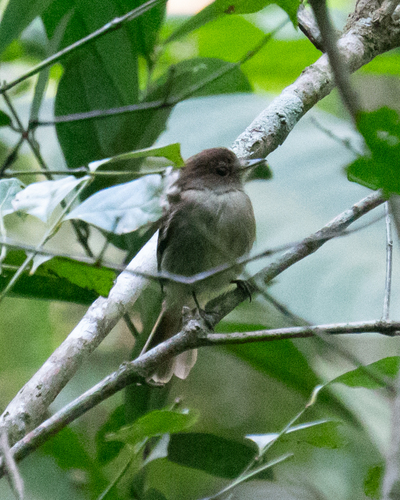 Euler's Flycatcher
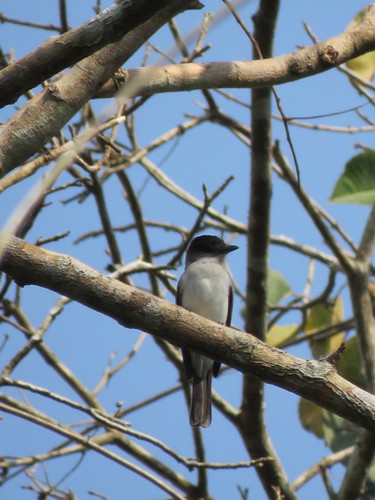 White-rumped Sirystes
In short
The most reliable field mark to separate these two is the bold white rump patch of the White-rumped Sirystes, which is obvious in flight and even when perched if the back is visible. Euler's Flycatcher never shows a white rump and is much smaller and more delicate overall. The Sirystes also has a blackish crown with a slight crest and a contrasting pale gray face, while Euler's Flycatcher is more uniformly olive-brown with a subtle pale eye-ring and lacks any crest. Both species have similar basic flycatcher shapes, but the Sirystes is bulkier and longer-tailed. Immature-specific wing patterns are not described for either species, so the focus is on adult plumage and structure.
Identification tips
- White rump patch (Sirystes only): Look for a bold white rump, especially visible in flight or when the bird is preening or flicking its wings. Euler's Flycatcher never shows a white rump at any age.
- Crown color and crest: Sirystes has a blackish crown with a slight crest, giving it a peaked look; Euler's Flycatcher has a warm olive-brown crown and is always smooth-headed.
- Facial contrast: Sirystes shows a slate gray face with a pale gray throat and breast, while Euler's Flycatcher is more uniform olive-brown with a subtle pale eye-ring and faint supercilium.
- Wing pattern: Sirystes has blackish wings with pale gray and white edges, but no wing bars. Euler's Flycatcher shows two pale buff wing bars and buffy edges to secondaries and tertials, but never white panels.
- Tail: Sirystes has a long, square-tipped, blackish tail; Euler's Flycatcher has a shorter, dusky tail.
- Size and structure: Sirystes is much larger and bulkier, with a longer tail and more robust jizz. Euler's Flycatcher is small, compact, and dainty.
- Belly color: Sirystes has a white belly; Euler's Flycatcher varies from pale yellow to white, depending on subspecies, but is never as sharply white as Sirystes.
- Breast and throat: Sirystes' breast and throat are pale gray, blending into the white belly. Euler's Flycatcher has a grayish white throat and a brownish olive wash on the breast.
- Bill color: Sirystes has a black bill; Euler's Flycatcher has a black maxilla and a dull pinkish or orangish pink mandible, but this is subtle and rarely visible in the field.
- Leg color: Both have blackish legs and feet; not useful for separation.
- Iris color: Sirystes has a coffee-brown iris; Euler's Flycatcher has a dark iris. This is subtle and not usually diagnostic at a distance.
- Sex and age: Both species are sexually monomorphic and lack described age-specific flight marks, so all field marks apply to all ages and sexes.
- Range check: If in Trinidad or outside the Amazon basin, Sirystes is unlikely; Euler's Flycatcher is more widespread.
- Perched vs. flight views: The white rump of Sirystes is most obvious in flight, but can also be seen when perched if the back is visible. Euler's Flycatcher never shows this mark.
- Wing bars (Euler's only): If you see two pale buff wing bars, you are looking at Euler's Flycatcher, not Sirystes.
Size
White-rumped Sirystes is significantly larger, measuring 18–19 cm in length and weighing 24–32 g. In contrast, Euler's Flycatcher is much smaller at 12.7–13.5 cm and 9–13.8 g. This size difference is usually obvious in the field, especially if you have a sense of scale from nearby birds or branches. The Sirystes also appears longer-tailed and more robust, while Euler's Flycatcher is compact and daintier.
Plumage
- Adults (all seasons): The Sirystes has a striking white rump patch that stands out against its otherwise gray and black plumage, especially in flight or when the back is exposed. Its crown is blackish with a slight crest, and the face is slate gray, contrasting with the pale gray throat and breast and white belly. The wings are blackish with pale gray and white edging. In contrast, Euler's Flycatcher is warm olive-brown above, with a subtle whitish eye-ring and faint pale supercilium, brownish olive breast, and pale yellow to white belly. Its wings are dusky with pale buff wing bars and edges, but never show white panels or a rump patch. Both sexes look alike in each species.
- Juvenile/immature: No distinctive age-specific upperwing or flight marks are described for either species, so separation relies on the same adult features.
Behaviour
Both species are typical tyrant flycatchers, often sallying from perches to catch insects. The Sirystes, being larger and longer-tailed, may appear more robust and upright when perched, sometimes showing its slight crest. Euler's Flycatcher is more delicate and tends to perch lower and more unobtrusively. Behavioral differences are subtle and not always reliable for separation.
Habitat
Both species occur in South American forests, but their ranges only partially overlap. Euler's Flycatcher is widespread across South America (except Chile), including Trinidad, and is generally found in a wider variety of forest types. White-rumped Sirystes is more restricted to the western and central Amazon (Bolivia, Brazil, Colombia, Ecuador, Peru, Venezuela). If you are outside the Sirystes' range (e.g., Trinidad), only Euler's Flycatcher is possible. However, habitat alone is not diagnostic where both occur.
Euler's Flycatcher · White-rumped Sirystes · My Tricky Birds