

Ethiopian Swallow vs Wire-tailed Swallow
Hirundo aethiopica versus Hirundo smithii
Play a quiz with Ethiopian Swallow and Wire-tailed Swallow
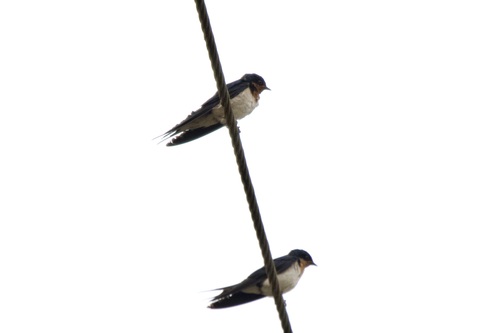 Ethiopian Swallow
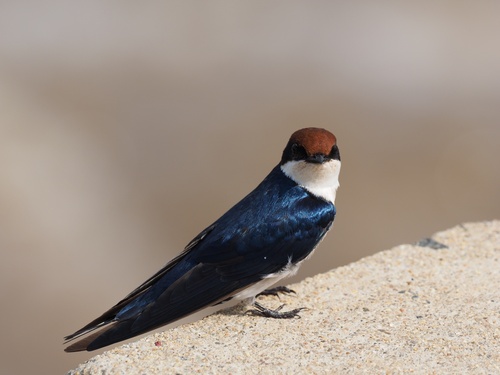 Wire-tailed Swallow
In short
The most reliable field mark to separate Ethiopian Swallow from Wire-tailed Swallow is the presence of extremely long, filamentous outer tail feathers ('wires') in adult Wire-tailed Swallows, which are absent in Ethiopian Swallow. Juvenile Wire-tailed Swallows lack these wires, but can be told by their brown crown and back, contrasting with the more uniform plumage of young Ethiopian Swallows. Both species are small, blue-and-white swallows with chestnut or brownish caps, but the Wire-tailed Swallow’s tail shape and cap color (especially in adults) are key. Immature birds are often confused, so pay close attention to crown color and tail structure.
Identification tips
- Tail wires in adults: Adult Wire-tailed Swallows have extremely long, filamentous outer tail feathers ('wires') that trail well beyond the tail tip. Ethiopian Swallow never shows these wires at any age or sex.
- Juvenile crown color: Juvenile Wire-tailed Swallows have a brown crown, back, and tail, contrasting with their white underparts. Ethiopian Swallow juveniles lack this strong brown crown and are more uniformly colored above.
- Adult cap color: Adult Wire-tailed Swallows show a bright chestnut cap that stands out against the blue upperparts. Ethiopian Swallow’s cap is duller and less sharply defined.
- Tail shape in flight: Even when tail wires are not obvious (e.g., in female Wire-tailed Swallow or in poor views), Wire-tailed Swallow often shows a more deeply forked tail than Ethiopian Swallow, though this is subtle and best used in combination with other marks.
- Sexual dimorphism: Only Wire-tailed Swallow shows sexual dimorphism in tail wire length—males have longer wires than females. Ethiopian Swallow does not show this difference.
- Flight silhouette: Wire-tailed Swallow adults have a distinctive flight profile due to their trailing wires, especially when seen from behind or below. Ethiopian Swallow’s flight is more typical of small swallows, lacking any trailing filaments.
- Perched posture: When perched, adult Wire-tailed Swallow’s wires are often visible, sometimes even dragging on the perch. Ethiopian Swallow never shows this feature.
- Plumage contrast in immatures: Young Wire-tailed Swallows have a noticeably brownish back and crown, while Ethiopian Swallow immatures are more uniformly colored and lack the strong head-back contrast.
- Cap demarcation: The boundary between the cap and the white underparts is sharper and more vivid in Wire-tailed Swallow adults; Ethiopian Swallow’s head color blends more subtly into the rest of the plumage.
- Habitat context: Both species can be found near water, but Wire-tailed Swallow is more tightly associated with water bodies. If seen far from water, Ethiopian Swallow is more likely, though not diagnostic.
- Range overlap: Where both species occur, always check for tail wires first, then crown color and back pattern in immatures.
- Confusion risk in juveniles: Juvenile Wire-tailed Swallows without wires are a major pitfall; focus on the brown crown and back to separate them from Ethiopian Swallow.
- No reliable size difference: Do not rely on size or mass to separate these species in the field.
- No voice distinction in available notes: Vocalizations are not described as distinctive between the two, so do not use calls for separation.
- Seasonal context: Both species are largely resident in Africa, so season is not a strong separator. Focus on plumage and structure year-round.
Size
Both species are nearly identical in size and mass, with Ethiopian Swallow averaging 13.0 g and Wire-tailed Swallow 12.7 g [wikidata]. In the field, size is not a reliable separator, as both appear as small, slender swallows. Wire-tailed Swallow is sometimes described as slightly longer due to its tail wires (adults), but body bulk is essentially the same.
Plumage
- Juvenile/Immature birds: Juvenile Wire-tailed Swallows lack the long tail wires and instead show a brown crown, back, and tail, with underparts still white. Ethiopian Swallow juveniles do not have the pronounced brown crown and back; their cap and upperparts are less contrasting and more uniform. This difference in head and back color is the best mark for immatures.
- Adults: Adult Wire-tailed Swallows have a bright chestnut cap, bright blue upperparts, and long, filamentous tail wires (males longer than females). Ethiopian Swallow adults have a similar blue-and-white pattern but lack the tail wires and have a less intensely colored cap. The cap of Ethiopian Swallow is not as bright chestnut as in Wire-tailed Swallow and may appear duller or less sharply demarcated.
- Sex differences: Both species are sexually similar, but in Wire-tailed Swallow, females have shorter tail wires than males. Ethiopian Swallow does not show such sexual dimorphism in tail length.
Behaviour
Wire-tailed Swallows are often seen flying low over water, displaying their long tail wires in flight, and are fast, agile flyers. Ethiopian Swallow is also aerial and agile, but lacks the distinctive trailing wires, making its flight silhouette more typical of small swallows. Both species perch, but Wire-tailed Swallow’s wires are conspicuous even when perched (in adults).
Habitat
Both species occur in open country, often near water and human habitation. Wire-tailed Swallow is especially associated with water bodies, where it feeds low over the surface. Ethiopian Swallow has a wide range across Africa and is non-migratory, while Wire-tailed Swallow (African subspecies) is also resident but may be more tightly linked to aquatic habitats. Habitat alone is not a reliable separator where ranges overlap.