

Dusky Long-tailed Cuckoo vs African Cuckoo
Cercococcyx mechowi versus Cuculus gularis
Play a quiz with Dusky Long-tailed Cuckoo and African Cuckoo
 Dusky Long-tailed Cuckoo
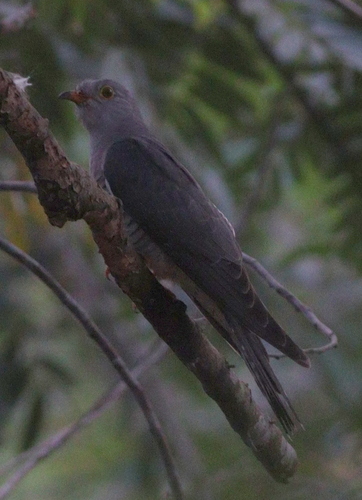 African Cuckoo
In short
The most reliable field mark to separate Dusky Long-tailed Cuckoo from African Cuckoo is the combination of upperpart color and wing pattern: Dusky Long-tailed has dark brown, sooty-grey upperparts with a purple-blue sheen and prominent buff and white spots on the wings, while African Cuckoo is overall dark grey above with no spotting. Juvenile Dusky Long-tailed Cuckoos show rufous barring on the upperparts, unlike the two juvenile morphs of African Cuckoo (grey and hepatic). In flight, Dusky Long-tailed’s tail is longer and more graduated, and its underparts are more heavily barred. Habitat is also a strong clue: Dusky Long-tailed is a forest species, African Cuckoo prefers open woodland and savannah. Calls are very different, but both are more often heard than seen.
Identification tips
- Juvenile upperparts: Look for rufous bars on the upperparts of juvenile Dusky Long-tailed Cuckoo; African Cuckoo juveniles never show this, instead appearing grey or brown (hepatic) with white or buff barring.
- Adult upperwing pattern: Dusky Long-tailed Cuckoo shows buff and white spots on the dark brown wings (all ages); African Cuckoo’s wings are plain dark grey with no spotting.
- Tail shape and length: Dusky Long-tailed’s tail is longer and more graduated, especially obvious when perched or in flight. African Cuckoo’s tail is long but less graduated, with a white tip and dark barring.
- Upperpart color: Dusky Long-tailed is dark brown with a sooty-grey wash and purple-blue iridescence; African Cuckoo is dark grey, lacking brown tones or iridescence.
- Underpart barring: Dusky Long-tailed has heavier, blackish-brown barring on white underparts; African Cuckoo’s barring is dark grey and more regular, with creamy or buff tones in juveniles.
- Vent color: Dusky Long-tailed has a buff vent, which may be visible when the bird is preening or in good light; African Cuckoo’s vent is not buff.
- Bare part color: Dusky Long-tailed has dark brown eyes, greenish-black bill, and yellow feet. African Cuckoo males have yellow eyes, females light brown, with a yellow bill (black/horn tip) and yellowish legs. Eye color is best seen at close range.
- Flight style: African Cuckoo’s flight is dashing and falcon-like, often drawing comparisons to a small raptor; Dusky Long-tailed’s flight is less conspicuous and more secretive.
- Perching posture: African Cuckoo often perches almost vertically, especially in open; Dusky Long-tailed is more likely to be hidden in undergrowth or mid-canopy.
- Habitat context: Dense forest or thick undergrowth points strongly to Dusky Long-tailed; open woodland or savannah to African Cuckoo.
- Vocalizations: Dusky Long-tailed’s call is a 'hu hee wheeu' or a long, accelerating/descending series; African Cuckoo’s male gives a two-note 'coo-coo' with the second note higher and louder, and the female a bubbling 'kwik-kwik-kwik'.
- Seasonal movement: African Cuckoo is migratory and may be absent outside the rainy season in some areas; Dusky Long-tailed is resident in its forest range.
- Sex differences: Only African Cuckoo shows sexual dimorphism in eye color (yellow in males, light brown in females); Dusky Long-tailed sexes are alike.
- Association with mixed flocks: Dusky Long-tailed may join mixed-species flocks in forest, African Cuckoo is usually solitary.
- Host choice (contextual): Both are brood parasites, but their host species differ and are unlikely to help in field ID unless observed at a nest.
Size
Both species are similar in length, about 32–33 cm (13 in) [wikipedia]. Dusky Long-tailed Cuckoo is slightly heavier (50–61 g) than African Cuckoo (no precise mass given, but similar size). Both have long tails, but Dusky Long-tailed’s is notably more graduated and appears longer relative to the body. Structure is otherwise similar, with both showing typical slender cuckoo proportions.
Plumage
- Juvenile/immature: Dusky Long-tailed Cuckoo juveniles have a blackish throat and rufous bars on the upperparts, which is unique among these two. African Cuckoo juveniles come in two morphs: a grey morph (greyer than adult, white barring, creamy-white underparts with dense dark barring) and a hepatic morph (brown above, buff/tawny below, not rufous-barred like Dusky Long-tailed).
- Adult upperparts: Dusky Long-tailed is dark brown with a sooty-grey wash and a purple-blue iridescence, plus buff and white spots on the wings. African Cuckoo is dark grey above, with no spots or iridescence.
- Underparts: Both have white underparts with dark barring, but Dusky Long-tailed’s barring is blackish-brown and heavier; African Cuckoo’s is dark grey and more regular. Dusky Long-tailed’s vent is buff, African Cuckoo’s is not described as such.
- Tail: Dusky Long-tailed’s tail is longer and more graduated, dark brown with possible spotting; African Cuckoo’s is dark grey with dark barring and a white tip.
- Bare parts: Dusky Long-tailed has dark brown eyes, greenish-black bill, yellow feet. African Cuckoo males have yellow eyes, females light brown, with a yellow bill tipped black/horn and yellowish legs.
- Sexes: Both species are similar between sexes, but eye color differs in African Cuckoo.
Behaviour
Dusky Long-tailed Cuckoo is often found in dense undergrowth or mid-canopy, sometimes joining mixed-species flocks, and is more likely to be seen in pairs calling from treetops. African Cuckoo is generally solitary, forages in trees and on the ground, and perches almost vertically. African Cuckoo’s flight is described as 'dashing' and reminiscent of a small raptor, while Dusky Long-tailed’s flight is less remarked upon but likely more secretive due to its forest habitat.
Habitat
Habitat is a strong separator: Dusky Long-tailed Cuckoo is a forest specialist, preferring dense undergrowth, lianas, tall secondary forest, and riverine forest in Central Africa. African Cuckoo is found in open woodland and savannah with scattered acacias, and is absent from dense forest and arid regions. If you see a cuckoo in thick forest, it is much more likely to be Dusky Long-tailed; in open woodland or savannah, African Cuckoo is the default.
Voice
Dusky Long-tailed Cuckoo gives a 'hu hee wheeu' and a series of accelerating then decelerating, descending notes. African Cuckoo’s male call is a two-note 'coo-coo' with the second note higher and louder; the female gives a bubbling 'kwik-kwik-kwik'. The calls are very different and diagnostic if heard well.