

Common Yellowthroat vs Cape May Warbler
Geothlypis trichas versus Setophaga tigrina
Play a quiz with Common Yellowthroat and Cape May Warbler
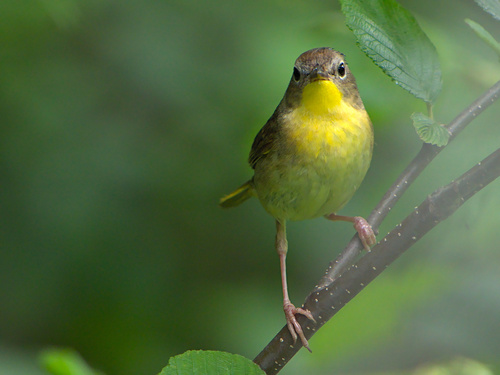 Common Yellowthroat
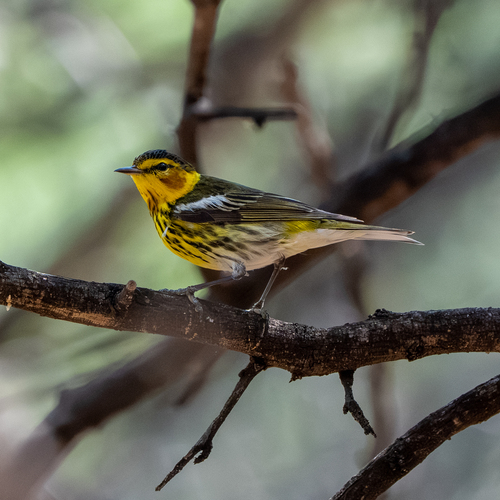 Cape May Warbler
In short
The most reliable field mark between Common Yellowthroat and Cape May Warbler is the presence of a bold black face mask (adult male Common Yellowthroat) versus the Cape May's yellow-streaked underparts and chestnut face patch (adult male). Immature and female Common Yellowthroats lack the mask but are plain-faced and olive above, while Cape May Warbler of all ages shows a yellowish rump and at least a faint white wing bar, with some head pattern even in immatures. In flight or perched, look for the Cape May's streaked yellow underparts and wing bar versus the Yellowthroat's plain yellow throat and chest with olive upperparts. Both are small warblers, but Cape May is slightly larger and slimmer. Habitat can help: Common Yellowthroat favors low, dense vegetation, while Cape May Warbler is more often high in conifers.
Identification tips
- Face pattern (adult males): Only Common Yellowthroat adult males have a bold black mask bordered above with white or gray; Cape May never shows this mask.
- Head pattern (Cape May): Adult male Cape May has a chestnut face patch framed in yellow with a black eyestripe; females/immatures are duller but still show a hint of this pattern, never a plain face.
- Wing bar: Cape May Warbler of all ages shows at least a faint white wing bar; Common Yellowthroat never shows a wing bar.
- Yellow rump: Cape May always has a yellowish rump, visible in flight or when the tail is flicked; Common Yellowthroat's rump is olive, matching the back.
- Underpart streaking: Cape May Warbler is streaked below (boldly in adult males, less so in females/immatures); Common Yellowthroat is plain yellow on throat and chest, fading to white on belly, with no streaking.
- Bill shape: Cape May has a slightly longer, thinner bill compared to the short, stubby bill of Common Yellowthroat; this is subtle but can help in good views.
- Tail and jizz: Cape May is slimmer, longer-winged, and often appears more active and agile in treetops; Yellowthroat is rounder, shorter-tailed, and typically stays low.
- Flight views (immatures): In flight, Cape May's yellow rump and wing bar are visible even in young birds; Yellowthroat immatures are plain, lacking these marks.
- Sex/age pitfalls: Female and immature Common Yellowthroats are very plain-faced and lack any wing bar or streaking; female/immature Cape May may be confused with other streaked warblers but still shows some streaking and a wing bar.
- Habitat: If the bird is in dense, low vegetation or marsh, suspect Yellowthroat; if it's high in a conifer or sallying for insects, suspect Cape May.
- Voice: Listen for the loud, rolling "twichety" of Yellowthroat versus the high, thin "tsi tsi tsi" of Cape May.
- Seasonal context: During migration, both may be found outside their breeding habitats, but Cape May is more likely to be seen in flowering trees or high in gardens, while Yellowthroat sticks to low cover.
- Behavior: Cape May is more likely to be seen foraging at the tips of branches or sallying for insects; Yellowthroat is secretive, often flicking its tail and diving into cover.
- Plumage brightness: Southwestern Common Yellowthroats are brighter yellow below, but still lack streaking, wing bar, or yellow rump.
- When in doubt: If the bird is streaked below, has a wing bar, and a yellow rump, it's Cape May; if it's plain yellow below with a black mask (male) or plain face (female/immature), it's Common Yellowthroat.
Size
Cape May Warbler is slightly larger and slimmer than Common Yellowthroat, with a body mass around 10.7 g [wikidata]. Cape May's length is 12–14 cm and wingspan 19–22 cm [wikipedia], while Common Yellowthroat is smaller and more compact (exact mass not given here). In the field, Cape May may appear longer-winged and more slender, especially when foraging actively in treetops, compared to the more rounded, short-tailed look of a Yellowthroat in low cover.
Plumage
For age and sex:
- Adult male Common Yellowthroat: unmistakable black face mask bordered above with white or gray, olive upperparts, bright yellow throat and chest, white belly.
- Adult female/immature Common Yellowthroat: no mask, plain olive above, yellow throat/chest, white belly—very plain-faced. First-year males may show a faint mask, darkening by spring.
- Cape May Warbler (adult male): brown back, yellowish rump, dark brown crown, bright yellow throat/nape, chestnut face patch framed in yellow, black eyestripe, yellow underparts with bold black streaks, narrow white wing bar.
- Female/immature Cape May Warbler: duller, but always shows yellowish rump, at least a faint white wing bar, some streaking below, and a hint of head pattern.
- In flight: Cape May always shows the yellow rump and wing bar; Common Yellowthroat lacks both, appearing plainer and more uniform.
- Key contrast: Cape May is streaked and patterned with a wing bar and yellow rump; Common Yellowthroat is plain below, with or without a mask, and no wing bar or yellow rump.
Behaviour
Common Yellowthroat is often seen skulking low in dense vegetation, rarely venturing high. It flicks its tail and may pop up briefly before diving back into cover. Cape May Warbler is much more arboreal, foraging actively at the tips of conifer branches, often high in the canopy, and may sally out for insects. Cape May is more likely to be seen in the open, especially during migration, while Yellowthroat is secretive and low.
Habitat
Common Yellowthroat prefers marshes, wet fields, and dense low vegetation, especially near water. It is rarely found in treetops. Cape May Warbler breeds in northern coniferous forests and is most often seen in or near spruce and other conifers, especially during migration when it may visit flowering trees or gardens but still favors higher perches. If you see a small warbler in dense reeds or wet thickets, it's likely a Yellowthroat; if it's high in a spruce or pine, Cape May is more probable.
Voice
Common Yellowthroat's song is a loud, rolling "twichety twichety twichety twich" and its call is a soft "jip" [wikipedia]. Cape May Warbler's song is a simple repetition of high "tsi" notes, and the call is a thin "sip" [wikipedia]. The Yellowthroat's song is richer and more varied, while Cape May's is higher-pitched and more monotone. Calls are both thin, but Cape May's is sharper.