

Common Rosefinch vs Trumpeter Finch
Carpodacus erythrinus versus Bucanetes githagineus
Play a quiz with Common Rosefinch and Trumpeter Finch
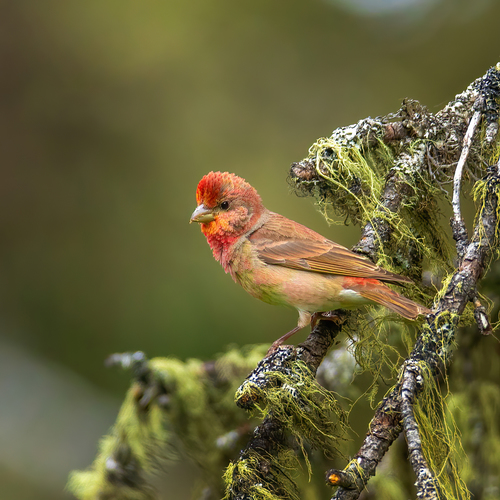 Common Rosefinch
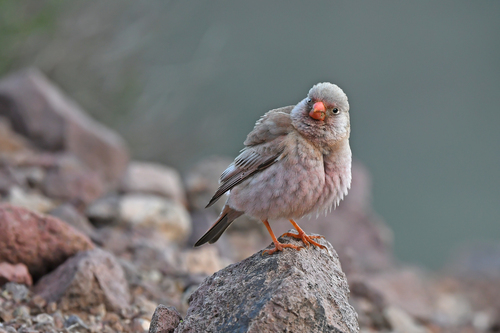 Trumpeter Finch
In short
The most reliable field mark between Common Rosefinch and Trumpeter Finch is the overall coloration and bill color in adult males: Common Rosefinch males show a vivid rosy-red on head, breast, and rump with a heavy, conical dark bill, while Trumpeter Finch males have a pinkish rump and breast, but a distinctive red bill and a paler, sandy-brown upper body. Females and immatures of both species are much duller, but Trumpeter Finch always looks paler and more washed-out, with a short, thick, pale bill and a more compact, long-winged shape. In flight or at rest, look for the rosefinch’s two indistinct wingbars (often subtle) versus the trumpeter’s plain wings and pink tail base with dark tip. Habitat is also a strong clue: Trumpeter Finch is a bird of open, arid country, while Common Rosefinch prefers thickets and woodland edges.
Identification tips
- Bill color and shape: Trumpeter Finch always shows a thick, short, pale or reddish bill (red in adult males), while Common Rosefinch has a heavy, conical, dark bill. This is often visible even at a distance.
- Male plumage (breeding): Adult male Common Rosefinch is rosy-red on head, breast, and rump, with brown wings and faint wingbars. Trumpeter Finch male has a red bill, greyish head and neck, pale brown upperparts, and pinkish breast/rump, but never the deep red of rosefinch. The pink is less extensive and less saturated.
- Female/immature plumage: Female and immature Trumpeter Finches are much paler and sandier, with a uniform washed-out look and a thick, pale bill. Female/immature rosefinches are brownish above, buff below, and may show a slightly brighter rump, but are never as pale or sandy as Trumpeter Finch.
- Wing pattern: Common Rosefinch may show two faint wingbars (all ages), while Trumpeter Finch’s wings are plain. This is subtle but worth checking at close range or in photos.
- Tail pattern: Trumpeter Finch has a pink tail with a dark terminal band, especially visible in adult males; rosefinch lacks this feature.
- Overall coloration: Trumpeter Finch is always paler, sandy, and washed-out, while rosefinch is richer brown or red (males) or yellowish-buff (females/immatures).
- Structure: Trumpeter Finch is more compact, with a large head, short tail, and thick bill. Rosefinch is more typical-finch shaped, with a longer tail and less 'cute' proportions.
- Habitat: Trumpeter Finch is almost always in open, dry, stony or sandy ground, rarely near trees. Rosefinch is in bushy, wooded, or riverside habitats.
- Behavior: Trumpeter Finch often feeds on the ground in flocks, sometimes far from cover; rosefinch is more often seen singly or in pairs, feeding in bushes or trees.
- Vocalizations: Trumpeter Finch’s song is a nasal, buzzing trill, very different from the sweet, warbling song of rosefinch. Calls are also sharper and more metallic in Trumpeter Finch.
- Flight style: Trumpeter Finch appears compact and swift in flight, often low over the ground; rosefinch has a more typical finch undulating flight.
- Seasonal changes: After moult, male rosefinch’s red is subdued and becomes brighter with feather wear; Trumpeter Finch males become duller and more like females in non-breeding plumage, but bill remains red.
- Rare color forms: Occasionally, male rosefinch may appear yellowish instead of red due to diet/parasites, but overall structure and habitat still separate them.
- Pitfalls: In poor light, both species can look dull and brownish; focus on bill shape/color, habitat, and overall paleness for Trumpeter Finch.
- Geographic context: Trumpeter Finch is rare outside arid southern Europe, North Africa, and Asia; rosefinch is widespread in Europe and Asia, especially near water or woodland.
Size
Common Rosefinch is slightly larger, measuring 13–15 cm in length, with a heavier, more robust body and bill. Trumpeter Finch is smaller and more compact, with a proportionally larger head, shorter tail, and a noticeably thicker, shorter bill. In the field, Trumpeter Finch may appear more 'cute' or squat, while Common Rosefinch looks more like a typical finch in structure.
Plumage
- Juveniles and Females: Both species are dull, but Trumpeter Finch is paler overall, with sandy or buffy tones and a washed-out appearance. Its bill is always thick and pale, sometimes with a reddish tinge in males. Common Rosefinch females and immatures are brownish above with yellowish or buff underparts, and may show a slightly brighter rump, but never the sandy uniformity of Trumpeter Finch. The rosefinch’s wingbars (though faint) may be visible at close range; Trumpeter Finch wings are plain.
- Adult Males (Breeding): Common Rosefinch males are strikingly rosy-red on the head, breast, and rump, with dark brown wings and two faint wingbars, and a heavy, dark bill. Trumpeter Finch males have a red bill, grey head and neck, pale brown upperparts, and pinkish breast and rump, but the pink is less extensive and less saturated than the rosefinch’s red. The tail of Trumpeter Finch is pink with a dark terminal band, a feature not shown by rosefinch.
- Non-breeding/First-winter Males: Both species become duller, but rosefinch males retain some red, especially on the rump and face, while Trumpeter Finch males become more like females: sandy, washed-out, but with a red bill.
Behaviour
Trumpeter Finch often forms small flocks, especially outside the breeding season, and is more likely to be seen feeding on the ground in open, arid areas. It may fly long distances to water, sometimes in the evening. Common Rosefinch is more solitary or in pairs during breeding, foraging in bushes or low trees, and is less likely to be seen in open, barren ground. In flight, Trumpeter Finch appears compact and swift, while rosefinch has a more typical finch flight.
Habitat
Habitat is a strong separator: Trumpeter Finch is almost always found in dry, open, desert-like areas, rocky plains, or semi-arid steppe, often far from trees. Common Rosefinch prefers thickets, woodland edges, riverine scrub, and sometimes gardens or orchards, usually with at least some tree or bush cover. If you see a finch in a lush riverside thicket, it is unlikely to be Trumpeter Finch.
Voice
Trumpeter Finch has a distinctive, nasal, buzzing trill, often described as tinny or trumpet-like. Common Rosefinch’s song is a sweet, warbling series of notes, very different from the trumpeter’s nasal quality. Calls are also different: Trumpeter Finch gives a sharp, metallic 'dzrrt', while rosefinch calls are softer and less metallic.