

Common Chaffinch vs European Serin
Fringilla coelebs versus Serinus serinus
Play a quiz with Common Chaffinch and European Serin
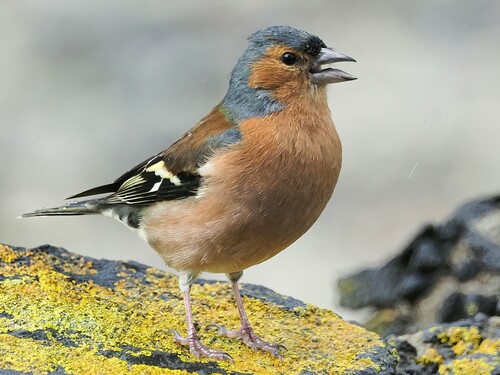 Common Chaffinch
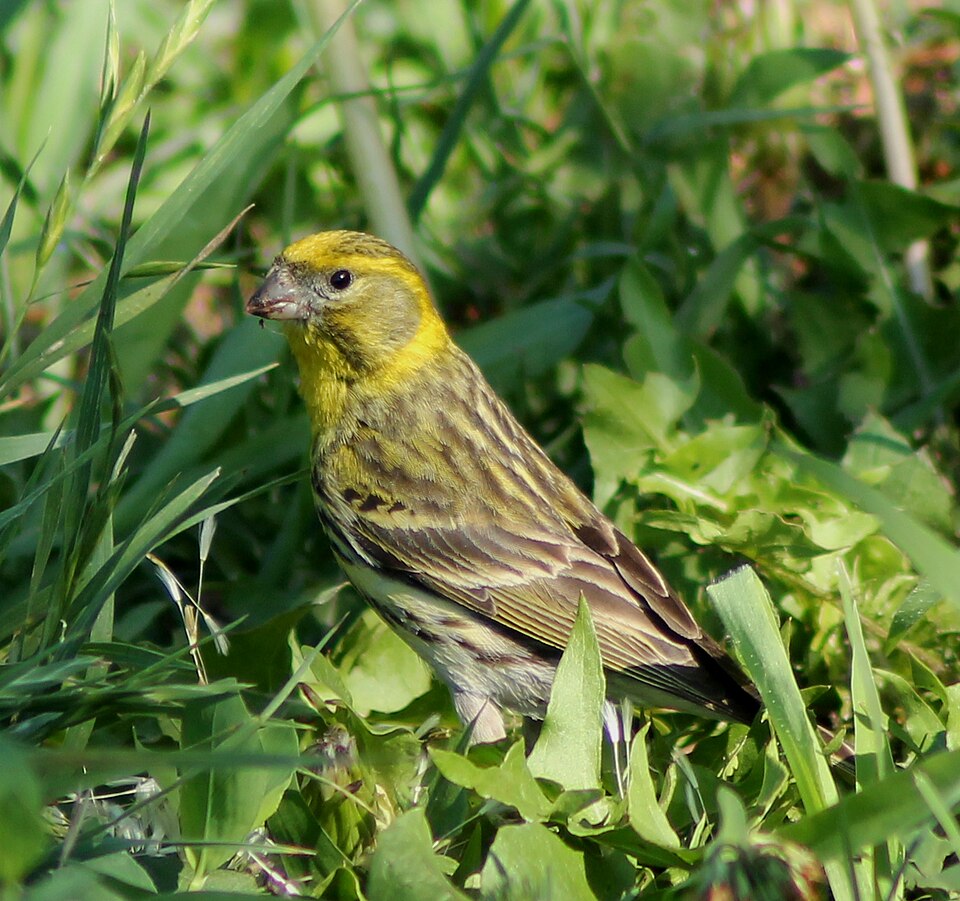 European Serin
In short
The most reliable field mark to separate Common Chaffinch from European Serin is the bold white double wing bar and white tail sides of the Chaffinch, which are obvious in all ages and especially striking in flight. European Serin is smaller, with a shorter tail and a much more streaked appearance overall, including the underparts. Chaffinch males show a blue-grey cap and rich rust-red underparts, while Serin males are bright yellow on the face and breast with heavy streaking. Females and juveniles of both species are duller, but Chaffinch always shows the strong wing bars and lacks the overall yellow and streaked look of Serin. In flight or perched, Chaffinch appears larger, longer-tailed, and more robust, while Serin is compact and active.
Identification tips
- White wing bars and tail sides (Chaffinch): Look for two bold white wing bars and white wedges on the outer tail feathers in all ages and sexes of Chaffinch. These are visible both perched and in flight and are never shown by Serin.
- Yellow and streaked appearance (Serin): Serin of all ages is heavily streaked on the upperparts and underparts, with a yellow rump and yellowish tones on the face, breast, and wing bars. Chaffinch never shows this overall streaked and yellow look.
- Size and structure: Chaffinch is larger, longer-tailed, and more robust, with a strong, thick bill. Serin is noticeably smaller, with a short tail and a more delicate, compact build.
- Male plumage: Male Chaffinch has a blue-grey cap, black forehead, and rich rust-red underparts—unique among European finches. Male Serin is bright yellow on the face and breast, with heavy streaking and yellow wing/tail accents.
- Female and juvenile confusion: Female and juvenile Chaffinch are duller but retain the white wing bars and tail sides. Female/immature Serin is streaky and yellowish, lacking the Chaffinch's clean wing pattern.
- Flight views: In flight, Chaffinch shows a strong white wing pattern and white outer tail, while Serin shows yellowish wing bars and tail sides but no white. Serin always looks more streaked and yellowish.
- Bill shape: Chaffinch has a robust, conical finch bill; Serin's bill is finer and more pointed, reflecting its smaller size.
- Behavior: Chaffinch is often seen feeding on the ground or perched upright, moving with deliberate hops. Serin is more restless, often flitting about in the canopy or on exposed twigs, and forms flocks outside the breeding season.
- Habitat context: In Mediterranean or open woodland with conifers, especially in southern Europe, Serin is more likely. In more northern, mixed, or broadleaf woodland, or in gardens and farmland, Chaffinch is much more common.
- Vocalizations: If heard, Serin's song is a rapid, buzzy trill, unlike the Chaffinch's more melodic and structured song.
- Seasonal bill color (Chaffinch): In spring, Chaffinch's bill becomes bluish-grey with a small black tip; in winter, it is pale grey. This is subtle but may help in close views.
- Rump color: Chaffinch has a light olive-green rump (male) or dull olive-green (female), while Serin's rump is bright yellow.
- Underpart color: Chaffinch males have rust-red underparts; Serin is always streaked below, never solidly colored.
- Mixing with other finches: Serin often joins mixed-species flocks in winter, but Chaffinch is usually in single-species groups or with other large finches.
- Pitfall: Do not rely on overall 'greenish' tones alone—female Chaffinch can appear olive, but always check for the bold white wing bars and tail sides to confirm.
Size
Common Chaffinch is noticeably larger and heavier (body mass ~22g) than European Serin, which is the smallest European finch. Chaffinch measures about 14.5 cm in length with a wingspan of 24.5–28.5 cm, while Serin is only 11–12 cm long and proportionately much lighter. Chaffinch has a longer tail and a more robust, thickset body, whereas Serin is compact and short-tailed. This size difference is apparent even at a distance, especially when both species are seen together or with other finches for scale.
Plumage
- Juvenile/immature birds: Both juvenile Chaffinch and female/immature Serin are duller than adult males, but Chaffinch juveniles still show the strong white wing bars and white tail sides, while Serin juveniles have streaked underparts and a yellowish rump but lack bold wing markings.
- Adults (male): Male Chaffinch is unmistakable with a blue-grey cap, black forehead, rust-red underparts, and olive-green rump. The wings have two contrasting white bars and a white panel on the coverts, with white wedges on the outer tail feathers. Male Serin is bright yellow on the face and breast, heavily streaked on the upperparts and flanks, with yellow wing bars and yellow tail sides, but lacks the Chaffinch's white wing/tail pattern.
- Females: Female Chaffinch is dull grey-brown above and paler below but still shows white wing bars and tail sides. Female Serin is streaky greyish-green above with a yellow rump and streaked pale underparts, and has yellowish but less distinct wing bars.
- Flight views: Chaffinch of all ages shows bold white wing bars and white outer tail, while Serin shows yellowish wing bars and yellow tail sides but no white. Serin always appears more streaked and yellowish, never with the Chaffinch's clean wing pattern.
Behaviour
Chaffinch is a robust, ground-feeding finch, often seen hopping on the ground or perched upright in trees. It is less restless than Serin and may appear more deliberate in its movements. Serin is much more active and often conspicuous, flitting about in open woodland or cultivated areas, frequently perching on exposed twigs and making short, fluttery flights. Outside the breeding season, Serin often forms flocks, sometimes mixing with other finches. In flight, Chaffinch appears strong and direct, while Serin is quick and bounding, with a more fluttery jizz.
Habitat
Chaffinch is widespread and common in a variety of habitats, including woodlands, parks, gardens, and farmland across much of Europe. It is not particularly tied to conifers or open country. European Serin prefers open woodland, especially with some conifers, as well as cultivated areas and orchards, mainly in southern and central Europe and North Africa. Serin is much more likely to be found in Mediterranean-type habitats, and is less common in northern or densely forested areas where Chaffinch is abundant.
Voice
Chaffinch has a varied and well-known song, but the notes do not provide details here. European Serin's song is described as a buzzing trill, which is very familiar in Mediterranean countries. In the field, Serin's song is a rapid, high-pitched, buzzy series of notes, quite different from the Chaffinch's more structured and melodic song. Calls are not described in detail, but Serin's typical vocalizations are higher-pitched and more sibilant.