

Chestnut-throated Huet-huet vs Ochre-flanked Tapaculo
Pteroptochos castaneus versus Eugralla paradoxa
Play a quiz with Chestnut-throated Huet-huet and Ochre-flanked Tapaculo
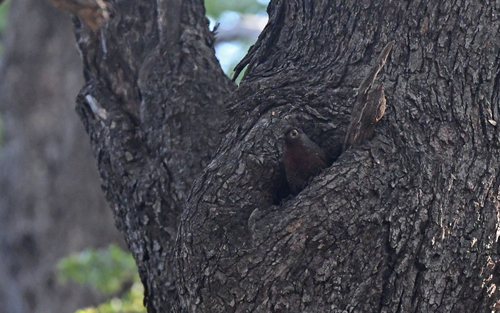 Chestnut-throated Huet-huet
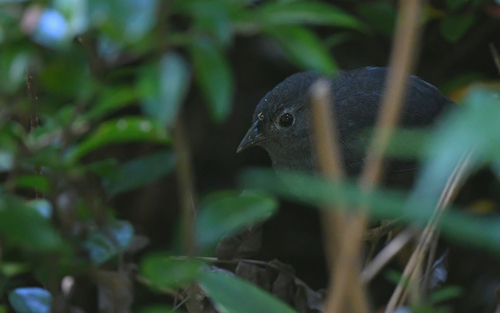 Ochre-flanked Tapaculo
In short
The most reliable field mark to separate Chestnut-throated Huet-huet from Ochre-flanked Tapaculo is size: the huet-huet is vastly larger and bulkier, with a stocky build and a dark red throat, while the tapaculo is much smaller, more compact, and shows ochre-brown flanks and a clay-brown vent. Juvenile Ochre-flanked Tapaculo is distinctly barred cinnamon/rufous and dusky gray, unlike any age of huet-huet. In adults, the huet-huet’s pale buff wing bar and chestnut throat contrast with the tapaculo’s plain dark gray upperparts and unique facial profile. Both occur in similar southern South American forests, so direct comparison is possible, but confusion is most likely with quick, poor views or immature birds.
Identification tips
- Size is the most immediate clue: Chestnut-throated Huet-huet is nearly five times heavier and much longer than Ochre-flanked Tapaculo. If the bird looks thrush-sized or larger, it is a huet-huet; if it is wren-sized, it is a tapaculo. This holds for all ages and sexes.
- Juvenile plumage is diagnostic: Young Ochre-flanked Tapaculo is barred cinnamon/rufous and dusky gray all over. No huet-huet, at any age, shows this pattern. If you see a small, barred bird in this region, it is the tapaculo.
- Throat color in adults: Chestnut-throated Huet-huet has a dark red (chestnut) throat, contrasting with its dark brown body. Ochre-flanked Tapaculo’s throat is plain gray, matching the rest of the underparts.
- Wing bar: Adult huet-huet shows a pale buff bar on the wing, visible when perched or in flight. This mark is absent in the tapaculo at all ages.
- Flank and vent color: Ochre-flanked Tapaculo has tawny-brown (ochre) flanks and a clay-brown vent and abdomen, contrasting with its gray underparts. The huet-huet is uniformly dark brown below, except for the chestnut throat.
- Facial profile: The tapaculo has a unique 'Roman nose' profile, with a pronounced, sloping forehead and bill. The huet-huet has a more typical, robust thrush-like head and bill.
- Overall color tone: Huet-huet is dark brown overall, while the tapaculo is dark gray above and paler gray below, with brown restricted to the flanks and vent.
- Structure and jizz: The huet-huet is stocky, with a heavy, rounded body and strong legs. The tapaculo is smaller, more compact, and may appear more delicate.
- In flight: The pale buff wing bar of the huet-huet may be glimpsed in flight, while the tapaculo’s wings are plain.
- Perched posture: Huet-huet often appears upright and robust, while tapaculo may seem more horizontal and mouse-like.
- Habitat overlap: Both occur in similar forests, so do not rely on habitat alone for identification.
- No sexual dimorphism noted: Both species appear similar in both sexes, so these marks apply to males and females.
- Voice not covered: Vocalizations are not described in the notes, so do not use song or call for separation based on this information.
- Pitfalls: Poor views of a juvenile tapaculo may be mistaken for a small, odd-plumaged huet-huet, but the barring is unique. Conversely, a large, dark bird with a chestnut throat and wing bar is always a huet-huet.
- Molecular distinction: These species were once considered conspecific, but are now known to be distinct; do not assume intermediate forms.
Size
Chestnut-throated Huet-huet is dramatically larger, averaging 165 g and 23 cm in length, making it the largest rhinocryptid after the giant antpittas [wikipedia]. Ochre-flanked Tapaculo is much smaller, with adults around 34.5 g and 14.5 cm long [wikidata][wikipedia]. In the field, the huet-huet appears robust and heavy-bodied, while the tapaculo is compact and noticeably lighter. Even at a distance, the size gap is striking and should be apparent with binoculars if both species are known from the area.
Plumage
Juvenile Ochre-flanked Tapaculo is heavily barred cinnamon/rufous and dusky gray throughout, a pattern not found in any age of Chestnut-throated Huet-huet. Adult huet-huet is dark brown overall with a distinctive dark red (chestnut) throat and a pale buff wing bar; this wing bar is absent in the tapaculo. Adult Ochre-flanked Tapaculo is dark gray above, paler gray on the underparts, with clay-brown on the abdomen and vent, and tawny-brown flanks. The tapaculo lacks any throat patch or wing bar, and its face is described as having a 'Roman nose' profile, which is unique among tapaculos. Both species are overall dark, but the huet-huet’s throat and wing bar, and the tapaculo’s ochre flanks and vent, are key contrasts.
Behaviour
Behavior is not strongly diagnostic from the available notes. Both species are skulking, ground-dwelling birds typical of Rhinocryptidae, and both may be seen moving through dense undergrowth. The huet-huet’s larger size may make it appear slower and more ponderous, while the tapaculo’s smaller size could make it seem more agile or mouse-like, but this is not a reliable field mark without direct comparison.
Habitat
Both species are found in south-central Chile and adjacent western Argentina, often in similar forested habitats [wikipedia]. Habitat alone is not a reliable separator, as their ranges and preferred environments overlap.
Chestnut-throated Huet-huet · Ochre-flanked Tapaculo · My Tricky Birds