

Motmot

Canebrake Groundcreeper vs Grassland Yellow-Finch

Clibanornis dendrocolaptoides versus Sicalis luteola

Play a quiz with Canebrake Groundcreeper and Grassland Yellow-Finch

Canebrake Groundcreeper (Clibanornis dendrocolaptoides) Canebrake Groundcreeper
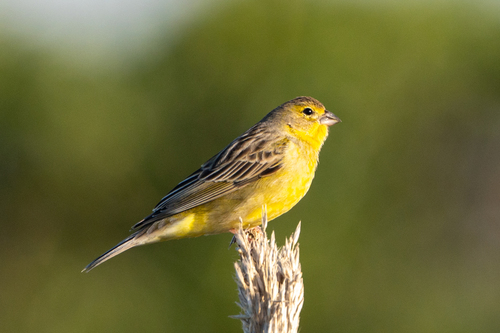
Grassland Yellow-Finch (Sicalis luteola) Grassland Yellow-Finch

Media

Loading…

In short

The most reliable field mark to separate Canebrake Groundcreeper from Grassland Yellow-Finch is overall structure and coloration: the groundcreeper is a much larger, heavier bird with a straight, dark bill and rich rufous-brown tones, while the yellow-finch is much smaller, lighter, and distinctly yellow. Juvenile groundcreepers show a plain buff-washed white throat and faintly mottled breast, but never approach the bright yellow of any age yellow-finch. In the field, look for the groundcreeper’s robust, ovenbird-like shape and earthy colors versus the yellow-finch’s compact, sparrow-like build and vivid yellow. Habitat can help: groundcreepers are skulkers in dense undergrowth, while yellow-finches are open-country birds.

Identification tips

  1. Size and bulk: The groundcreeper is over three times heavier than the yellow-finch. If the bird appears large, elongated, and robust, it is almost certainly a groundcreeper. Small, delicate birds are yellow-finches.
  2. Bill shape: Groundcreeper has a long, straight, dark bill suited for probing; yellow-finch has a short, conical, pale bill for seed-eating. Bill shape is diagnostic at close range.
  3. Overall color: Groundcreeper is never yellow at any age; it is rufous-brown to chestnut above, with grayish and ochraceous underparts. Yellow-finch is always yellowish, especially below, even in juveniles.
  4. Supercilium and face: Groundcreeper shows a narrow grayish or buff-gray supercilium that widens behind the eye, with dark brown lores and a dull reddish-brown face. Yellow-finch lacks this pattern, instead showing a plain or subtly marked face.
  5. Crown and back: Groundcreeper has a dark chestnut-brown crown and rufescent brown back; yellow-finch has olive or brownish upperparts but never chestnut or rufous.
  6. Wings and tail: Groundcreeper’s wing coverts and flight feathers are rufous-brown, and the tail is mostly rufous-chestnut. Yellow-finch has plain brownish wings and tail, never rufous or chestnut.
  7. Throat and underparts: Adult groundcreeper has a white throat with blackish speckles on the sides; juveniles have a plain buff-washed white throat. Yellow-finch is yellowish on the throat and underparts, sometimes with faint streaking in juveniles but never white or speckled.
  8. Breast and belly: Groundcreeper’s breast and belly are dull grayish, with rufous-brown sides and ochraceous flanks. Yellow-finch is bright yellow below, sometimes with faint streaks in juveniles.
  9. Leg color: Groundcreeper has olive-green to greenish gray legs and feet; yellow-finch’s legs are pale and unremarkable.
  10. Behavior: Groundcreeper moves slowly in dense undergrowth, rarely flying far or perching in the open. Yellow-finch is active, perches on exposed stems, and often flies in flocks.
  11. Habitat: Dense, tangled forest undergrowth points to groundcreeper; open grassland or weedy fields to yellow-finch.
  12. Juvenile confusion: Even juvenile groundcreepers, with their plainer throats and faintly mottled breasts, never show yellow tones. Juvenile yellow-finches may be duller but remain yellowish and lack the groundcreeper’s rufous and chestnut hues.
  13. Sexes: Both species are sexually monomorphic in plumage, so sex is not a useful field mark.
  14. Flight jizz: Groundcreeper’s flight is heavy and direct, rarely sustained; yellow-finch is quick, bounding, and agile.
  15. If in doubt: A bird that is both yellow and small is a yellow-finch; a large, rufous-brown, skulking bird is a groundcreeper.

Size

Canebrake Groundcreeper is substantially larger and heavier, weighing about 53 g and measuring 20–22 cm in length. It has a robust, elongated body typical of large furnariids. In contrast, Grassland Yellow-Finch is much smaller and lighter, at just 15.5 g, with a compact, finch-like build. This size difference is obvious in direct comparison: the groundcreeper looks bulky and elongated, while the yellow-finch is petite and delicate. Bill size and shape also differ: the groundcreeper’s bill is straight and strong, suited for probing, while the yellow-finch’s is short and conical.

Plumage

Juvenile Canebrake Groundcreeper can be told by its plain buff-washed white throat and faint buff mottling on the breast, with a grayer belly than adults. Even so, it remains a dull, earth-toned bird with rufous-brown upperparts and no yellow. Adults have a narrow grayish or buff-gray supercilium, dark chestnut crown, rufescent brown back, and rufous-brown wings and tail. The throat is white with blackish speckles, and the underparts are dull grayish with rufous-brown sides and ochraceous flanks. Grassland Yellow-Finch, by contrast, is bright yellow overall in adults, with olive or brownish tones on the back and wings but never the rich rufous or chestnut of the groundcreeper. Juvenile yellow-finches may be duller, but still show yellowish tones and lack the groundcreeper’s chestnut and rufous hues. No age or season of yellow-finch resembles the groundcreeper’s earthy, ovenbird-like plumage.

Behaviour

Canebrake Groundcreeper is a skulker, moving slowly and deliberately through dense undergrowth, often near the ground, probing with its straight bill. It is rarely seen in the open. Grassland Yellow-Finch is much more active and conspicuous, often seen perching on exposed grass stems or flying in flocks over open fields. Their flight is quick and bounding, typical of small seedeaters. The groundcreeper’s behavior is furtive and secretive, while the yellow-finch is social and visible.

Habitat

Canebrake Groundcreeper inhabits dense, tangled undergrowth in humid forests, especially areas with thick cane or bamboo, and is found in Argentina, Brazil, and Paraguay. It avoids open areas. Grassland Yellow-Finch, as its name suggests, is found in open grasslands, pastures, and weedy fields, rarely venturing into dense cover. If you see a bird in open grassy habitat, it is almost certainly a yellow-finch; a bird creeping through dense, shadowy undergrowth is likely a groundcreeper.

Submit a better description

Use the same sections as the comparison. Your text is published immediately.

The most reliable field mark to separate Canebrake Groundcreeper from Grassland Yellow-Finch is overall structure and coloration: the groundcreeper is a much larger, heavier bird with a straight, dark bill and rich rufous-brown tones, while the yellow-finch is much smaller, lighter, and distinctly yellow. Juvenile groundcreepers show a plain buff-washed white throat and faintly mottled breast, but never approach the bright yellow of any age yellow-finch. In the field, look for the groundcreeper’s robust, ovenbird-like shape and earthy colors versus the yellow-finch’s compact, sparrow-like build and vivid yellow. Habitat can help: groundcreepers are skulkers in dense undergrowth, while yellow-finches are open-country birds.

  1. Size and bulk: The groundcreeper is over three times heavier than the yellow-finch. If the bird appears large, elongated, and robust, it is almost certainly a groundcreeper. Small, delicate birds are yellow-finches.
  2. Bill shape: Groundcreeper has a long, straight, dark bill suited for probing; yellow-finch has a short, conical, pale bill for seed-eating. Bill shape is diagnostic at close range.
  3. Overall color: Groundcreeper is never yellow at any age; it is rufous-brown to chestnut above, with grayish and ochraceous underparts. Yellow-finch is always yellowish, especially below, even in juveniles.
  4. Supercilium and face: Groundcreeper shows a narrow grayish or buff-gray supercilium that widens behind the eye, with dark brown lores and a dull reddish-brown face. Yellow-finch lacks this pattern, instead showing a plain or subtly marked face.
  5. Crown and back: Groundcreeper has a dark chestnut-brown crown and rufescent brown back; yellow-finch has olive or brownish upperparts but never chestnut or rufous.
  6. Wings and tail: Groundcreeper’s wing coverts and flight feathers are rufous-brown, and the tail is mostly rufous-chestnut. Yellow-finch has plain brownish wings and tail, never rufous or chestnut.
  7. Throat and underparts: Adult groundcreeper has a white throat with blackish speckles on the sides; juveniles have a plain buff-washed white throat. Yellow-finch is yellowish on the throat and underparts, sometimes with faint streaking in juveniles but never white or speckled.
  8. Breast and belly: Groundcreeper’s breast and belly are dull grayish, with rufous-brown sides and ochraceous flanks. Yellow-finch is bright yellow below, sometimes with faint streaks in juveniles.
  9. Leg color: Groundcreeper has olive-green to greenish gray legs and feet; yellow-finch’s legs are pale and unremarkable.
  10. Behavior: Groundcreeper moves slowly in dense undergrowth, rarely flying far or perching in the open. Yellow-finch is active, perches on exposed stems, and often flies in flocks.
  11. Habitat: Dense, tangled forest undergrowth points to groundcreeper; open grassland or weedy fields to yellow-finch.
  12. Juvenile confusion: Even juvenile groundcreepers, with their plainer throats and faintly mottled breasts, never show yellow tones. Juvenile yellow-finches may be duller but remain yellowish and lack the groundcreeper’s rufous and chestnut hues.
  13. Sexes: Both species are sexually monomorphic in plumage, so sex is not a useful field mark.
  14. Flight jizz: Groundcreeper’s flight is heavy and direct, rarely sustained; yellow-finch is quick, bounding, and agile.
  15. If in doubt: A bird that is both yellow and small is a yellow-finch; a large, rufous-brown, skulking bird is a groundcreeper.

Canebrake Groundcreeper is substantially larger and heavier, weighing about 53 g and measuring 20–22 cm in length. It has a robust, elongated body typical of large furnariids. In contrast, Grassland Yellow-Finch is much smaller and lighter, at just 15.5 g, with a compact, finch-like build. This size difference is obvious in direct comparison: the groundcreeper looks bulky and elongated, while the yellow-finch is petite and delicate. Bill size and shape also differ: the groundcreeper’s bill is straight and strong, suited for probing, while the yellow-finch’s is short and conical.

Juvenile Canebrake Groundcreeper can be told by its plain buff-washed white throat and faint buff mottling on the breast, with a grayer belly than adults. Even so, it remains a dull, earth-toned bird with rufous-brown upperparts and no yellow. Adults have a narrow grayish or buff-gray supercilium, dark chestnut crown, rufescent brown back, and rufous-brown wings and tail. The throat is white with blackish speckles, and the underparts are dull grayish with rufous-brown sides and ochraceous flanks. Grassland Yellow-Finch, by contrast, is bright yellow overall in adults, with olive or brownish tones on the back and wings but never the rich rufous or chestnut of the groundcreeper. Juvenile yellow-finches may be duller, but still show yellowish tones and lack the groundcreeper’s chestnut and rufous hues. No age or season of yellow-finch resembles the groundcreeper’s earthy, ovenbird-like plumage.

Canebrake Groundcreeper is a skulker, moving slowly and deliberately through dense undergrowth, often near the ground, probing with its straight bill. It is rarely seen in the open. Grassland Yellow-Finch is much more active and conspicuous, often seen perching on exposed grass stems or flying in flocks over open fields. Their flight is quick and bounding, typical of small seedeaters. The groundcreeper’s behavior is furtive and secretive, while the yellow-finch is social and visible.

Canebrake Groundcreeper inhabits dense, tangled undergrowth in humid forests, especially areas with thick cane or bamboo, and is found in Argentina, Brazil, and Paraguay. It avoids open areas. Grassland Yellow-Finch, as its name suggests, is found in open grasslands, pastures, and weedy fields, rarely venturing into dense cover. If you see a bird in open grassy habitat, it is almost certainly a yellow-finch; a bird creeping through dense, shadowy undergrowth is likely a groundcreeper.

Discard your changes?

You have unsaved edits. If you leave now, those changes will be lost.

Canebrake Groundcreeper · Grassland Yellow-Finch · My Tricky Birds