

Burchell's Starling vs Meves's Starling
Lamprotornis australis versus Lamprotornis mevesii
Play a quiz with Burchell's Starling and Meves's Starling
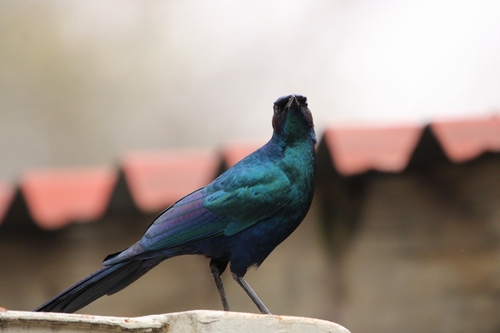 Burchell's Starling
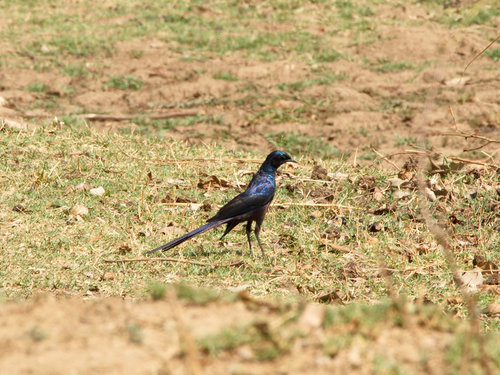 Meves's Starling
In short
The most reliable field mark to separate these two glossy starlings is the tail: Meves's Starling has a much longer, strongly graduated tail, with the central feathers noticeably longer than the outer ones, while Burchell's Starling has a shorter, less graduated tail. Both species are similarly sized and share iridescent plumage, but Meves's Starling often appears darker in dull light and shows more intense gloss in bright conditions. Eye color is also helpful: Meves's Starling has dark eyes, which can help distinguish it from other long-tailed starlings, though not from Burchell's. Habitat overlap is extensive, so structural and plumage features are key for confident identification, especially in mixed flocks or overlapping ranges.
Identification tips
- Tail length and graduation: Meves's Starling has a much longer tail with a strongly graduated shape—central tail feathers are the longest, with each pair shorter toward the edges. This is the single most reliable mark, visible both perched and in flight, and applies to all ages and sexes.
- Tail shape in flight: When flying, Meves's Starling's tail appears noticeably longer and more tapered, while Burchell's Starling's tail is shorter and more squared-off.
- Overall silhouette: Meves's Starling looks more elongated and slender due to its long tail, while Burchell's Starling appears stockier and more compact.
- Plumage gloss variation: Meves's Starling can look nearly black in poor light, but in bright light shows a strong iridescent gloss that varies by subspecies (from dull brownish to intense green-blue or violet-purple). Burchell's Starling is glossy but less variable and lacks the extreme gloss of some Meves's subspecies.
- Subspecific variation (Meves's only): If you encounter a starling with a violet-purple or dull brown gloss, it is likely a Meves's Starling of the violacior or benguelensis subspecies, respectively. Burchell's does not show this variation.
- Eye color: Meves's Starling has dark eyes, which helps separate it from other long-tailed starlings, but not from Burchell's, which also has dark eyes. This is not useful for separating these two, but may help rule out confusion with other species.
- Habitat context: If seen in mopane woodland or along river basins, especially in areas that flood seasonally, Meves's Starling is more likely. Burchell's is found in a wider range of woodland and savannah, but habitat overlap means this is only a supporting clue.
- Flocking behavior: Meves's Starling is often in small, active flocks. If you see a group of long-tailed glossy starlings, check for tail graduation to confirm Meves's.
- Bill and head structure: No significant differences are noted in the sources; both have typical starling bills and head shapes.
- Juvenile/immature plumage: No distinctive juvenile or immature wing or body marks are described for either species in the available sources. Age is not a reliable separator in the field for these two.
- Vocalizations: No diagnostic differences are described in the sources; do not rely on voice for separation.
- Seasonal or sex differences: No seasonal or sex-based plumage or structural differences are noted for either species.
- Pitfall—other long-tailed starlings: If you see a long-tailed starling with pale eyes, it is not Meves's or Burchell's, but another Lamprotornis species. For these two, focus on tail graduation and length.
- Pitfall—lighting conditions: Both species can appear dark in poor light; always check tail structure and length rather than relying on overall color or gloss.
- Pitfall—mixed flocks: In areas of overlap, both species may occur together. Always confirm identification with tail structure, not just habitat or flocking behavior.
Size
Both species are nearly identical in body mass (Burchell's Starling: 80.0g, Meves's Starling: 79.6g) and are similar in overall bulk. However, Meves's Starling is notably longer in total length (30–36 cm) due to its elongated tail, which makes it appear more slender and elongated, especially when perched or in flight. Burchell's Starling is more compact, with a proportionally shorter tail, giving it a stockier appearance.
Plumage
No age-specific upperwing or juvenile flight marks are described in the sources for either species. Both species are glossy and iridescent, but Meves's Starling shows more variation among its subspecies: some are duller and browner (benguelensis), others have a violet-purple gloss (violacior), and the nominate is intensely green-and-blue with some bronze on the flanks. In dull light, Meves's Starling can look almost black, while in bright light the gloss is more pronounced. Burchell's Starling is consistently glossy but lacks the extreme tail graduation and subspecific gloss variation of Meves's. Eye color is dark in Meves's Starling, which is useful for separating it from other long-tailed starlings, but not from Burchell's. No mention is made of seasonal or sex-based plumage differences, nor of distinctive juvenile or immature wing patterns.
Behaviour
Meves's Starling is often seen in small flocks, especially in mopane woodland and along river basins, sometimes in seasonally flooded areas. Burchell's Starling is described as monogamous and presumably sedentary, with no specific flocking or foraging behavior noted. In the field, Meves's may appear more active and social, especially in suitable woodland habitats.
Habitat
Both species overlap extensively in southern Africa, with Meves's Starling found across Angola, Botswana, Malawi, Mozambique, Namibia, South Africa, Zambia, and Zimbabwe, and Burchell's Starling native to dry and mesic woodlands and savannah of southern Africa. Meves's Starling is more closely associated with mopane woodland and riverine areas, especially those that flood in the rainy season, while Burchell's Starling is found in a broader range of woodland and savannah habitats. However, habitat alone is not diagnostic due to significant overlap.