

Brown-throated Sunbird vs Red-throated Sunbird
Anthreptes malacensis versus Anthreptes rhodolaemus
Play a quiz with Brown-throated Sunbird and Red-throated Sunbird
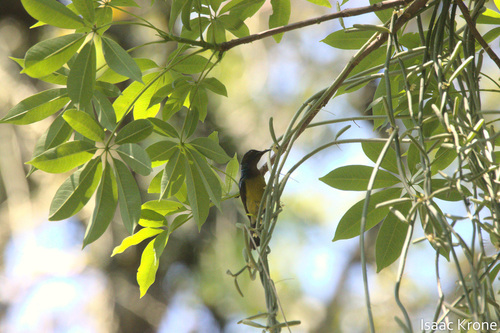 Brown-throated Sunbird
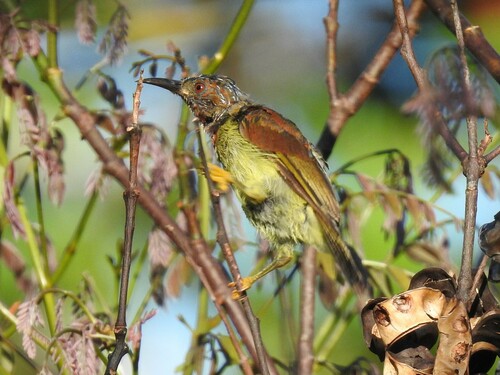 Red-throated Sunbird
In short
The most reliable way to separate Brown-throated Sunbird from Red-throated Sunbird is by focusing on plumage: male Brown-throated Sunbirds show iridescent green and purple upperparts with chestnut on the wing-coverts and scapulars, and are primarily yellow below, while Red-throated Sunbird males have a distinctive red throat (not present in Brown-throated). Females of Brown-throated are olive-green above and yellowish below, but female Red-throated Sunbird field marks are not detailed in the sources, so caution is needed. Structurally, Brown-throated Sunbird is a relatively large, heavy sunbird with a thick bill, and may average slightly smaller than Red-throated based on available mass data. Habitat preference can also help: Brown-throated is found in a wider range of semi-open habitats, while Red-throated is more closely tied to lowland forests. If you see a sunbird with a red throat in suitable forest, it's likely Red-throated; otherwise, check for the chestnut wing-coverts and overall coloration for Brown-throated.
Identification tips
- Red throat in males: Only Red-throated Sunbird males have a red throat; Brown-throated males never show this feature. If you see a red-throated male, the ID is straightforward.
- Chestnut wing-coverts and scapulars: Male Brown-throated Sunbirds have chestnut on the wing-coverts and scapulars, visible when perched or in good light. Red-throated males lack this chestnut coloration.
- Iridescent green and purple upperparts: Male Brown-throated Sunbirds show a mix of iridescent green and purple on the upperparts, while Red-throated males are less described in this respect—look for the overall impression of metallic sheen and chestnut in Brown-throated.
- Yellow underparts: Brown-throated Sunbird males are primarily yellow below, which can help in poor light or partial views. Red-throated males may have less extensive yellow, but details are lacking.
- Female separation is uncertain: Female Brown-throated Sunbirds are olive-green above and yellowish below. Female Red-throated Sunbird field marks are not described, so be cautious and use habitat and association with males if possible.
- Bill structure: Brown-throated Sunbird is described as having a thick bill, which may help distinguish it from other sunbirds, but this is not compared directly to Red-throated in the sources.
- Size: Both species are similar in size, but Brown-throated may appear slightly stockier; this is not a reliable field mark.
- Habitat context: Brown-throated Sunbird is common in semi-open habitats, gardens, and edges, while Red-throated is more restricted to lowland forest. Use habitat as a supporting clue, especially if plumage is ambiguous.
- Juvenile/immature separation: No specific juvenile or immature wing or flight marks are described for either species, so rely on overall color and habitat.
- No known vocal differences: The sources do not describe vocalizations for either species, so do not use voice for separation.
- Geographic overlap: Both species can occur in the same general region, but Brown-throated is more widespread in disturbed and open areas.
- No seasonal plumage differences noted: Both species appear to retain their diagnostic features year-round, so season is not a factor.
- Beware of the "grey-throated" confusion: In the Philippines, the grey-throated sunbird is sometimes considered a subspecies of Brown-throated, but differs in measurements and plumage; this is not a confusion with Red-throated, but be aware of local variation.
- Mixed flocks: If you see both species together, males are easy to separate by throat color; females may be best left unidentified unless seen with a male.
- Lighting and angle: Iridescent colors and chestnut may be hard to see in poor light. If the throat is clearly red, it is diagnostic for Red-throated; otherwise, look for chestnut and overall coloration for Brown-throated.
Size
Brown-throated Sunbird is described as relatively large and heavy for a sunbird, with a mass range of 7.4–13.5 g and a length of about 14 cm. Red-throated Sunbird's mass is given as 13.1 g, suggesting it is at least as heavy as the largest Brown-throated individuals, possibly slightly heavier on average, but the difference is subtle and not likely to be diagnostic in the field. Both species are similar in size, but Brown-throated may appear stockier due to its thick bill.
Plumage
For adult males, Brown-throated Sunbird has iridescent green and purple upperparts, chestnut on the wing-coverts and scapulars, and is mainly yellow below. Red-throated Sunbird males are defined by a red throat, which is absent in Brown-throated. Female Brown-throated Sunbirds are olive-green above and yellowish below; there is no detailed field description for female Red-throated Sunbirds in the sources, so separation of females is uncertain. No age-specific or juvenile wing pattern differences are described for either species, so immature separation relies on overall coloration and habitat context. In all ages, absence of a red throat and presence of chestnut on the wing-coverts favors Brown-throated.
Behaviour
Both species feed primarily on nectar, but Brown-throated Sunbird is also noted to take small fruits, berries, and feeds juveniles with insects. There is no behavioral detail for Red-throated Sunbird in the sources, so behavioral differences are not diagnostic.
Habitat
Brown-throated Sunbird occupies a wide range of semi-open habitats across southeast Asia, including gardens, edges, and secondary growth. Red-throated Sunbird is more specialized, found mainly in subtropical or tropical moist lowland forests. If you encounter a sunbird in open or disturbed areas, Brown-throated is more likely; in dense, undisturbed lowland forest, Red-throated is favored.
Brown-throated Sunbird · Red-throated Sunbird · My Tricky Birds