

Brown-cheeked Rail vs Slaty-breasted Rail
Rallus indicus versus Lewinia striata
Play a quiz with Brown-cheeked Rail and Slaty-breasted Rail
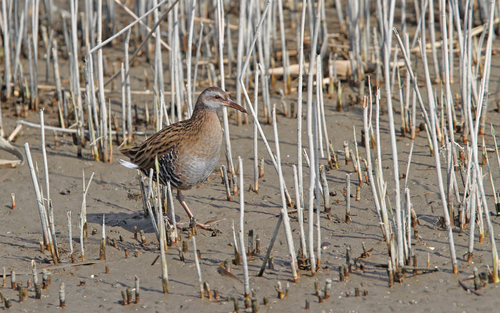 Brown-cheeked Rail
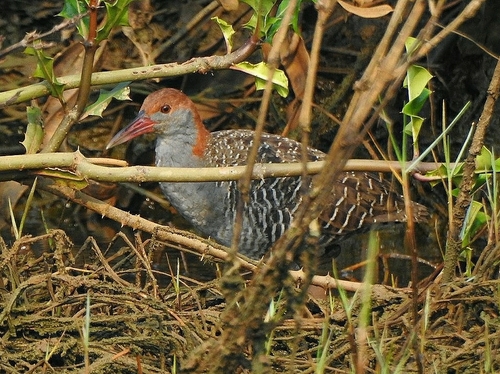 Slaty-breasted Rail
In short
The most reliable field mark between Brown-cheeked Rail and Slaty-breasted Rail is the combination of face and underpart color: Brown-cheeked Rail shows a distinct brown eyestripe and brown-tinged underparts, while Slaty-breasted Rail has a blue-grey breast and a chestnut crown/nape, lacking the brown facial stripe. In the field, Brown-cheeked Rail is paler above and browner below, with a clear brown stripe through the eye, whereas Slaty-breasted Rail stands out with its slaty-blue breast and reddish bill. Both are similar in size, but their coloration and face patterns are the quickest way to separate them. Vocalizations also differ, but are less likely to be diagnostic without experience. Habitat overlap is possible in Southeast Asia, but Brown-cheeked Rail is more migratory and northern-breeding.
Identification tips
- Face pattern is key: Brown-cheeked Rail always shows a clear brown eyestripe running through the face, while Slaty-breasted Rail lacks this and instead has a chestnut crown and nape. This is visible in all ages and seasons.
- Underpart color: Brown-cheeked Rail has brown-tinged underparts and a browner breast, with a white throat; Slaty-breasted Rail has a blue-grey (slaty) breast and more uniform underparts, lacking the brown tinge.
- Crown and nape: Slaty-breasted Rail's chestnut crown and nape are distinctive and absent in Brown-cheeked Rail, which has paler, less rufous upperparts.
- Bill color: Slaty-breasted Rail has a long, reddish bill, which contrasts with its slaty breast; Brown-cheeked Rail's bill is less distinctly colored and does not stand out as much.
- Upperparts: Brown-cheeked Rail is paler above than Slaty-breasted Rail, but darker than some western Water Rail forms; Slaty-breasted Rail is more uniformly colored above, with less contrast.
- No strong flight pattern marks: Neither species has a distinctive upperwing or flight pattern described for immatures or adults, so do not rely on in-flight wing markings for separation.
- Size is not reliable: Both species overlap in size and mass, so apparent bulk or length is not a safe separator.
- Vocalizations: If heard, Brown-cheeked Rail gives a sharp 'kyu' and metallic 'shrink, shrink' notes; Slaty-breasted Rail's calls are not described here, so only use this if you are familiar with Brown-cheeked Rail's voice.
- Habitat context: In northern Asia or during migration, Brown-cheeked Rail is more likely; in the Indian subcontinent and resident marshes of Southeast Asia, Slaty-breasted Rail is more expected, but both can overlap in winter.
- Behavior: Both skulk in dense marshes and are rarely seen in the open; behavior is not a strong separator.
- Season: Brown-cheeked Rail is a migrant, so in wintering areas, consider timing, but do not rely on this alone.
- Sex differences: No sex-specific field marks are described for either species.
- Juvenile/immature plumage: No distinctive juvenile or first-winter upperwing or body pattern is described for either species; use face and underpart color in all ages.
- When in doubt: Prioritize the combination of brown eyestripe and brown-tinged underparts (Brown-cheeked) versus chestnut crown/nape and slaty breast (Slaty-breasted).
Size
Brown-cheeked Rail is 23–29 cm in length and weighs 75–190 g, while Slaty-breasted Rail is slightly larger on average at 25–30 cm and 100–142 g. In practice, both appear as medium-sized rails and size alone is not a reliable separator, as their ranges overlap and individual variation is considerable. Bill length and body bulk are not distinctly different enough to be diagnostic in the field.
Plumage
For all ages, Brown-cheeked Rail shows paler upperparts and a brown-tinged breast, with a prominent brown eyestripe running through the face. The throat is white, contrasting with the browner breast. Slaty-breasted Rail, by contrast, has a chestnut crown and nape, a blue-grey breast, and lacks the brown eyestripe; its bill is reddish and stands out against the slaty underparts. No age-specific upperwing or flight pattern marks are described for either species, so separation relies on face and underpart color for both adults and immatures. Brown-cheeked Rail is generally darker above than similar water rail forms, but still paler than Slaty-breasted Rail. In perched or walking birds, the brown facial stripe and paler, browner underparts of Brown-cheeked Rail contrast with the more uniform, slaty-blue and chestnut pattern of Slaty-breasted Rail.
Behaviour
Both species are secretive and skulk in dense marsh vegetation, rarely flying unless flushed. Brown-cheeked Rail is noted for sometimes being so exhausted on migration that it can be caught by hand, but this is not a field mark. Feeding behavior is similar: both probe for invertebrates and seeds. There is no strong behavioral difference in foraging or movement style that is reliably diagnostic in the field.
Habitat
Brown-cheeked Rail breeds in northern Mongolia, eastern Siberia, northeast China, Korea, and northern Japan, wintering in southeast Asia, and is uncommon further south. Slaty-breasted Rail is native to the Indian subcontinent and Southeast Asia. Both can be found in marshes and wetlands, so habitat alone is not a strong separator in overlapping wintering grounds, but Brown-cheeked Rail is more migratory and northern-breeding, while Slaty-breasted Rail is more resident in the south.
Voice
Brown-cheeked Rail has a sharp piping 'kyu' courtship call, longer and clearer than the European Water Rail, and a song of metallic, slurred 'shrink, shrink' notes, about two per second. Its calls are quite different from western Water Rail and not responded to by them. No detailed vocal description is given for Slaty-breasted Rail here, so voice is only diagnostic if the distinctive 'kyu' or 'shrink' calls are heard from Brown-cheeked Rail. In practice, vocalizations are useful only if well known to the observer.