

Brown-capped Tyrannulet vs Southern Beardless-Tyrannulet
Ornithion brunneicapillus versus Camptostoma obsoletum
Play a quiz with Brown-capped Tyrannulet and Southern Beardless-Tyrannulet
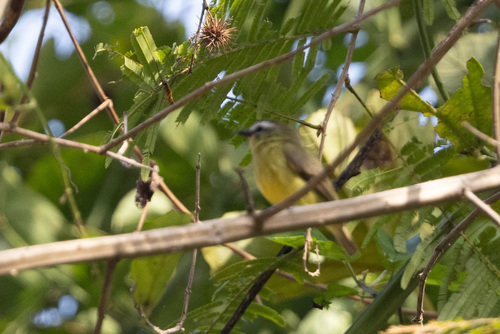 Brown-capped Tyrannulet
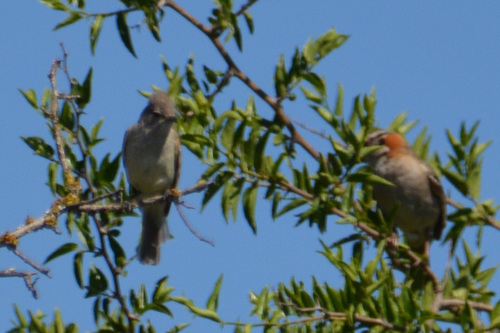 Southern Beardless-Tyrannulet
In short
The most reliable field mark between Brown-capped Tyrannulet and Southern Beardless-Tyrannulet is the crown and face pattern: Brown-capped Tyrannulet shows a distinctly brownish olive to dark brown crown with a white supercilium and forehead, while Southern Beardless-Tyrannulet has a grayish crown (often bushy) and a broken white eyering. Juvenile Brown-capped Tyrannulet has a less distinct supercilium and paler yellow underparts, while juvenile Southern Beardless-Tyrannulet is overall duller and browner with pale buffish underparts. Both are small flycatchers, but Southern Beardless-Tyrannulet is slightly longer and may show more obvious wing bars. Bill color and structure also differ subtly, with Brown-capped Tyrannulet having a black, arched bill and Southern Beardless-Tyrannulet a horn-colored maxilla and orangish or pinkish mandible. Use a combination of crown color, face pattern, and wing bar prominence for the most reliable separation, especially in perched birds.
Identification tips
- Crown Color: Brown-capped Tyrannulet has a brownish olive to dark brown crown (adults), while Southern Beardless-Tyrannulet's crown is grayish and often bushy with dark centers. This is the most reliable mark in good light.
- Supercilium and Forehead: Brown-capped Tyrannulet shows a white supercilium and white forehead, contrasting with the brown crown. Southern Beardless-Tyrannulet has white lores and a broken white eyering, but lacks a strong supercilium or white forehead.
- Wing Bars: Southern Beardless-Tyrannulet has two wide, cinnamon or creamy wing bars on the closed wing (adults and most subspecies), which are prominent in perched birds and sometimes visible in flight. Brown-capped Tyrannulet's wing bars are less distinct, especially in juveniles, and never as bold.
- Juvenile Plumage: Juvenile Brown-capped Tyrannulet is more olive-crowned and has a less distinct supercilium, with paler yellow underparts. Juvenile Southern Beardless-Tyrannulet is duller, browner, and has pale buffish underparts, often lacking clear facial markings.
- Bill Structure and Color: Brown-capped Tyrannulet has a black, arched maxilla, while Southern Beardless-Tyrannulet has a horn-colored upper bill and a dull orangish or pinkish lower mandible. This is subtle but can be seen at close range.
- Face Pattern: Brown-capped Tyrannulet's face is olive with a white supercilium; Southern Beardless-Tyrannulet's face is grayish white with a broken eyering and white lores.
- Underparts: Brown-capped Tyrannulet has bright yellow underparts with faint olive streaks on the breast and flanks. Southern Beardless-Tyrannulet is paler yellow below, with a grayish white throat and a faint olive wash on the breast.
- Upperparts: Brown-capped Tyrannulet is olive above; Southern Beardless-Tyrannulet is medium olive-gray above, sometimes with a warmer or grayer cast depending on subspecies.
- Tail: Both have dusky or olive tails; not a strong separator.
- Size: Southern Beardless-Tyrannulet is slightly longer (9.5–10.5 cm vs. 8 cm), but both are tiny and overlap in mass.
- Leg Color: Both have gray legs and feet; not useful for separation.
- Behavior: Southern Beardless-Tyrannulet may flick its wings more, making the wing bars more obvious, and can appear more warbler-like due to its longer bill.
- Habitat: Southern Beardless-Tyrannulet is more likely in open or disturbed habitats, but both occur in edge and second growth; do not rely on habitat alone where ranges overlap.
- Subspecies Variation: Southern Beardless-Tyrannulet shows considerable subspecific variation in upperpart and underpart color, but always lacks a brown crown. Brown-capped Tyrannulet is more consistent in appearance.
- Pitfalls: Immature Brown-capped Tyrannulet can look duller and less distinct, but should still show some supercilium and olive tones. Southern Beardless-Tyrannulet juveniles are plainer and browner, with less facial contrast.
Size
Brown-capped Tyrannulet averages about 8 cm in length and 7.5 g in mass, making it a very small flycatcher. Southern Beardless-Tyrannulet is slightly larger, at 9.5–10.5 cm and 7–9 g. In the field, this size difference is subtle and may not be apparent unless both species are seen side by side. Both are lightweight and compact, but Southern Beardless-Tyrannulet may appear a bit longer-bodied, especially when perched.
Plumage
-
Juveniles: Juvenile Brown-capped Tyrannulet shows a more olive (less brown) crown, a less distinct supercilium, paler tips on the wing coverts, and paler yellow underparts. Juvenile Southern Beardless-Tyrannulet is overall duller and browner than adults, with pale buffish white underparts. Both lack strong adult contrast, but Brown-capped Tyrannulet juveniles retain some supercilium and a more olive face, while Southern Beardless-Tyrannulet juveniles are plainer and browner.
-
Adults: Brown-capped Tyrannulet adults have a brownish olive to dark brown crown, white forehead, lores, and supercilium, olive upperparts, dusky olive wings and tail, and bright yellow underparts with faint olive streaks on the breast and flanks. Southern Beardless-Tyrannulet adults (nominate) have a grayish crown and nape (often bushy with dark centers), white lores, a broken white eyering, medium olive-gray upperparts and tail, dusky wings with whitish to creamy edges on the inner flight feathers, and two wide cinnamon-tipped wing bars. Underparts are grayish white on the throat, mostly pale yellow below with a faint olive wash on the breast. Subspecies variation in Southern Beardless-Tyrannulet can shift the tone of upperparts and underparts, but the crown remains grayish (not brown), and wing bars are generally more prominent than in Brown-capped Tyrannulet.
-
Wing Pattern: Southern Beardless-Tyrannulet has two wide, often cinnamon or creamy wing bars on the closed wing (adults and most subspecies), while Brown-capped Tyrannulet's wing bars are less distinct, especially in juveniles.
Behaviour
Both species are active, restless flycatchers that forage in the mid to upper levels of trees and shrubs. Southern Beardless-Tyrannulet may appear slightly more warbler-like due to its longer, pointed bill and tendency to flick its wings, making the wing bars more visible. Brown-capped Tyrannulet, being a bit smaller and with a more compact jizz, may appear more delicate. In flight, neither species shows strikingly unique patterns, but Southern Beardless-Tyrannulet's wing bars can sometimes catch the eye as it flits between perches.
Habitat
Both species overlap broadly in Central and northern South America, including Costa Rica, Panama, Colombia, Ecuador, and Venezuela. Brown-capped Tyrannulet is more localized, while Southern Beardless-Tyrannulet is widespread across nearly all of mainland South America (except Chile) and Trinidad. Both use edge, second growth, and open woodland, but Southern Beardless-Tyrannulet is more likely in drier, open, or disturbed habitats, while Brown-capped Tyrannulet may favor slightly denser or more humid forest edges. Habitat alone is rarely diagnostic where both occur.
Brown-capped Tyrannulet · Southern Beardless-Tyrannulet · My Tricky Birds