

Bronzy Hermit vs Band-tailed Barbthroat
Glaucis aeneus versus Threnetes ruckeri
Play a quiz with Bronzy Hermit and Band-tailed Barbthroat
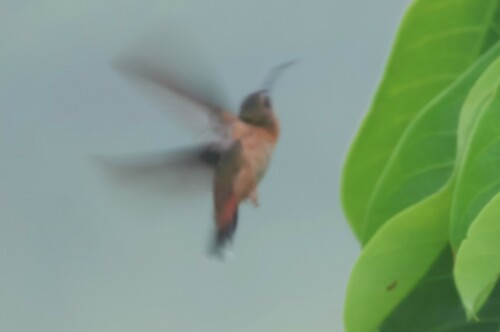 Bronzy Hermit
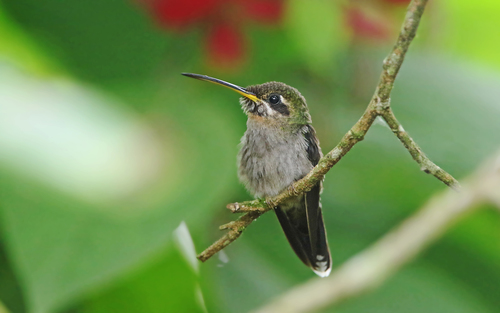 Band-tailed Barbthroat
In short
The most reliable field mark to separate Bronzy Hermit from Band-tailed Barbthroat is the tail pattern: Bronzy Hermit shows a gray-green upper tail with white tips and a reddish underside near the base, while Band-tailed Barbthroat has a dark tail with distinctive white bases and tips creating a strong black band near the end. Bill shape also differs: Bronzy Hermit has a clearly decurved bill (especially in females), whereas Band-tailed Barbthroat’s bill is nearly straight (males) or only slightly decurved (females). Both species share bronzy-green upperparts and a pale moustachial stripe, but throat and belly coloration, as well as underpart contrast, help in good light. Size and structure overlap, but Band-tailed Barbthroat is slightly larger and heavier. In flight or perched, focus on tail pattern and bill shape for the most consistent separation.
Identification tips
- Tail pattern is the single most reliable field mark: Bronzy Hermit has a gray-green upper tail with white tips and a reddish underside near the base; Band-tailed Barbthroat’s tail is dark with both white bases and tips, creating a strong black band near the end. This is visible in both perched and spread-tail views, and applies to all ages.
- Bill shape is a key structural difference: Bronzy Hermit’s bill is distinctly decurved (especially in females), while Band-tailed Barbthroat’s is nearly straight in males and only slightly decurved in females. Look for this in profile, especially when the bird is feeding or preening.
- Facial pattern: Both have a pale moustachial stripe, but Bronzy Hermit’s face is otherwise dusky, while Band-tailed Barbthroat shows a dark ear patch and chin with a dusky malar stripe. The overall effect is more contrast in Band-tailed Barbthroat’s face.
- Throat and underparts color: Bronzy Hermit has a deep buff throat and breast with a pale buff belly, giving a warm, uniform look. Band-tailed Barbthroat’s throat is ochraceous (sometimes bright orange in some subspecies), with gray underparts and some green feathers, creating more contrast between throat and belly.
- Subspecific variation in Band-tailed Barbthroat: In northern populations (T. r. ventosus), the throat can be bright orange and the belly ochraceous-tinged, but the tail pattern remains a constant separator.
- Juvenile/immature marks: Young Band-tailed Barbthroats have ochraceous feather edges, which may give a warmer, more mottled look to the underparts. Bronzy Hermit juveniles are not described as differing from adults in the notes.
- Relative size: Band-tailed Barbthroat is slightly larger and heavier, but this is subtle and not reliable unless both are seen together.
- Habitat preference: Band-tailed Barbthroat can be found in more open or disturbed habitats (shrublands, plantations), while Bronzy Hermit is more tied to humid forest and edges. In overlap zones, this may help but is not definitive.
- Vocalizations: If you hear a fast, high-pitched, multi-note song with trills, it is likely Band-tailed Barbthroat. Bronzy Hermit’s voice is not described in the notes.
- Sexual dimorphism: Both species have similar plumage in both sexes, but female Bronzy Hermit has a more strongly decurved bill, and female Band-tailed Barbthroat’s bill is only slightly more decurved than the male’s.
- Feeding behavior: Both are trap-line feeders and may rob nectar, so behavior at flowers is not a separator.
- Perched jizz: Both can look similar when perched, but the combination of bill shape and tail pattern should always be checked.
- In flight: Tail pattern is often visible in flight, especially when the bird fans its tail while hovering or landing.
- Pitfalls: Overlapping ranges and similar bronzy-green upperparts can cause confusion; always check tail and bill, not just overall color.
- When in doubt: If you cannot see the tail pattern or bill shape clearly, avoid making a positive ID, as plumage alone (especially upperparts) can be misleading.
Size
Band-tailed Barbthroat is marginally larger, measuring 10–11 cm in length and weighing 5–7 g, while Bronzy Hermit is 9–10 cm and weighs 3–6.5 g (males) or 3–6 g (females) [wikipedia]. The difference is subtle and not always obvious in the field, but Band-tailed Barbthroat can look bulkier and longer-tailed when seen side by side. Both are medium-sized for hermit hummingbirds, so size alone is rarely diagnostic unless both are together.
Plumage
Juvenile and immature plumages are not strongly differentiated between these two species in the available notes, but some age-related marks can help. Young Band-tailed Barbthroats have ochraceous feather edges, which may give a warmer or more mottled look to the throat and underparts. Adult Bronzy Hermit of all ages shows bronzy or coppery green upperparts, a deep buff throat and breast, and a pale buff belly, with a white moustache and dusky face. Its tail is gray-green above with white tips and reddish below near the base. Band-tailed Barbthroat adults have bronze-green upperparts, a dark ear patch and chin, and a dusky malar stripe; the throat is ochraceous (especially in some subspecies), and the underparts are gray with some green feathers. Its tail is dark with white bases and tips, forming a strong black band near the end—this is the most distinctive field mark in all ages. Females of both species are similar to males but with less contrast and, in Band-tailed Barbthroat, a slightly more decurved bill. Subspecific variation in Band-tailed Barbthroat can affect throat color (from ochraceous to bright orange), but the tail pattern remains consistent.
Behaviour
Both species are typical hermit hummingbirds, feeding by trap-lining circuits of flowers and occasionally robbing nectar. Band-tailed Barbthroat is noted for feeding at Heliconia and sometimes piercing the base of flowers. Both species are usually observed in the understory or at forest edges, often low to the ground. There is no strong behavioral difference in flight or feeding style that is diagnostic for separation.
Habitat
Both species overlap widely in Central America (Costa Rica, Panama, Nicaragua, Honduras, Colombia, Ecuador). Band-tailed Barbthroat has a slightly broader range, extending into Belize, Guatemala, Venezuela, and western Ecuador, and is found in a wider variety of habitats including semi-open shrublands, thickets, plantations, and forest edges up to 1,200 m elevation. Bronzy Hermit is more strictly associated with humid forest and forest edge. In areas of overlap, habitat is not a reliable separator, but Band-tailed Barbthroat may be more likely in more open or disturbed habitats.
Voice
Band-tailed Barbthroat has a distinctive song: a fast, high-pitched phrase of 5–10 notes, such as 'tzi-tzi-tsee-ee-tsi-tzi-tzi', repeated with intervals of several seconds. The Pacific slope population in Costa Rica has a more complex song with trills. No vocal description is provided for Bronzy Hermit in the notes, so voice is not a reliable separator unless Band-tailed Barbthroat’s song is heard.