

Bronze-tailed Plumeleteer vs Crowned Woodnymph
Chalybura urochrysia versus Thalurania colombica
Play a quiz with Bronze-tailed Plumeleteer and Crowned Woodnymph
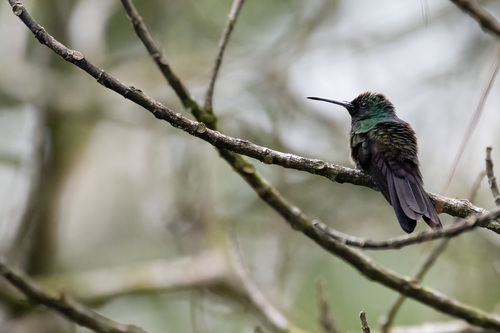 Bronze-tailed Plumeleteer
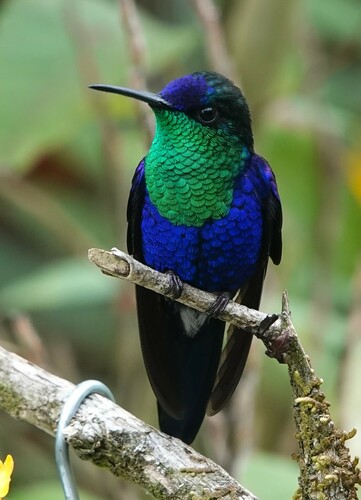 Crowned Woodnymph
In short
The most reliable field mark to separate Bronze-tailed Plumeleteer from Crowned Woodnymph is the tail: adult plumeleteers show a straight-edged, bronze- or purplish-bronze tail (never deeply forked), while adult male woodnymphs have a distinctly forked, blue-black tail. Immature birds of both species can be confusing, but the plumeleteer always has a stouter, straight bill and fluffy white or gray undertail coverts, while the woodnymph’s bill is finer and the undertail coverts are less prominent. Males of both species are glittering green, but woodnymphs add violet or blue on the crown and belly, and plumeleteers never do. Females and immatures are best separated by underpart color and tail pattern: plumeleteer females are gray below with green flecks and have outer tail feathers tipped gray, while woodnymph females are pale gray below with blue-black tails tipped white. Both species overlap in much of Central America, but the plumeleteer is heavier and bulkier, especially in direct comparison.
Identification tips
- Tail shape is the most reliable field mark in all plumages: Bronze-tailed Plumeleteer has a straight-edged, bronze or purplish-bronze tail (never forked); Crowned Woodnymph males have a deeply forked, blue-black tail. Female woodnymphs have blue-black tails with white tips on the outer three pairs of feathers, while female plumeleteers have gray-tipped outer tail feathers.
- Bill structure: Plumeleteer has a stouter, straight black bill with a dull pink to dark red base on the lower mandible (visible at close range); woodnymphs have a finer, more delicate bill, usually all black.
- Undertail coverts: Plumeleteers (both sexes) show long, fluffy white or grayish undertail coverts, especially obvious when perched or hovering; woodnymphs have less prominent, shorter undertail coverts, sometimes with white fringes only in some subspecies.
- Adult male crown and belly color: Male plumeleteers are metallic green above and below, sometimes with a blue or bronze tinge depending on subspecies, but never with violet or blue on the crown or belly. Male woodnymphs show a violet or blue crown and belly (or glittering green crown in some subspecies), with a glittering green throat and chest.
- Adult female underparts: Female plumeleteers are gray below with green flecks on the sides; female woodnymphs are pale gray on the throat and chest, darker gray on the belly, and lack green flecks except for a faint green gloss in some subspecies.
- Immature plumage: Immature plumeleteers have buffy to cinnamon fringing on the crown, nape, and rump, and their undertail coverts are always pale and fluffy; immature woodnymph males are dusky overall with limited iridescent purple, and their tails are already deeply forked and blue-black. Immature woodnymph females are dull green above and entirely pale gray below.
- Size and jizz: Plumeleteers are bulkier, heavier, and appear more robust, with a thicker bill and heavier chest; woodnymphs are smaller, lighter, and more delicate, with a finer bill and a more fluttery flight.
- Tail color in flight: Plumeleteer tails flash bronze or purplish-bronze (depending on subspecies), while woodnymph tails are blue-black and often appear darker and more contrasting with the body.
- Sexual dimorphism: Both species are sexually dimorphic, but the contrast is sharper in woodnymphs, with males showing strong violet or blue and deeply forked tails, while females are more subdued; in plumeleteers, both sexes are green above, but males are much brighter below.
- Habitat context: If seen in dense, undisturbed forest interior, plumeleteer is more likely; in more open or edge habitats, woodnymph is more likely, though both can overlap in some areas.
- Subspecies variation: Some plumeleteer subspecies (isaurae) have a blue throat and breast, but still lack the violet crown and belly of woodnymph males; woodnymph subspecies vary in the amount of violet and green, but always retain the forked tail.
- Perched posture: Plumeleteers often perch with the tail slightly drooped and undertail coverts fluffed; woodnymphs perch more upright, with the forked tail often spread or fanned.
- Feeding behavior: Plumeleteers are more aggressive and territorial at flower patches, especially Heliconia; woodnymphs are more likely to feed quickly and move on.
- Voice: Not diagnostic with current information; both species have typical hummingbird chips and trills.
- Pitfalls: Immature and female woodnymphs can look similar to female plumeleteers, but always check tail shape and undertail coverts for confirmation.
Size
Bronze-tailed Plumeleteer is noticeably larger and heavier than Crowned Woodnymph. Plumeleteer males are 10.5–12 cm long and weigh about 7.1 g, while females are about 6.1 g. In contrast, male woodnymphs are only 9.5–11.5 cm and weigh 4–5.5 g, with females even smaller at 8.5–9.2 cm and 3.5–4.2 g. In the field, this translates to a more robust, thickset impression for the plumeleteer, especially in the body and bill, compared to the more delicate, slender woodnymph.
Plumage
Immature birds of both species can be tricky, but there are key differences. Immature Bronze-tailed Plumeleteers resemble adults but have buffy to cinnamon fringing on the crown, nape, and rump; their undertail coverts remain fluffy and pale. Immature woodnymph males have dusky (not green or violet) crown, throat, and underparts, with only limited iridescent purple, and their tails are already deeply forked and blue-black. Immature woodnymph females are dull green above and entirely pale gray below, with blue-black tails tipped white. In adults, male plumeleteers are metallic green above and below with a bronze or purplish-bronze tail (straight-edged), while male woodnymphs have a violet or blue crown and belly, glittering green chest, and a deeply forked blue-black tail. Female plumeleteers are metallic green above, gray below with green flecks, and have grayish white undertail coverts and gray-tipped outer tail feathers; female woodnymphs are bright green above, pale gray throat and chest, darker gray belly, and blue-black tails with white tips on the outer three pairs of feathers.
Behaviour
Both species are active, aggressive hummingbirds, but the plumeleteer is especially known for defending patches of Heliconia and other rich nectar sources, often in the forest understory to mid-strata. The woodnymph is also active in similar strata but is generally less aggressive and more likely to be seen flitting rapidly between flowers. In flight, the plumeleteer appears heavier and more direct, while the woodnymph is lighter and more agile, with a more fluttery, erratic flight style.
Habitat
Both species occur in humid forest and mature secondary growth, but the Bronze-tailed Plumeleteer is more tied to the interior and edges of dense forest and avoids open areas. It can be found from sea level up to 700 m in Costa Rica and up to 900 m in Colombia. The Crowned Woodnymph has a broader range, from Belize and Guatemala south to northern Peru, and is more tolerant of semi-open habitats, including gardens and plantations, though it also favors forest edges and clearings. Local abundance may overlap, but the plumeleteer is more likely in denser, less disturbed forest.
Bronze-tailed Plumeleteer · Crowned Woodnymph · My Tricky Birds