

Bristle-thighed Curlew vs Whimbrel
Numenius tahitiensis versus Numenius phaeopus
Play a quiz with Bristle-thighed Curlew and Whimbrel
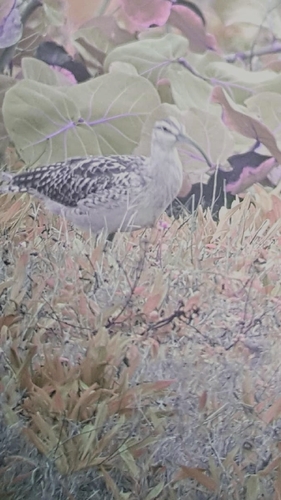 Bristle-thighed Curlew
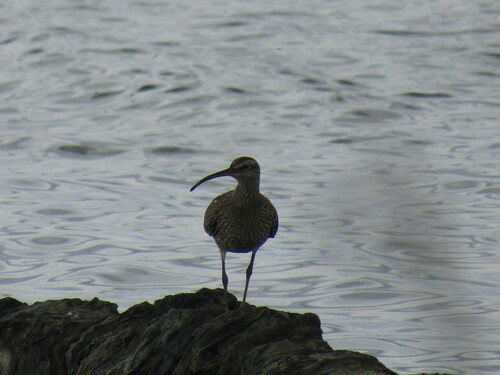 Whimbrel
In short
The most reliable field mark to separate Bristle-thighed Curlew from Whimbrel is the color of the rump and tail in flight: Bristle-thighed Curlew shows a pale buffy-orange rump and tail, while Whimbrel (Eurasian) has a mainly white rump or, in New World birds, a rump similar to the rest of the upperparts. Bristle-thighed Curlew also has larger, buffier upperpart spots, a plain light belly, and barely marked flanks, compared to Whimbrel's more streaked underparts. Both species are similar in size and general shape, but careful attention to rump, tail, and underpart pattern is key, especially on birds in flight or at a distance. Structure and bill shape are very similar, so plumage marks are essential for confident separation.
Identification tips
- Rump and tail color in flight (all ages): Bristle-thighed Curlew shows a pale buffy-orange rump and tail, while Eurasian Whimbrel has a white rump (Europe/Asia) or a brown rump matching the upperparts (New World). This is the single most reliable field mark when birds are airborne or preening.
- Upperpart spotting (all ages): Bristle-thighed Curlew has larger, more prominent buff spots on the upperparts, giving a more patterned and 'spotted' look. Whimbrel is more uniformly grey-brown and finely streaked.
- Underpart pattern (all ages): Bristle-thighed Curlew has a plain, unmarked light belly and barely marked flanks. Whimbrel shows more streaking or barring on the underparts, especially on the flanks.
- Tail color (all ages): Bristle-thighed Curlew's tail is rust-colored or buffy, not white or brown like Whimbrel's. This is best seen in flight or when the tail is fanned.
- Leg feathering (adults): Bristle-thighed Curlew has bristled feathers at the base of the legs, but this is rarely visible in the field and not a practical separator.
- Bill shape and length: Both species have long, decurved bills of similar length and shape. Bill is not a helpful field mark for separating these two.
- Head pattern: Both show similar head stripes; this is not a reliable separator.
- Size and structure: Both are similar in size and overall build. Do not rely on size to separate them.
- Habitat and range: Bristle-thighed Curlew winters on remote Pacific islands and breeds in Alaska; Whimbrel is widespread in Eurasia and North America. If seen on a Pacific island in winter, Bristle-thighed Curlew is likely; elsewhere, check plumage carefully.
- Behavior: Both species forage by probing and can be wary. No behavioral differences are useful for separation.
- Vocalizations: Not reliably separable by voice based on these notes.
- Pitfalls: Immature and adult Whimbrels in the New World have a brown rump, which can be confused with Bristle-thighed Curlew if not seen well. Always check for the buffy-orange tail and rump in Bristle-thighed Curlew.
- When marks fail: If rump and tail are not seen, focus on upperpart spotting and underpart streaking. If still unsure, consider range and habitat, but do not rely on these alone in areas of overlap.
- Sex and age: No strong sexual dimorphism or age-specific marks are detailed beyond the rump/tail and upperpart pattern, which apply to all ages.
- In summary: Prioritize rump and tail color in flight, then upperpart and underpart pattern. Use habitat and range only as supporting context.
Size
Both Bristle-thighed Curlew and Whimbrel are medium-to-large curlews with very similar dimensions. Bristle-thighed Curlew measures about 40–44 cm in length with a wingspan around 84 cm, while Whimbrel ranges from 37–47 cm in length and 75–90 cm in wingspan. Females of both species average slightly larger than males. In the field, size is not a reliable separator between these two, as overlap is extensive and both share the classic long-legged, long-billed curlew silhouette.
Plumage
- Juvenile/immature and adult flight views: The rump and tail are the most diagnostic: Bristle-thighed Curlew always shows a pale buffy-orange rump and tail, contrasting with the rest of the upperparts, while Eurasian Whimbrel has a white rump (in Europe/Asia) or a rump matching the brown upperparts (in New World birds).
- Upperparts: Bristle-thighed Curlew has larger, more prominent buff spots on the upperparts, giving a more patterned look, while Whimbrel is more uniformly grey-brown and finely streaked.
- Underparts: Bristle-thighed Curlew has a plain, unmarked light belly and barely marked flanks, whereas Whimbrel's underparts are more streaked or barred, especially on the flanks.
- Tail: Bristle-thighed Curlew's tail is rust-colored or buffy, not white or brown like Whimbrel's.
- Legs: Bristle-thighed Curlew has bristled feathers at the base of the legs, but this is rarely visible in the field.
- Bill: Both have long, decurved bills, but bill shape is not a reliable separator.
- Head pattern: Not highlighted as a strong separator in these notes; both have similar head stripes.
Behaviour
Both species forage by probing mud or sand for invertebrates and can be seen walking methodically across open ground. There are no strong behavioral differences highlighted in the sources that are useful for field separation. Both may be seen singly or in small groups, and both can be wary and quick to flush.
Habitat
Bristle-thighed Curlew breeds in Alaska and winters on remote tropical Pacific islands, favoring open coasts and islands during the nonbreeding season. Eurasian Whimbrel breeds across the subarctic Palearctic and Europe, using a wide range of open habitats including tundra, marshes, and coastal mudflats. In North America, Whimbrel (Hudsonian) is found on coasts and mudflats as well. If seen in the Pacific islands in winter, Bristle-thighed Curlew is the default; in Eurasia, Whimbrel is vastly more likely. However, in Alaska and on migration, both may overlap, so context helps but is not diagnostic.
Voice
No distinctive vocal differences are detailed in the notes for field separation between these two. Whimbrel is named for its rippling whistle, but Bristle-thighed Curlew's voice is not described here. Voice is not a reliable separator based on these sources.