

Blunt-winged Warbler vs Large-billed Reed Warbler
Acrocephalus concinens versus Acrocephalus orinus
Play a quiz with Blunt-winged Warbler and Large-billed Reed Warbler
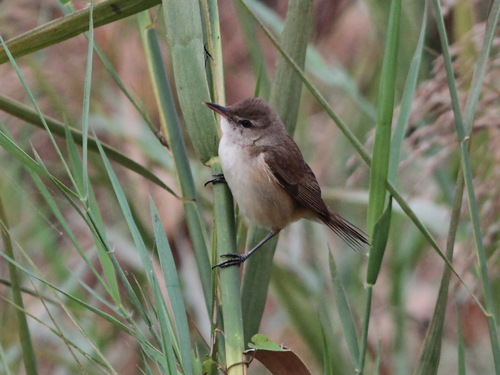 Blunt-winged Warbler
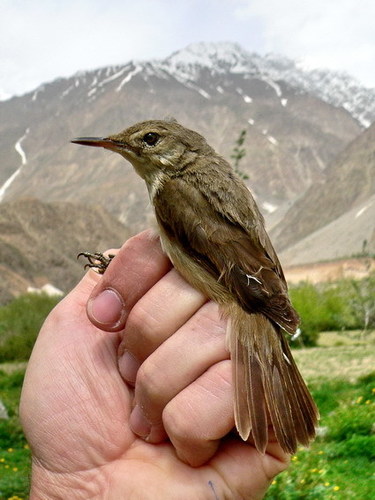 Large-billed Reed Warbler
In short
The most reliable field mark to separate Blunt-winged Warbler from Large-billed Reed Warbler is the tail and bill structure, especially in perched or foraging birds: Large-billed Reed Warbler shows a distinctly longer, more graduated and pointed tail, and a noticeably larger, paler-based bill. In flight or at rest, Large-billed Reed Warbler also tends to fan and spread its tail, accentuating the pointed feather tips, while Blunt-winged Warbler’s tail appears shorter and less graduated. Both species are plain brownish warblers, but Large-billed Reed Warbler has a paler, creamier underside and more olive-brown upperparts. Juvenile or immature-specific wing pattern differences are not described in available sources, so structure and tail shape are your best clues. Both are rare and local in the field, so context is rarely helpful.
Identification tips
- Tail Shape and Graduation: Large-billed Reed Warbler has a noticeably longer, more graduated tail with pointed, lanceolate tips. When perched or fanning its tail, this feature is obvious; Blunt-winged Warbler’s tail is shorter and less graduated, with more rounded tips. This is reliable in all plumages.
- Tail Fanning Behavior: Watch for Large-billed Reed Warbler actively fanning and spreading its tail while foraging—this accentuates the pointed, uneven tail feathers and is not typical of Blunt-winged Warbler.
- Bill Structure: The bill of Large-billed Reed Warbler is longer, stouter, and has a paler lower mandible and cutting edges, giving a heavier-headed impression. Blunt-winged Warbler’s bill is finer and more typical for a marsh-warbler.
- Overall Size and Jizz: Large-billed Reed Warbler is slightly larger and bulkier, with a longer tail and bill, while Blunt-winged Warbler is more compact. In direct comparison, the difference is subtle but can be seen with experience.
- Upperpart Color: Large-billed Reed Warbler has olive-brown upperparts, while Blunt-winged Warbler is more uniformly brown, but this difference is subtle and can be affected by light and wear.
- Underpart Color: The underside of Large-billed Reed Warbler is distinctly pale creamy, with even paler underwing and axillaries. Blunt-winged Warbler’s underparts are less contrasting, more buff or brownish.
- Tail Tip Shape: The tail feathers of Large-billed Reed Warbler are sharply pointed; Blunt-winged Warbler’s are more rounded. This is best seen on birds in the hand or with excellent views.
- Wing Structure: Large-billed Reed Warbler has short, rounded wings, which may give a slightly different flight silhouette, but this is subtle and not always reliable in the field.
- Perched Posture: Large-billed Reed Warbler often appears longer-tailed and heavier-billed when perched upright, while Blunt-winged Warbler is more compact and less 'heavy-headed.'
- Bill Color: Look for the pale lower mandible and cutting edges on Large-billed Reed Warbler, especially in good light; Blunt-winged Warbler’s bill is more uniformly dark.
- Habitat Context: Both species occur in marshy or reedbed habitats, but Large-billed Reed Warbler is extremely rare and localized; if seen outside known range or season, consider the likelihood of confusion.
- No Distinctive Juvenile Wing Pattern: There are no described age-specific upperwing or flight pattern marks to separate juveniles or immatures of these species, so rely on structure and tail shape at all ages.
- No Reliable Vocal Differences: No vocalizations are described in the available notes, so do not use song or call for separation.
- Beware of Lighting: Plumage tones (olive-brown vs. plain brown) can be misleading in poor light; structural features are more reliable.
- Direct Comparison is Best: If both species are present, direct comparison of tail graduation, bill size, and overall jizz is the most reliable approach; otherwise, focus on the combination of long, pointed tail and heavy bill for Large-billed Reed Warbler.
Size
Large-billed Reed Warbler is slightly larger overall, with a total length of about 130 mm (5 in), a tail of 58 mm (2.3 in), and a wing of 61 mm (2.4 in) [wikipedia]. Blunt-winged Warbler’s measurements are not specified in the available notes, but it is generally considered smaller and more compact within Acrocephalus. The bill of Large-billed Reed Warbler is notably longer (20 mm from gape) and stouter, giving it a heavier-headed look compared to the more typical, finer-billed Blunt-winged Warbler.
Plumage
- Juvenile and Immature Plumage: No age-specific upperwing or flight pattern differences are described in the available sources for either species.
- Adult Plumage: Large-billed Reed Warbler has olive-brown upperparts and visible portions of wings and tail, with a distinctly pale creamy underside and even paler underwing and axillaries. The tail feathers are pointed and more acutely lanceolate than in Blunt-winged Warbler, and the tail is more obviously graduated (difference between longest and shortest tail feathers is about 10 mm). The bill is dark above but pale on the cutting edges and lower mandible. Blunt-winged Warbler is described only as a typical marsh-warbler, suggesting plain brownish upperparts and less contrast between upper and underparts. No distinctive wing panels, tertial edges, or contrasting flight marks are noted for either species.
Behaviour
Large-billed Reed Warbler is noted for its habit of fanning and spreading its tail while foraging, which accentuates the pointed, graduated tail feathers. This behavior is not described for Blunt-winged Warbler, which is likely to behave more like a typical Acrocephalus, moving through reeds and low vegetation without obvious tail fanning. No specific flight style differences are described, but the short and rounded wings of Large-billed Reed Warbler may give it a more fluttery, less direct flight compared to other reed warblers.
Habitat
Both species are associated with marshy or reedbed habitats, but detailed habitat preferences are not described in the provided notes. Large-billed Reed Warbler is extremely rare and localized, with breeding sites confirmed in Central Asia and migration through the Himalayas, wintering in northern India and Southeast Asia. Blunt-winged Warbler is a typical marsh-warbler, likely to be found in similar wetland habitats but is not as globally rare or restricted as Large-billed Reed Warbler.
Blunt-winged Warbler · Large-billed Reed Warbler · My Tricky Birds