

Blue-headed Parrot vs White-crowned Parrot
Pionus menstruus versus Pionus senilis
Play a quiz with Blue-headed Parrot and White-crowned Parrot
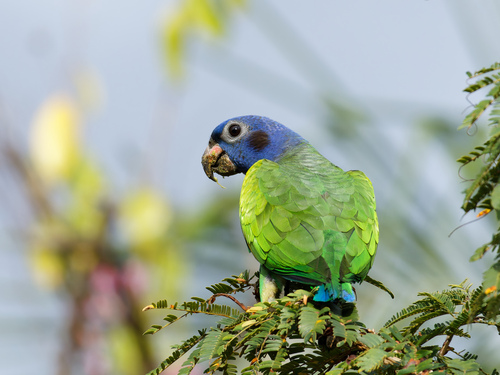 Blue-headed Parrot
 White-crowned Parrot
In short
The most reliable field mark to separate Blue-headed Parrot from White-crowned Parrot is the color of the head: adult Blue-headed Parrots have a bright blue head and neck, while adult White-crowned Parrots show a crisp white crown, forehead, and lores, with the rest of the head mostly green or blue-tinged. Immature birds are trickier: juvenile Blue-headed Parrots have less blue on the head and may show reddish or pinkish feathers around the cere, while juvenile White-crowned Parrots lack the white crown entirely, instead showing a green head with pale yellowish cheeks and crown. Both species have red undertail coverts, but wing and body coloration differ in detail. Structure and size are similar, but Blue-headed is slightly larger and heavier. Habitat overlap is limited, with Blue-headed Parrot found mainly in South America and southern Central America, and White-crowned Parrot restricted to Central America and southern Mexico.
Identification tips
- Head color (adults): Blue-headed Parrot always shows a bright blue head and neck, while White-crowned Parrot has a crisp, pure white crown, forehead, and lores with the rest of the head greenish or blue-tinged. This is the single most reliable mark in adults.
- Head color (juveniles): Juvenile Blue-headed Parrots have mostly green heads with little blue and may show reddish or pinkish feathers around the cere. Juvenile White-crowned Parrots lack any white on the crown, instead showing a green head with pale yellowish cheeks and crown. Immature birds of both species can be confusing, but the absence of white on the crown rules out adult White-crowned.
- Throat and chin: White-crowned Parrot has a white patch on the chin and center of throat, visible even when the crown is partly obscured. Blue-headed Parrot lacks this, with the throat matching the blue of the head or green of the body.
- Ear patches: Blue-headed Parrot has dark ear patches contrasting with the blue head; White-crowned Parrot's ear region is greenish with blue or purple feather tips, but not distinctly darker.
- Wing coverts: Blue-headed Parrot shows yellowish tones on the wing coverts, while White-crowned Parrot's lesser and median coverts are reddish-brown with pale tips, giving a spotty appearance in perched birds and a brown-patched look in flight.
- Back and mantle: White-crowned Parrot has a reddish-brown mantle and back, contrasting with the green scapulars and rump. Blue-headed Parrot's back is green, matching the rest of the body.
- Bill color: Blue-headed Parrot has a black upper mandible with reddish sides; White-crowned Parrot's bill is yellowish with a slight greenish tinge. Bill color can be subtle but helps at close range.
- Undertail coverts: Both species have red undertail coverts, so this is not a safe separator.
- Flight views: In flight, White-crowned Parrot shows brown patches in the upperwing and a spotty effect, while Blue-headed Parrot's wing is more uniformly green with yellowish coverts. Both species show red undertail coverts in flight.
- Juvenile confusion: Immature Blue-headed Parrots may be mistaken for White-crowned if the blue hood is not fully developed, but the lack of any white on the crown and presence of reddish feathers around the cere point to Blue-headed. Juvenile White-crowned Parrots lack white on the crown and have yellowish cheeks, not blue.
- Size: Blue-headed Parrot is slightly larger and heavier, but this is rarely obvious unless birds are side by side.
- Habitat and range: If seen in South America (outside Panama/Costa Rica), it is almost certainly Blue-headed Parrot. In Mexico or northern Central America, only White-crowned Parrot occurs. In Panama and Costa Rica, both are possible, so use plumage marks.
- Voice: Blue-headed Parrot gives high-pitched squeaky calls, while White-crowned Parrot's call is a harsher screech. This can help with experience but is not always diagnostic.
- Sexes: Both species are sexually monomorphic; male and female look alike.
- Behavior: Both are social, wary, and often seen in small flocks, so behavior is not a reliable separator.
Size
Blue-headed Parrot is the larger and heavier of the two, reaching about 27–28 cm in length and weighing up to 245 g, while White-crowned Parrot is smaller at about 24 cm and 212 g [wikipedia][wikidata]. Both are medium-sized, broad-bodied parrots with short tails, but the size difference is subtle and not always reliable in the field unless seen side by side.
Plumage
- Juvenile/immature birds:
- Juvenile Blue-headed Parrots have mostly green heads with only a little blue, and often show red or pinkish feathers around the cere. The blue hood develops gradually, taking up to two years to reach full intensity.
- Juvenile White-crowned Parrots lack the white crown entirely; their head, hindneck, and breast are green, with light yellowish cheeks and crown.
- Adults:
- Blue-headed Parrot: Bright blue head, neck, and upper breast; body mostly green; red undertail coverts; yellowish on wing coverts; dark ear patches; black upper mandible with reddish sides.
- White-crowned Parrot: Pure white crown, forehead, lores, chin, and center of throat; rest of head green with bluish and purplish feather tips; mantle and back reddish-brown; green belly; red undertail coverts; violet-blue primary coverts and green greater coverts; lesser and median coverts reddish-brown with pale tips, giving a spotty wing appearance; rump and upper tail coverts brighter green.
- Flight views: Both show red undertail coverts, but White-crowned Parrot's upperwing has brown patches and a spotty look, while Blue-headed Parrot's wing is more uniformly green with yellowish coverts.
Behaviour
Both species are social and often seen in small flocks or pairs. Blue-headed Parrots are noisy, especially at roosts, and may gather in large numbers at dawn and dusk. White-crowned Parrots are also social but more cautious, often flying off with loud screeches when disturbed. Both climb branches while feeding and are wary in the canopy. No major behavioral differences are diagnostic for field separation.
Habitat
Blue-headed Parrot is mainly found in humid and semi-humid forests and semi-open country in tropical South America, extending into southern Central America (Costa Rica, Panama, Trinidad, Venezuela, Bolivia, Brazil). It avoids the Andes spine and is largely Amazonian, with some disjunct coastal populations. White-crowned Parrot is restricted to Central America, from eastern Mexico to western Panama, in lowlands and foothills up to 1600 m, favoring forest edges, canopy, and adjacent second growth. Overlap is limited to southern Central America (Costa Rica, Panama), so context can help, but is not always diagnostic.
Voice
Blue-headed Parrot gives high-pitched, squeaky 'sweenk' calls and is generally noisy at roosts. White-crowned Parrot has a harsher, screeching call, described as 'kreeek-kreeek' or 'kree-ah-kee-ah', especially in flight. Both can be silent while perched in the canopy. Voice can help with experience, but overlap in harshness and volume means it's not always reliable for quick separation.