

Blue-headed Parrot vs White-crowned Parrot
Pionus menstruus contro Pionus senilis
Fai un quiz con Blue-headed Parrot e White-crowned Parrot
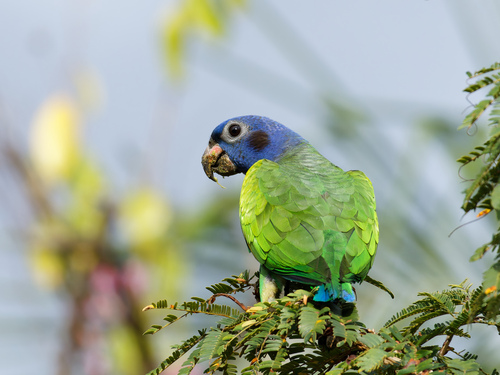 Blue-headed Parrot
 White-crowned Parrot
In breve
Il segno di campo più affidabile per separare il Blue-headed Parrot dal White-crowned Parrot è il colore della testa: i Blue-headed Parrots adulti hanno una testa e un collo blu brillante, mentre i White-crowned Parrots adulti mostrano una corona bianca netta, fronte e lore, con il resto della testa per lo più verde o bluastro. Gli uccelli immaturi sono più complicati: i Blue-headed Parrots juvenili hanno meno blu sulla testa e possono mostrare piume rossastre o rosa attorno al cere, mentre i White-crowned Parrots juvenili non hanno affatto la corona bianca, mostrando invece una testa verde con guance e corona giallastre chiare. Entrambe le specie hanno copritail rosse, ma la colorazione delle ali e del corpo differisce nei dettagli. La struttura e la dimensione sono simili, ma il Blue-headed è leggermente più grande e pesante. La sovrapposizione degli habitat è limitata, con il Blue-headed Parrot trovato principalmente in Sud America e nel sud dell'America Centrale, e il White-crowned Parrot limitato all'America Centrale e al sud del Messico.
Consigli di identificazione
- Colore della testa (adulti): Il Blue-headed Parrot mostra sempre una testa e un collo blu brillante, mentre il White-crowned Parrot ha una corona bianca netta, fronte e lore con il resto della testa verde o bluastro. Questo è il segno più affidabile negli adulti.
- Colore della testa (juvenili): I Blue-headed Parrots juvenili hanno per lo più teste verdi con poco blu e possono mostrare piume rossastre o rosa attorno al cere. I White-crowned Parrots juvenili non hanno alcun bianco sulla corona, mostrando invece una testa verde con guance e corona giallastre chiare. Gli uccelli immaturi di entrambe le specie possono essere confusi, ma l'assenza di bianco sulla corona esclude il White-crowned adulto.
- Gola e mento: Il White-crowned Parrot ha una macchia bianca sul mento e al centro della gola, visibile anche quando la corona è parzialmente oscurata. Il Blue-headed Parrot non ha questo, con la gola che corrisponde al blu della testa o al verde del corpo.
- Macchie auricolari: Il Blue-headed Parrot ha macchie auricolari scure che contrastano con la testa blu; la regione auricolare del White-crowned Parrot è verdastra con punte di piume blu o viola, ma non è distintamente più scura.
- Copritail: Il Blue-headed Parrot mostra toni giallastri sulle copritail, mentre le copritail minori e mediane del White-crowned Parrot sono marrone-rossastre con punte chiare, dando un aspetto maculato negli uccelli in posa e un aspetto maculato in volo.
- Schiena e mantello: Il White-crowned Parrot ha un mantello e una schiena marrone-rossastra, in contrasto con le scapole verdi e il sopracciglio. La schiena del Blue-headed Parrot è verde, corrispondente al resto del corpo.
- Colore del becco: Il Blue-headed Parrot ha una mandibola superiore nera con lati rossastri; il becco del White-crowned Parrot è giallastro con una leggera sfumatura verdastra. Il colore del becco può essere sottile ma aiuta a distanza ravvicinata.
- Copritail: Entrambe le specie hanno copritail rosse, quindi questo non è un separatore sicuro.
- Viste in volo: In volo, il White-crowned Parrot mostra macchie marroni nell'ala superiore e un effetto maculato, mentre l'ala del Blue-headed Parrot è più uniformemente verde con copritail giallastre.
- Confusione giovanile: I Blue-headed Parrots immaturi possono essere scambiati per White-crowned se il cappuccio blu non è completamente sviluppato, ma l'assenza di bianco sulla corona e la presenza di piume rossastre attorno al cere indicano il Blue-headed. I White-crowned Parrots juvenili non hanno bianco sulla corona e hanno guance giallastre, non blu.
- Dimensione: Il Blue-headed Parrot è leggermente più grande e pesante, ma questo è raramente ovvio a meno che gli uccelli non siano affiancati.
- Habitat e distribuzione: Se visto in Sud America (fuori da Panama/Costa Rica), è quasi certamente un Blue-headed Parrot. In Messico o nel nord dell'America Centrale, si trova solo il White-crowned Parrot. In Panama e Costa Rica, entrambi sono possibili, quindi usa i segni del piumaggio.
- Voce: Il Blue-headed Parrot emette richiami acuti e striduli, mentre il richiamo del White-crowned Parrot è un urlo più aspro. Questo può aiutare con l'esperienza ma non è sempre diagnostico.
- Sessi: Entrambe le specie sono sessualmente monomorfiche; maschio e femmina si somigliano.
- Comportamento: Entrambi sono sociali, diffidenti e spesso visti in piccoli gruppi, quindi il comportamento non è un separatore affidabile.
Taglia
Il Blue-headed Parrot è il più grande e pesante dei due, raggiungendo circa 27–28 cm di lunghezza e pesando fino a 245 g, mentre il White-crowned Parrot è più piccolo, circa 24 cm e 212 g [wikipedia][wikidata]. Entrambi sono pappagalli di dimensioni medie, dal corpo largo e con code corte, ma la differenza di dimensione è sottile e non sempre affidabile sul campo a meno che non siano visti fianco a fianco.
Piumaggio
- Uccelli juvenili/immaturi:
- I Blue-headed Parrots juvenili hanno per lo più teste verdi con solo un po' di blu e spesso mostrano piume rosse o rosa attorno al cere. Il cappuccio blu si sviluppa gradualmente, impiegando fino a due anni per raggiungere la piena intensità.
- I White-crowned Parrots juvenili non hanno affatto la corona bianca; la loro testa, collo posteriore e petto sono verdi, con guance e corona giallastre chiare.
- Adulti:
- Blue-headed Parrot: testa, collo e parte superiore del petto blu brillante; corpo per lo più verde; copritail rosse; giallastre sulle copritail; macchie auricolari scure; mandibola superiore nera con lati rossastri.
- White-crowned Parrot: corona, fronte, lore, mento e centro della gola bianchi puri; resto della testa verde con punte di piume bluastre e violacee; mantello e schiena marrone-rossastro; ventre verde; copritail rosse; copritail primarie blu-viola e copritail maggiori verdi; copritail minori e mediane marrone-rossastre con punte chiare, dando un aspetto maculato all'ala; il sopracciglio e le copritail superiori sono di un verde più brillante.
- Viste in volo: Entrambi mostrano copritail rosse, ma l'ala superiore del White-crowned Parrot ha macchie marroni e un aspetto maculato, mentre l'ala del Blue-headed Parrot è più uniformemente verde con copritail giallastre.
Comportamento
Entrambe le specie sono sociali e spesso viste in piccoli gruppi o coppie. I Blue-headed Parrots sono rumorosi, specialmente nei luoghi di riposo, e possono radunarsi in gran numero all'alba e al tramonto. I White-crowned Parrots sono anche sociali ma più cauti, spesso volando via con forti strida quando disturbati. Entrambi arrampicano rami mentre si nutrono e sono diffidenti nella chioma. Non ci sono differenze comportamentali significative diagnostiche per la separazione sul campo.
Habitat
Il Blue-headed Parrot si trova principalmente in foreste umide e semi-umide e in paesaggi semi-aperti nel Sud America tropicale, estendendosi nel sud dell'America Centrale (Costa Rica, Panama, Trinidad, Venezuela, Bolivia, Brasile). Evita la spina dorsale delle Ande ed è per lo più amazzonico, con alcune popolazioni costiere disgiunte. Il White-crowned Parrot è limitato all'America Centrale, dall'est del Messico fino all'ovest di Panama, in pianure e pendii fino a 1600 m, preferendo i margini delle foreste, la chioma e la crescita secondaria adiacente. La sovrapposizione è limitata al sud dell'America Centrale (Costa Rica, Panama), quindi il contesto può aiutare, ma non è sempre diagnostico.
Voce
Il Blue-headed Parrot emette richiami acuti e striduli 'sweenk' ed è generalmente rumoroso nei luoghi di riposo. Il White-crowned Parrot ha un richiamo più aspro e stridente, descritto come 'kreeek-kreeek' o 'kree-ah-kee-ah', specialmente in volo. Entrambi possono essere silenziosi mentre sono posati nella chioma. La voce può aiutare con l'esperienza, ma la sovrapposizione in asprezza e volume significa che non è sempre affidabile per una rapida separazione.
Blue-headed Parrot · White-crowned Parrot · I miei uccelli difficili