

Motmot

Blue-eared Kingfisher vs Banded Kingfisher

Alcedo meninting versus Lacedo pulchella

Play a quiz with Blue-eared Kingfisher and Banded Kingfisher
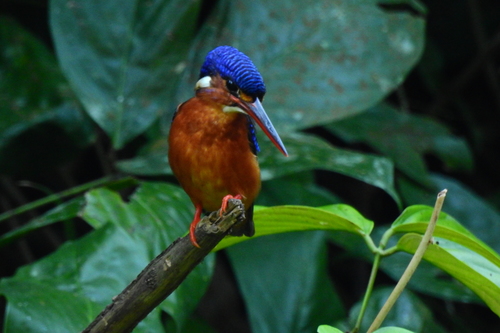
Blue-eared Kingfisher (Alcedo meninting) Blue-eared Kingfisher
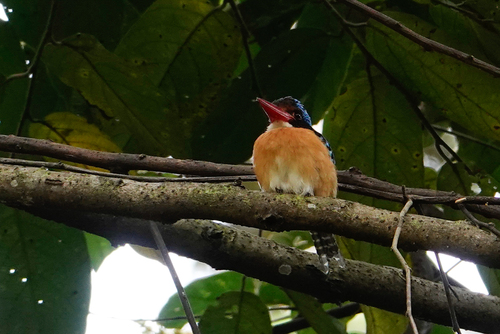
Banded Kingfisher (Lacedo pulchella) Banded Kingfisher

Media

Loading…

In short

The most reliable field mark to separate Blue-eared Kingfisher from Banded Kingfisher is the presence of blue ear coverts and a small, compact kingfisher shape in Blue-eared, versus the larger size, prominent short crest, and striking sexual dimorphism of Banded Kingfisher. Juvenile Blue-eared Kingfishers can show rufous ear-coverts (like Common Kingfisher), but Banded Kingfisher juveniles are always duller, with a brown-orange bill and dusky barring. In adults, Blue-eared Kingfisher is a small, dark-crowned, intensely cobalt bird with rich rufous underparts and no crest, while Banded Kingfisher males are boldly blue-capped with chestnut face and blue-banded upperparts, and females are heavily banded rufous-and-black above. Bill color and shape, head pattern, and habitat context are also strong clues.

Identification tips

  1. Juvenile Blue-eared Kingfisher: Look for mottled throat and upper breast, rufous ear-coverts (like Common Kingfisher), and a reddish bill with whitish tips. Banded Kingfisher juveniles never show blue ear coverts or this compact shape.
  2. Adult Blue-eared Kingfisher: Diagnostic blue ear coverts, dark crown, intense cobalt-blue upperparts, and rich rufous underparts. No crest. Bill all dark in males, reddish lower mandible in females.
  3. Adult Banded Kingfisher (male): Bright blue cap, chestnut face and nape, blue-banded black upperparts, white belly, and a thick, sturdy red bill. Short crest often raised. Never shows blue ear coverts.
  4. Adult Banded Kingfisher (female): Rufous and black banded upperparts, white underparts with black barring on chest and flanks, thick red bill, and short crest. No blue on the ear coverts or crown.
  5. Bill color and shape: Blue-eared Kingfisher has a proportionally smaller, finer bill (dark in males, bicolored in females). Banded Kingfisher of both sexes has a thick, long, bright red bill, even in juveniles (though duller).
  6. Crest: Only Banded Kingfisher shows a short, often raised crest. Blue-eared Kingfisher always appears smooth-headed.
  7. Size and structure: Blue-eared Kingfisher is small and compact (16 cm), while Banded Kingfisher is noticeably larger and more robust (20 cm), with a heavier jizz.
  8. Head pattern: Blue-eared Kingfisher has a dark crown and blue ear coverts; Banded Kingfisher males have a blue cap and chestnut face, females have rufous-black banded head.
  9. Underparts: Blue-eared Kingfisher is rich rufous below (except white throat), Banded Kingfisher male is rufous on breast/flanks with white belly, female is white with black barring.
  10. Upperparts: Blue-eared Kingfisher is intense cobalt overall; Banded Kingfisher male is blue-banded black, female is rufous-black banded.
  11. Habitat: Blue-eared is tied to dense, shaded forest streams; Banded is in lowland forest, often away from water.
  12. Behavior: Blue-eared perches low over water, Banded perches higher, often upright, and responds to calls.
  13. Vocalization: Only Banded Kingfisher gives a distinctive whistled call; Blue-eared is mostly silent.
  14. Sexual dimorphism: Banded Kingfisher sexes look very different; Blue-eared Kingfisher sexes are similar except bill color.
  15. Common pitfalls: Juvenile Blue-eared can be confused with Common Kingfisher, but not Banded Kingfisher. If you see a kingfisher with a crest or thick red bill, it's Banded. If you see blue ear coverts and no crest, it's Blue-eared.

Size

Blue-eared Kingfisher is a compact, small kingfisher (about 16 cm), noticeably smaller and more delicate than Banded Kingfisher, which is larger and sturdier at 20 cm. The Banded Kingfisher has a heavier, more robust build and a thicker, longer red bill, while Blue-eared is daintier with a proportionally smaller bill. These size and structure differences are obvious if both species are seen in the same context, but can be subtle if seen alone.

Plumage

Juvenile Blue-eared Kingfisher can show rufous ear-coverts (like Common Kingfisher), but usually has mottling on the throat and upper breast, and a reddish bill with whitish tips. This mottling disappears in adults, which have blue ear coverts, a dark crown, intense cobalt-blue upperparts, and rich rufous underparts. Adult males have an all-dark bill, females a reddish lower mandible. Banded Kingfisher juveniles are duller than adults, with a brown-orange bill and dusky barring on the underparts, but never show blue ear coverts or a compact kingfisher shape. Adult male Banded Kingfisher is unmistakable with a bright blue cap, chestnut face and nape, blue-banded black upperparts, and a white belly. Adult female is boldly banded rufous-and-black above, with white underparts and black barring on the chest and flanks. Both sexes have a short crest that is often raised and a thick red bill. No age of Banded Kingfisher ever looks like Blue-eared Kingfisher, and vice versa, once you see the head pattern and crest.

Behaviour

Blue-eared Kingfisher typically perches quietly on low branches over shaded forest streams, diving for aquatic prey. Its movements are quick and direct, and it tends to stay close to water in dense cover. Banded Kingfisher, in contrast, is a tree kingfisher of lowland forest, often found higher in the mid-story or canopy, sometimes away from water. It is more likely to be seen perched upright, showing off its crest, and can respond to imitated calls. The Banded's foraging is less tied to water, and its posture is more upright and robust.

Habitat

Blue-eared Kingfisher is strongly associated with dense, shaded evergreen forest streams and pools, usually under 1000 m elevation, and rarely strays far from water. Banded Kingfisher is a bird of lowland tropical forest, often in drier or more open forest than Blue-eared, and is less dependent on proximity to water. If you are deep in dense forest by a shaded stream, Blue-eared is more likely; in more open or drier lowland forest, especially away from water, Banded is the default.

Voice

Banded Kingfisher has a distinctive long whistled 'wheeeoo' followed by a series of 'chiwiu' notes, repeated rapidly and fading. It is responsive to imitations. Blue-eared Kingfisher is generally quiet and not known for any distinctive call in the field, so a vocalizing kingfisher in Southeast Asian forest is far more likely to be Banded.

Submit a better description

Use the same sections as the comparison. Your text is published immediately.

The most reliable field mark to separate Blue-eared Kingfisher from Banded Kingfisher is the presence of blue ear coverts and a small, compact kingfisher shape in Blue-eared, versus the larger size, prominent short crest, and striking sexual dimorphism of Banded Kingfisher. Juvenile Blue-eared Kingfishers can show rufous ear-coverts (like Common Kingfisher), but Banded Kingfisher juveniles are always duller, with a brown-orange bill and dusky barring. In adults, Blue-eared Kingfisher is a small, dark-crowned, intensely cobalt bird with rich rufous underparts and no crest, while Banded Kingfisher males are boldly blue-capped with chestnut face and blue-banded upperparts, and females are heavily banded rufous-and-black above. Bill color and shape, head pattern, and habitat context are also strong clues.

  1. Juvenile Blue-eared Kingfisher: Look for mottled throat and upper breast, rufous ear-coverts (like Common Kingfisher), and a reddish bill with whitish tips. Banded Kingfisher juveniles never show blue ear coverts or this compact shape.
  2. Adult Blue-eared Kingfisher: Diagnostic blue ear coverts, dark crown, intense cobalt-blue upperparts, and rich rufous underparts. No crest. Bill all dark in males, reddish lower mandible in females.
  3. Adult Banded Kingfisher (male): Bright blue cap, chestnut face and nape, blue-banded black upperparts, white belly, and a thick, sturdy red bill. Short crest often raised. Never shows blue ear coverts.
  4. Adult Banded Kingfisher (female): Rufous and black banded upperparts, white underparts with black barring on chest and flanks, thick red bill, and short crest. No blue on the ear coverts or crown.
  5. Bill color and shape: Blue-eared Kingfisher has a proportionally smaller, finer bill (dark in males, bicolored in females). Banded Kingfisher of both sexes has a thick, long, bright red bill, even in juveniles (though duller).
  6. Crest: Only Banded Kingfisher shows a short, often raised crest. Blue-eared Kingfisher always appears smooth-headed.
  7. Size and structure: Blue-eared Kingfisher is small and compact (16 cm), while Banded Kingfisher is noticeably larger and more robust (20 cm), with a heavier jizz.
  8. Head pattern: Blue-eared Kingfisher has a dark crown and blue ear coverts; Banded Kingfisher males have a blue cap and chestnut face, females have rufous-black banded head.
  9. Underparts: Blue-eared Kingfisher is rich rufous below (except white throat), Banded Kingfisher male is rufous on breast/flanks with white belly, female is white with black barring.
  10. Upperparts: Blue-eared Kingfisher is intense cobalt overall; Banded Kingfisher male is blue-banded black, female is rufous-black banded.
  11. Habitat: Blue-eared is tied to dense, shaded forest streams; Banded is in lowland forest, often away from water.
  12. Behavior: Blue-eared perches low over water, Banded perches higher, often upright, and responds to calls.
  13. Vocalization: Only Banded Kingfisher gives a distinctive whistled call; Blue-eared is mostly silent.
  14. Sexual dimorphism: Banded Kingfisher sexes look very different; Blue-eared Kingfisher sexes are similar except bill color.
  15. Common pitfalls: Juvenile Blue-eared can be confused with Common Kingfisher, but not Banded Kingfisher. If you see a kingfisher with a crest or thick red bill, it's Banded. If you see blue ear coverts and no crest, it's Blue-eared.

Blue-eared Kingfisher is a compact, small kingfisher (about 16 cm), noticeably smaller and more delicate than Banded Kingfisher, which is larger and sturdier at 20 cm. The Banded Kingfisher has a heavier, more robust build and a thicker, longer red bill, while Blue-eared is daintier with a proportionally smaller bill. These size and structure differences are obvious if both species are seen in the same context, but can be subtle if seen alone.

Juvenile Blue-eared Kingfisher can show rufous ear-coverts (like Common Kingfisher), but usually has mottling on the throat and upper breast, and a reddish bill with whitish tips. This mottling disappears in adults, which have blue ear coverts, a dark crown, intense cobalt-blue upperparts, and rich rufous underparts. Adult males have an all-dark bill, females a reddish lower mandible. Banded Kingfisher juveniles are duller than adults, with a brown-orange bill and dusky barring on the underparts, but never show blue ear coverts or a compact kingfisher shape. Adult male Banded Kingfisher is unmistakable with a bright blue cap, chestnut face and nape, blue-banded black upperparts, and a white belly. Adult female is boldly banded rufous-and-black above, with white underparts and black barring on the chest and flanks. Both sexes have a short crest that is often raised and a thick red bill. No age of Banded Kingfisher ever looks like Blue-eared Kingfisher, and vice versa, once you see the head pattern and crest.

Blue-eared Kingfisher typically perches quietly on low branches over shaded forest streams, diving for aquatic prey. Its movements are quick and direct, and it tends to stay close to water in dense cover. Banded Kingfisher, in contrast, is a tree kingfisher of lowland forest, often found higher in the mid-story or canopy, sometimes away from water. It is more likely to be seen perched upright, showing off its crest, and can respond to imitated calls. The Banded's foraging is less tied to water, and its posture is more upright and robust.

Blue-eared Kingfisher is strongly associated with dense, shaded evergreen forest streams and pools, usually under 1000 m elevation, and rarely strays far from water. Banded Kingfisher is a bird of lowland tropical forest, often in drier or more open forest than Blue-eared, and is less dependent on proximity to water. If you are deep in dense forest by a shaded stream, Blue-eared is more likely; in more open or drier lowland forest, especially away from water, Banded is the default.

Banded Kingfisher has a distinctive long whistled 'wheeeoo' followed by a series of 'chiwiu' notes, repeated rapidly and fading. It is responsive to imitations. Blue-eared Kingfisher is generally quiet and not known for any distinctive call in the field, so a vocalizing kingfisher in Southeast Asian forest is far more likely to be Banded.

Discard your changes?

You have unsaved edits. If you leave now, those changes will be lost.

Blue-eared Kingfisher · Banded Kingfisher · My Tricky Birds