

Blue-and-white Flycatcher vs Hainan Blue Flycatcher
Cyanoptila cyanomelana versus Cyornis hainanus
Play a quiz with Blue-and-white Flycatcher and Hainan Blue Flycatcher
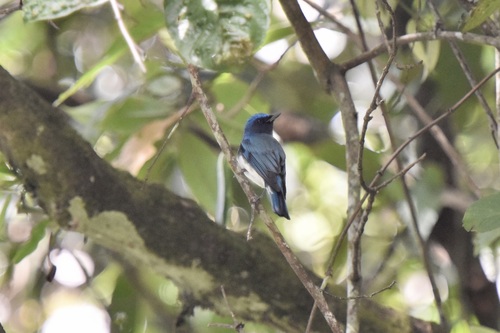 Blue-and-white Flycatcher
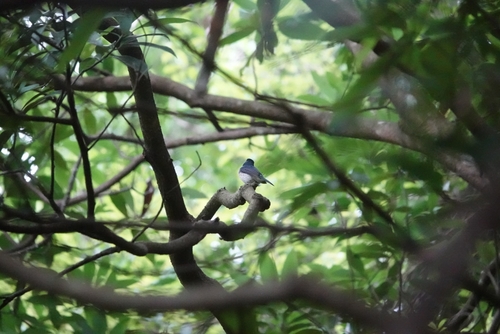 Hainan Blue Flycatcher
In short
The most reliable field mark between Blue-and-white Flycatcher and Hainan Blue Flycatcher is the male's plumage: Blue-and-white Flycatcher males show deep cobalt blue upperparts with a sharp black face and upper breast, contrasting with a clean white belly and a prominent white patch at the base of the outer tail feathers. Hainan Blue Flycatcher males are also blue above, but lack the strong black face and breast, and their underparts are more uniformly colored without the stark white belly. Females and immatures of both species are brownish, but Blue-and-white Flycatcher females are larger and have a smaller-headed look. In flight or perched, focus on the tail pattern and the extent of blue and white on the underparts for the best separation.
Identification tips
- White tail patch (all ages): Blue-and-white Flycatcher shows a prominent white base to the outer tail feathers, especially visible in flight or when the tail is spread. Hainan Blue Flycatcher lacks this feature entirely.
- Adult male face and breast: Blue-and-white males have a black face and upper breast, sharply set off from the deep blue upperparts and white underparts. Hainan Blue males are blue above but do not have a black face or breast, and their underparts are less sharply divided.
- Underpart contrast (adult males): The clean, bright white belly and vent of Blue-and-white Flycatcher contrasts with the blue and black above. Hainan Blue males have more uniformly colored underparts, lacking the stark white of Blue-and-white.
- Immature male wing color: Immature Blue-and-white males show blue wings on an otherwise brown, female-like body. Hainan Blue immatures are brownish overall and do not show this blue wing patch.
- Female structure: Blue-and-white Flycatcher females are larger and have a smaller-headed, more delicate profile compared to other brown flycatchers, including Hainan Blue. This is subtle but can help with experience.
- Size and jizz: Blue-and-white is bulkier and longer-tailed, while Hainan Blue is smaller and more compact. This is most apparent when both species are seen in the same area, but can be useful for experienced observers.
- Bill and head shape: Blue-and-white Flycatcher has a proportionally larger bill and longer wings, but these are subtle in the field and best used as supporting marks.
- Habitat context: Blue-and-white is expected in temperate forests of northeast Asia, while Hainan Blue is a bird of subtropical/tropical forests further south. Out-of-range records should prompt extra caution and careful checking of plumage details.
- Song: If heard, Blue-and-white Flycatcher's song is a short, melancholic whistle. Hainan Blue's song is not described here, so do not rely on this mark unless familiar with both.
- Pitfalls with immatures: Immature Blue-and-white males can be confusing, as they combine blue wings with an otherwise brown plumage. Always check for the white tail patch and overall size.
- Perched vs. flight views: The white tail patch of Blue-and-white is most obvious in flight or when the tail is spread. If only perched views are available, focus on face pattern and underpart contrast.
- Seasonal context: Blue-and-white is migratory and may appear outside its breeding range during migration. Hainan Blue is more resident in its range. Consider time of year when assessing vagrants.
- Female confusion: Both species' females are brownish and pale below, but Blue-and-white females are larger and have a more delicate, small-headed look. Use size and structure as supporting marks.
- No reliable wing panel or upperwing pattern: Neither species is described as having a diagnostic wing panel or upperwing pattern in these notes, so focus on tail and underpart contrast.
- When in doubt: If the bird lacks a white tail patch and is small and compact, it is more likely Hainan Blue. If it shows a white tail patch and is larger with a black face (male), it is Blue-and-white.
Size
Blue-and-white Flycatcher is the larger species, averaging about 23 g in body mass and measuring 16–17 cm in length [wikidata][wikipedia]. Hainan Blue Flycatcher is distinctly smaller and more delicate, though precise measurements are not provided here. In the field, Blue-and-white often appears bulkier and longer-tailed, especially compared to the more compact Hainan Blue.
Plumage
-
Adult males: Blue-and-white Flycatcher males are deep cobalt blue above, with a black face and upper breast, and a clean white belly and vent. They also show a prominent white patch at the base of the outer tail feathers, which can be visible in flight or when the tail is spread. Hainan Blue Flycatcher males are blue above but lack the black face and breast, and their underparts are more uniformly colored, with less contrast between the throat/chest and belly.
-
Females and immatures: Both species' females are brownish above and pale below, but Blue-and-white Flycatcher females are larger and have a smaller-headed profile. Immature Blue-and-white males have blue wings but are otherwise brown like females, while young Hainan Blue Flycatchers are also brownish but lack the distinctive blue wing patch of immature Blue-and-white males. The white tail patch is a reliable mark for Blue-and-white at all ages, especially in flight.
-
Flight/wing pattern: The white base to the outer tail feathers is a unique feature of Blue-and-white Flycatcher, visible in flight or when the tail is fanned. Hainan Blue lacks this mark.
Behaviour
Both species are typical flycatchers, often sallying from perches to catch insects. Blue-and-white Flycatcher may appear more robust and deliberate in its movements, while Hainan Blue Flycatcher is generally more active and agile, reflecting its smaller size. However, behavioral differences are subtle and not usually diagnostic without close comparison.
Habitat
Blue-and-white Flycatcher breeds in temperate forests of Japan, Korea, northeastern China, and the Russian Far East, often in mature woodland. Hainan Blue Flycatcher is native to southern China, Hainan, and Indochina, preferring subtropical or tropical forest habitats. Overlap is minimal, but vagrants can occur, so habitat alone is not always conclusive.
Voice
Blue-and-white Flycatcher has a short, melancholic series of whistles. No vocal details are provided for Hainan Blue Flycatcher in these notes, so voice is not a reliable separator here.
Blue-and-white Flycatcher · Hainan Blue Flycatcher · My Tricky Birds