

Motmot

Black Paradise-Flycatcher vs Amur Paradise-Flycatcher

Terpsiphone atrocaudata versus Terpsiphone incei

Play a quiz with Black Paradise-Flycatcher and Amur Paradise-Flycatcher
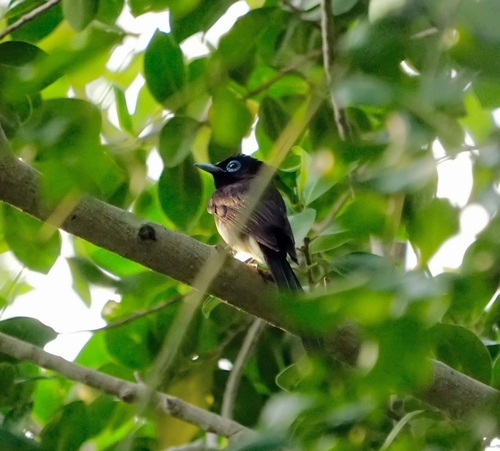
Black Paradise-Flycatcher (Terpsiphone atrocaudata) Black Paradise-Flycatcher
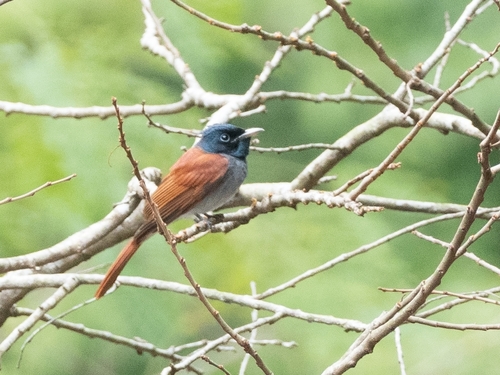
Amur Paradise-Flycatcher (Terpsiphone incei) Amur Paradise-Flycatcher

Media

Loading…

In short

The most reliable field mark to separate Black Paradise-Flycatcher from Amur Paradise-Flycatcher is the color of the upperparts: Black Paradise-Flycatcher males and females show a rich, plain chestnut back and wings, while Amur males can have either chestnut or grayish upperparts, but never as deep or plain as Black. Both have long tails and black hoods with blue eye-rings, but Black Paradise-Flycatcher is slightly smaller and lacks the white morph seen in some Amur males. Females and immatures are especially tricky, but the deeper chestnut tones and overall darker appearance of Black Paradise-Flycatcher are helpful. Always consider range and season, but plumage is key for field separation.

Identification tips

  1. Upperparts color (all ages): Black Paradise-Flycatcher shows a deep, plain chestnut back and wings in both sexes and all ages; Amur males can be chestnut (but paler and less saturated) or grayish, and females are always paler or grayish-chestnut above.
  2. Gray morph (adult male Amur only): If you see a paradise-flycatcher with grayish upperparts and a black hood, it's Amur; Black Paradise-Flycatcher never shows gray above.
  3. White morph (adult male Amur only): Black Paradise-Flycatcher never has a white morph; any white-morph paradise-flycatcher is Amur (or Asian Paradise-Flycatcher, not covered here).
  4. Tail length (breeding males): Both can have extremely long tails in breeding males, but this is not a reliable separator on its own. Immature males of Black Paradise-Flycatcher have shorter tails, as do females of both species.
  5. Hood and chest (adult males): Both have black hoods, but Black Paradise-Flycatcher has a purplish-blue gloss and blackish-grey chest, while Amur is simply black. The chest color is subtle and may not be visible in poor light.
  6. Underparts: Both have white or off-white underparts, but Black Paradise-Flycatcher may appear dingier or with more restricted white, especially in some subspecies.
  7. Eye-ring and bill: Both species have blue eye-rings and blue bills, so this is not a useful separator.
  8. Female/immature confusion: Females and immatures of both species are duller, but Black Paradise-Flycatcher is always darker and richer chestnut above, while Amur is paler or grayish. In poor light, this can be difficult, so use range and season as supporting clues.
  9. Size: Black Paradise-Flycatcher is slightly smaller and more compact, but this is rarely obvious unless birds are side by side.
  10. Range and season: In Japan and the Ryukyus during the breeding season, Black Paradise-Flycatcher is expected. In northeast China and the Russian Far East, Amur is the breeder. Both migrate through Southeast Asia, so overlap is possible in spring and fall.
  11. No distinctive juvenile wing pattern: Neither species has a unique juvenile or first-winter upperwing pattern described, so focus on upperparts color for young birds.
  12. No strong behavioral or habitat differences: Both use similar forest habitats and show similar flycatching behavior.
  13. Subspecies variation (Black Paradise-Flycatcher): Some subspecies (e.g., illex, periophthalmica) are smaller and darker, with more restricted white on the belly, but still show the deep chestnut upperparts diagnostic of the species.
  14. Migrant context: During migration in Southeast Asia, both species can occur together. Use plumage, especially upperparts color, as the primary separator.
  15. Pitfalls: Beware of lighting conditions that can make chestnut appear darker or paler. Always check multiple features, especially for females and immatures.

Size

Black Paradise-Flycatcher is slightly smaller than Amur Paradise-Flycatcher, with a measured average body mass of 18.7g [wikidata]. This difference is subtle and not always apparent in the field, especially as both species are slender, long-tailed birds. Tail length in males of both species can be strikingly long during the breeding season, but Black Paradise-Flycatcher tends to look more compact overall. Size alone is rarely diagnostic unless seen side by side.

Plumage

For adults, Black Paradise-Flycatcher males have a glossy black hood with a purplish-blue gloss, blackish-grey chest, off-white underparts, and a mantle, back, wings, and rump that are a rich, plain dark chestnut. Their extremely long black central tail feathers are a key feature in breeding males, but shorter in immatures. Females are similar but duller, with darker brown chestnut areas. Amur Paradise-Flycatcher adult males always have black hoods, white underparts, blue eye-rings, and small crests, but their upperparts can be either chestnut or grayish. The chestnut morph of Amur is paler and less saturated than Black Paradise-Flycatcher, and the gray morph is unique to Amur. Both species lack a white morph in the Black Paradise-Flycatcher, which helps rule out confusion with white Amur males. Immature and female birds are best separated by the depth and uniformity of chestnut on the upperparts: Black Paradise-Flycatcher is always deeper and plainer, while Amur is paler or grayish. No distinctive juvenile or first-winter upperwing pattern is described for either species, so focus on overall coloration.

Behaviour

Both species are active, agile flycatchers, often sallying for insects from perches in the mid to upper canopy. Their flight is graceful and somewhat undulating, with long tails trailing behind. Males of both species display their long tails during courtship and territorial flights. There are no strong behavioral differences noted between the two in the field.

Habitat

Black Paradise-Flycatcher breeds in mature broadleaf forests of Japan, Korea, Taiwan, and the northern Philippines, and migrates through Southeast Asia. Amur Paradise-Flycatcher breeds further north in China and the Russian Far East, also wintering in Southeast Asia. Both species use similar forested habitats during migration and winter, so habitat alone is not a reliable separator where ranges overlap. However, Black Paradise-Flycatcher is more likely in Japan and the Ryukyus, while Amur is more likely in northeast China and Russia.

Submit a better description

Use the same sections as the comparison. Your text is published immediately.

The most reliable field mark to separate Black Paradise-Flycatcher from Amur Paradise-Flycatcher is the color of the upperparts: Black Paradise-Flycatcher males and females show a rich, plain chestnut back and wings, while Amur males can have either chestnut or grayish upperparts, but never as deep or plain as Black. Both have long tails and black hoods with blue eye-rings, but Black Paradise-Flycatcher is slightly smaller and lacks the white morph seen in some Amur males. Females and immatures are especially tricky, but the deeper chestnut tones and overall darker appearance of Black Paradise-Flycatcher are helpful. Always consider range and season, but plumage is key for field separation.

  1. Upperparts color (all ages): Black Paradise-Flycatcher shows a deep, plain chestnut back and wings in both sexes and all ages; Amur males can be chestnut (but paler and less saturated) or grayish, and females are always paler or grayish-chestnut above.
  2. Gray morph (adult male Amur only): If you see a paradise-flycatcher with grayish upperparts and a black hood, it's Amur; Black Paradise-Flycatcher never shows gray above.
  3. White morph (adult male Amur only): Black Paradise-Flycatcher never has a white morph; any white-morph paradise-flycatcher is Amur (or Asian Paradise-Flycatcher, not covered here).
  4. Tail length (breeding males): Both can have extremely long tails in breeding males, but this is not a reliable separator on its own. Immature males of Black Paradise-Flycatcher have shorter tails, as do females of both species.
  5. Hood and chest (adult males): Both have black hoods, but Black Paradise-Flycatcher has a purplish-blue gloss and blackish-grey chest, while Amur is simply black. The chest color is subtle and may not be visible in poor light.
  6. Underparts: Both have white or off-white underparts, but Black Paradise-Flycatcher may appear dingier or with more restricted white, especially in some subspecies.
  7. Eye-ring and bill: Both species have blue eye-rings and blue bills, so this is not a useful separator.
  8. Female/immature confusion: Females and immatures of both species are duller, but Black Paradise-Flycatcher is always darker and richer chestnut above, while Amur is paler or grayish. In poor light, this can be difficult, so use range and season as supporting clues.
  9. Size: Black Paradise-Flycatcher is slightly smaller and more compact, but this is rarely obvious unless birds are side by side.
  10. Range and season: In Japan and the Ryukyus during the breeding season, Black Paradise-Flycatcher is expected. In northeast China and the Russian Far East, Amur is the breeder. Both migrate through Southeast Asia, so overlap is possible in spring and fall.
  11. No distinctive juvenile wing pattern: Neither species has a unique juvenile or first-winter upperwing pattern described, so focus on upperparts color for young birds.
  12. No strong behavioral or habitat differences: Both use similar forest habitats and show similar flycatching behavior.
  13. Subspecies variation (Black Paradise-Flycatcher): Some subspecies (e.g., illex, periophthalmica) are smaller and darker, with more restricted white on the belly, but still show the deep chestnut upperparts diagnostic of the species.
  14. Migrant context: During migration in Southeast Asia, both species can occur together. Use plumage, especially upperparts color, as the primary separator.
  15. Pitfalls: Beware of lighting conditions that can make chestnut appear darker or paler. Always check multiple features, especially for females and immatures.

Black Paradise-Flycatcher is slightly smaller than Amur Paradise-Flycatcher, with a measured average body mass of 18.7g [wikidata]. This difference is subtle and not always apparent in the field, especially as both species are slender, long-tailed birds. Tail length in males of both species can be strikingly long during the breeding season, but Black Paradise-Flycatcher tends to look more compact overall. Size alone is rarely diagnostic unless seen side by side.

For adults, Black Paradise-Flycatcher males have a glossy black hood with a purplish-blue gloss, blackish-grey chest, off-white underparts, and a mantle, back, wings, and rump that are a rich, plain dark chestnut. Their extremely long black central tail feathers are a key feature in breeding males, but shorter in immatures. Females are similar but duller, with darker brown chestnut areas. Amur Paradise-Flycatcher adult males always have black hoods, white underparts, blue eye-rings, and small crests, but their upperparts can be either chestnut or grayish. The chestnut morph of Amur is paler and less saturated than Black Paradise-Flycatcher, and the gray morph is unique to Amur. Both species lack a white morph in the Black Paradise-Flycatcher, which helps rule out confusion with white Amur males. Immature and female birds are best separated by the depth and uniformity of chestnut on the upperparts: Black Paradise-Flycatcher is always deeper and plainer, while Amur is paler or grayish. No distinctive juvenile or first-winter upperwing pattern is described for either species, so focus on overall coloration.

Both species are active, agile flycatchers, often sallying for insects from perches in the mid to upper canopy. Their flight is graceful and somewhat undulating, with long tails trailing behind. Males of both species display their long tails during courtship and territorial flights. There are no strong behavioral differences noted between the two in the field.

Black Paradise-Flycatcher breeds in mature broadleaf forests of Japan, Korea, Taiwan, and the northern Philippines, and migrates through Southeast Asia. Amur Paradise-Flycatcher breeds further north in China and the Russian Far East, also wintering in Southeast Asia. Both species use similar forested habitats during migration and winter, so habitat alone is not a reliable separator where ranges overlap. However, Black Paradise-Flycatcher is more likely in Japan and the Ryukyus, while Amur is more likely in northeast China and Russia.

Discard your changes?

You have unsaved edits. If you leave now, those changes will be lost.

Black Paradise-Flycatcher · Amur Paradise-Flycatcher · My Tricky Birds