

Black-headed Gull vs Common Gull
Chroicocephalus ridibundus versus Larus canus
Play a quiz with Black-headed Gull and Common Gull
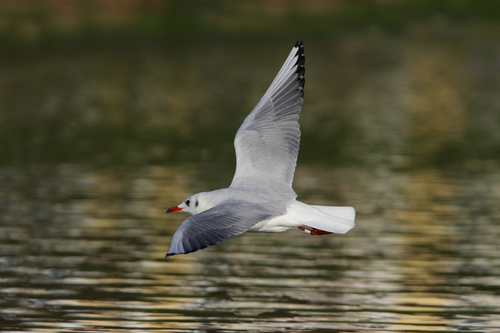 Black-headed Gull
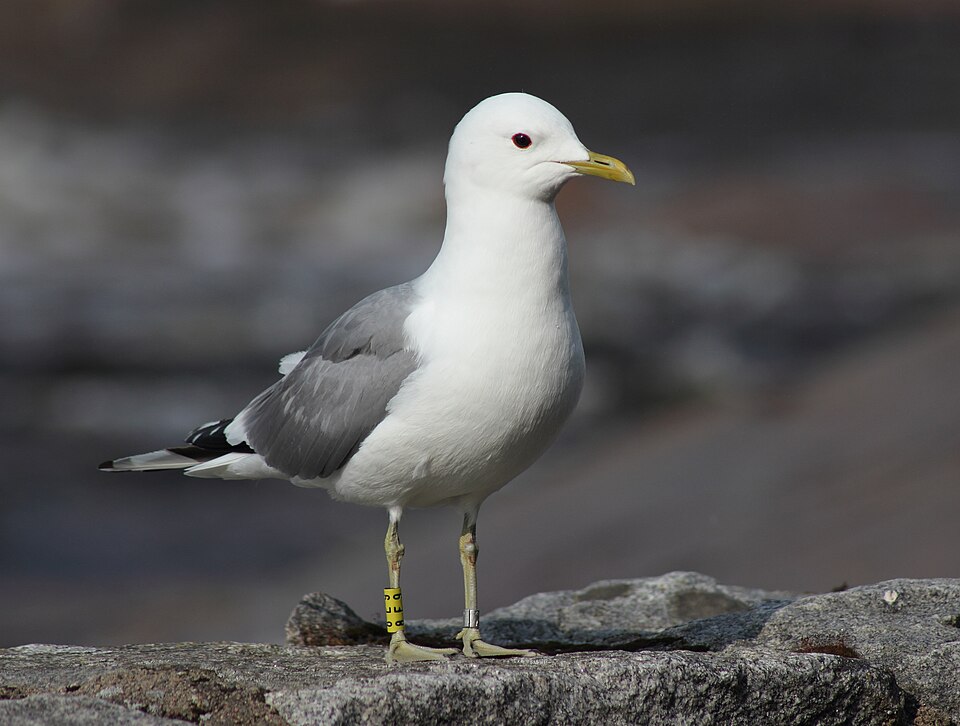 Common Gull
In short
The most reliable field mark between Black-headed Gull and Common Gull, especially for immatures in flight, is the wing pattern: juvenile and first-winter Black-headed Gulls show a distinctive brown carpal bar and black tail band, while Common Gulls have a neater, scaly brown upperwing and lack the strong carpal bar. Adults are best separated by head and bill: Black-headed Gulls in summer have a chocolate-brown hood and red bill/legs, while Common Gulls have a white head (with grey streaks in winter) and a greenish-yellow bill and legs. In flight, Black-headed Gulls show a white leading edge to the outer wing and dark under-primaries, while Common Gulls have black wingtips with white 'mirrors' and a more uniform pale underwing. Structure and size also differ, with Common Gull being noticeably heavier and bulkier. Both species overlap widely in range and habitat, so plumage and structure are key.
Identification tips
- Juvenile/first-winter wing pattern: Look for a bold brown carpal bar and black tail band in Black-headed Gull (juvenile/first-winter); Common Gull lacks the carpal bar and has a neater, scaly brown upperwing with a less contrasting pattern. This is the most reliable mark for immatures in flight.
- Tail band: Black-headed Gull juveniles/first-winters show a distinct black tail band; Common Gull immatures have a more diffuse or absent tail band.
- Adult summer head: Black-headed Gull has a chocolate-brown hood (not truly black) from March to July; Common Gull always has a white head (with faint streaking only in winter).
- Bill and leg color: Black-headed Gull has a red bill and legs (all seasons); Common Gull has a greenish-yellow bill (unmarked in summer, with a faint dark band in winter) and yellow legs (duller in winter).
- Adult winter head: Black-headed Gull loses the hood, showing just two dark spots behind the eye; Common Gull develops fine grey streaking over the head and nape.
- Flight pattern (adults): Black-headed Gull shows a white leading edge to the outer wing (outer primaries) and dark under-primaries; Common Gull shows black wingtips with large white 'mirrors' on p9/p10 and a more uniform pale underwing.
- Wingtip pattern (adults): Black-headed Gull has black tips to the primaries but lacks the large white 'mirrors' of Common Gull.
- Size and structure: Common Gull is noticeably heavier and bulkier, with a deeper chest and thicker neck; Black-headed Gull is smaller, more delicate, and daintier. Use this only when birds are side by side.
- Bill shape: Common Gull has a shorter, more tapered bill; Black-headed Gull's bill is finer and more slender.
- Leg color in immatures: Black-headed Gull immatures have dull reddish or brownish legs; Common Gull immatures start with pink legs, turning greyish before yellow.
- Aging: Black-headed Gull matures in two years, so second-year birds may look adult-like but retain some immature marks; Common Gull matures in three (or four) years, so more age classes with intermediate plumages are possible.
- Habitat: Both species overlap widely, but Black-headed Gull is more likely inland and in urban parks, while Common Gull is more coastal or on larger lakes in winter. Not diagnostic.
- Behavior: Black-headed Gull is more gregarious and bold around people, often scavenging in parks and fields; Common Gull can be more wary.
- Voice: If heard well, Common Gull gives a high-pitched 'laughing' call; Black-headed Gull is shriller and more nasal, but calls are not always diagnostic.
- Seasonal context: In late summer and autumn, beware of Black-headed Gulls in partial hood or with retained brown marks; check for carpal bar and tail band in young birds. In winter, focus on head pattern and bill/leg color.
Size
Common Gull is consistently larger and heavier than Black-headed Gull: average adult mass is about 386.5 g for Common Gull versus 280.5 g for Black-headed Gull [wikidata]. Common Gull is also longer (40–46 cm vs 34–39 cm) and has a slightly broader wingspan (100–115 cm vs 100–110 cm), though there is some overlap in wingspan. In the field, Common Gull appears bulkier and more robust, with a thicker neck and deeper chest, while Black-headed Gull is more delicate and dainty. However, size alone is unreliable at distance or in mixed flocks due to overlap and posture.
Plumage
- Juvenile/First-winter: Black-headed Gull juveniles show a distinctive brown carpal bar on the inner wing, a black band on the tail, and a mottled brown pattern on the body. By late summer, they retain the carpal bar and tail band but have a greyer back. Common Gull juveniles have scaly black-brown upperparts and a neat, less contrasting wing pattern without the strong carpal bar; their legs are pink, turning greyish in the second year. By first winter, Common Gulls have a white head and belly with fine streaks and some grey on the saddle, lacking the bold carpal bar and tail band of Black-headed Gull.
- Adults (summer): Black-headed Gull has a chocolate-brown hood (not truly black), red bill and legs, white neck, underparts and tail, pale grey back and wings, and black wingtips. Common Gull adults have a white head, grey mantle and back, yellowish-green bill (unmarked in breeding season), and yellow legs. Their wingtips are black with large white 'mirrors' on the outer primaries.
- Adults (winter): Black-headed Gull loses the hood, showing just two dark spots behind the eye, and keeps the red bill and legs. Common Gull develops grey streaking on the head and a faint dark bill band, with legs becoming duller yellow. In flight, Black-headed Gull shows a white leading edge to the outer wing and dark under-primaries, while Common Gull shows black wingtips with white mirrors and a more uniform pale underwing.
- Aging: Black-headed Gull matures in two years, Common Gull in three (or four in Kamchatka). This affects the presence of immature marks in flocks.
Behaviour
Both species are gregarious, especially in winter, and often forage in flocks. Black-headed Gull is highly social, forming large colonies in breeding season and large roosts in winter. It is not pelagic and rarely seen far at sea. Common Gull can breed colonially or singly and is also omnivorous and opportunistic, but may be less bold around people than Black-headed Gull. Both species walk and feed on the ground; Black-headed Gull is noted for head-bobbing walking displays.
Habitat
Both species breed and winter across much of the Palearctic, often sharing lakes, marshes, and coastal habitats. Black-headed Gull is more likely to be found inland, breeding in reed beds, marshes, and on islands in lakes, and is abundant in urban parks and fields in winter. Common Gull breeds near water or in marshes, sometimes in trees, and winters along coasts, estuaries, and large inland bodies of water. Habitat overlap is extensive, so context is rarely diagnostic.
Voice
Common Gull gives a high-pitched 'laughing' cry, which is distinctive if heard well. Black-headed Gull has a more shrill, nasal call. However, vocalizations are not always easy to separate in mixed flocks and are less reliable than plumage and structure for field ID.