
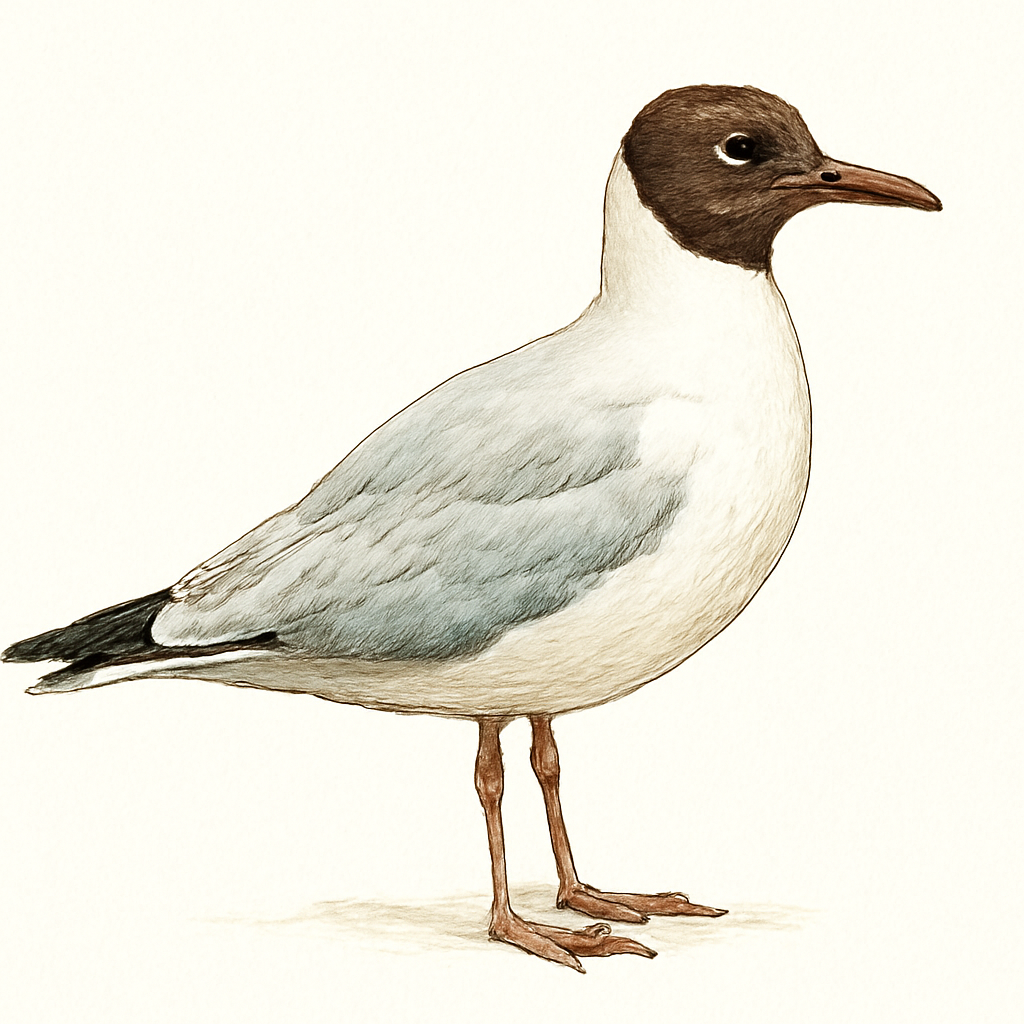
Black-headed Gull
Chroicocephalus ridibundus
Gulls, Terns, and Skimmers (Laridae) · Charadriiformes · Gulls, Terns, and Skimmers
Play a quiz with Black-headed Gull and similar species
View all photos, video and sound
Reviewed
How to identify Black-headed Gull
Black-headed Gull is a small gull with a chocolate-brown hood in summer, red bill and legs, pale grey wings, and a white leading edge to the outer wing.
Adult summer Black-headed Gull is best recognized by its chocolate-brown (not black) hood, which covers the head but leaves the throat white. The bill and legs are red, and the body is mainly white with pale grey wings and back. In flight, look for the distinctive white leading edge on the outer wing and black tips to the primaries; the underside of the inner primaries is dark, a useful mark. In winter, the hood is lost, leaving only two dark spots behind the eyes, and the rest of the head is white.
Juveniles show a mottled brown pattern and a black tail band, with a brown bar on the inner wing in their first winter. By their second winter, most birds resemble adults but may retain some brown in the wings or tail. There is no difference in plumage between sexes.
Black-headed Gull is a small, dainty gull, noticeably smaller and slimmer than most other common gulls. It is gregarious, often seen in flocks inland or at the coast, rarely far out to sea. Calls are sharp and harsh, but voice is less useful for quick identification.
Similar species
- Mediterranean Gull: Adult has a pure white wing without black tips, a thicker red bill, and in summer a jet-black hood that extends further down the nape. → How to tell them apart
- Bonaparte's Gull: Slightly smaller, with a thinner black bill, paler underwing (lacking the dark underside to inner primaries), and in summer a black hood that is more sharply defined. → How to tell them apart
- Little Gull: Much smaller, with a shorter bill, all-dark underwing, and in summer a black hood that extends further down the nape. → How to tell them apart
- Common Gull: Larger, with a pale eye, yellowish legs, and never shows a dark hood; head is streaked in winter. → How to tell them apart
- Franklin's Gull: Slightly smaller, with a darker, more extensive black hood in summer, and blacker wingtips with white spots (mirrors) on the primaries. → How to tell them apart
- Laughing Gull: Larger, with a longer bill, darker black hood in summer, and darker grey upperparts. → How to tell them apart
Often mixed up with
In quizzes, players most often confuse Black-headed Gull with these birds—either this species was picked by mistake, or the other way around.
| Species | Mix-ups |
|---|---|
| Mediterranean Gull Ichthyaetus melanocephalus | 529 |
| Little Gull Hydrocoloeus minutus | 352 |
| Black-legged Kittiwake Rissa tridactyla | 198 |
| Common Gull Larus canus | 144 |
| Bonaparte's Gull Chroicocephalus philadelphia | 115 |
Family
Laridae is a family of seabirds in the order Charadriiformes that includes the gulls, terns (including white terns), noddies, and skimmers. It includes 105 species arranged into 23 genera. They are an adaptable group of mostly aerial birds found worldwide.
Order
Charadriiformes (, from Charadrius, the type genus of family Charadriidae) is a diverse order of small to medium-large birds. It includes about 390 species and has members in all parts of the world. Most charadriiform birds live near water and eat invertebrates or other small animals; however, some are pelagic (seabirds), others frequent deserts, and a few are found in dense forest.