

Black-and-yellow Silky-flycatcher vs Bananaquit
Phainoptila melanoxantha versus Coereba flaveola
Play a quiz with Black-and-yellow Silky-flycatcher and Bananaquit
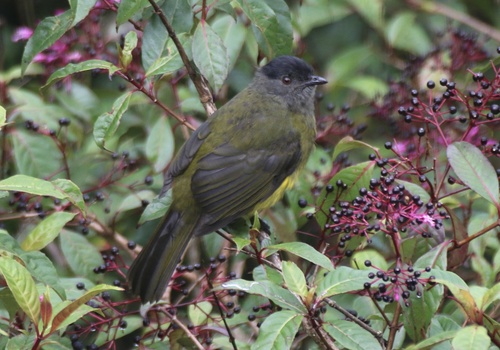 Black-and-yellow Silky-flycatcher
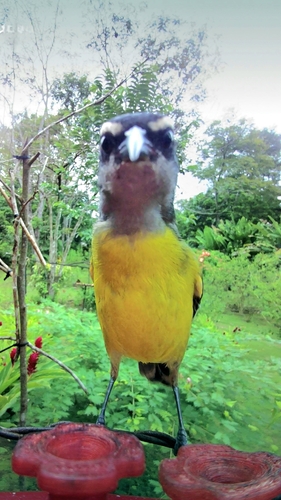 Bananaquit
In short
The most reliable field mark to separate Black-and-yellow Silky-flycatcher from Bananaquit is overall size and structure: the silky-flycatcher is much larger and heavier-bodied, with a broad, rounded tail and a thickset look, while Bananaquit is tiny, slender, and active. Adult male silky-flycatchers show a striking black-and-yellow pattern with a black head and back, unlike any Bananaquit. Bananaquit always shows a prominent white eyestripe and a slender, strongly curved bill, which the silky-flycatcher lacks. Juveniles of both species are duller, but the silky-flycatcher remains much bulkier and lacks the Bananaquit's facial pattern. Watch for the combination of size, tail shape, and head pattern for a confident ID.
Identification tips
- Size and shape: Silky-flycatcher is much larger and heavier than Bananaquit; use this as your first check, especially if you have any size reference (e.g., nearby birds, branches).
- Tail shape: Silky-flycatcher has a broad, rounded tail, while Bananaquit's tail is short and more squared off; the difference is obvious in flight or when perched.
- Bill structure: Bananaquit has a slender, strongly curved bill adapted for nectar feeding; silky-flycatcher has a thicker, straight bill. Bill shape is diagnostic at close range.
- Head pattern: Bananaquit always shows a bold white eyestripe (supercilium) and a black crown; silky-flycatcher never has a white eyestripe and instead has a plain black (male) or sooty gray (female/juvenile) head.
- Underparts: Silky-flycatcher males have a mix of black, olive-green, gray, and bright yellow on the underparts; Bananaquit has a clean yellow chest and belly with a white vent, never the mixed or olive tones of the silky-flycatcher.
- Rump and flanks: Silky-flycatcher shows a bright yellow rump and flanks, contrasting with a black back; Bananaquit's yellow is on the belly and chest, with the rump not as distinctly marked.
- Juvenile confusion: Juvenile silky-flycatchers are duller but retain the sooty crown and olive flanks; juvenile Bananaquits are also dull but always show some form of the white/yellow eyestripe and lack olive flanks.
- Sex differences: Bananaquit sexes are alike; silky-flycatcher males are more vividly patterned than females, but both sexes are much larger and lack the Bananaquit's facial pattern.
- Behavior: Bananaquit is far more active, flitting and feeding acrobatically among flowers; silky-flycatcher is slower, more deliberate, and often perches upright.
- Habitat context: In highland forests above 1,500 m in Costa Rica or Panama, expect silky-flycatcher; in gardens, parks, or lowland areas, Bananaquit is vastly more likely.
- Flight style: Silky-flycatcher flies directly and steadily; Bananaquit's flight is quick, often with rapid changes of direction.
- Iris color: Silky-flycatcher has a dull red iris (adults); Bananaquit's iris is dark, but this is rarely visible in the field.
- Legs and feet: Silky-flycatcher has black legs and feet with yellow soles; Bananaquit's legs are dark, but soles are not a field mark.
- Subspecies variation: Bananaquit shows regional plumage variation (e.g., white throats in some Caribbean forms), but always keeps the white eyestripe and curved bill; silky-flycatcher subspecies differ mainly in breast color but never approach Bananaquit's pattern.
- Vocalizations: Not diagnostic for separation; both species have variable calls, but field separation is best made visually.
Size
Black-and-yellow Silky-flycatcher is substantially larger, measuring about 20 cm in length and weighing around 58–60 g [wikidata]. In contrast, Bananaquit is much smaller, with lengths ranging from 10–13 cm and weights from 5.5–19 g [wikipedia]. In the field, this is a dramatic difference: the silky-flycatcher appears heavy-bodied, broad-tailed, and almost thrush-sized, while Bananaquit is a tiny, quick, warbler-like bird. Even at a distance or in poor light, the size gap is usually obvious if both species are familiar.
Plumage
- Juveniles and immatures: Juvenile Black-and-yellow Silky-flycatcher resembles adult females but is duller, with a sooty crown, faint dusky breast streaks, and olive-green flanks. Juvenile Bananaquits are also duller than adults, with partially yellow eyebrows and throat, but always show a white (or yellowish) eyestripe and lack the silky-flycatcher's sooty crown and olive flanks.
- Adult males: Silky-flycatcher males have a black head, back, wings, and tail, with a bright yellow rump and flanks, olive-green breast, and gray belly center. Bananaquit never shows this pattern; instead, it has dark gray to black upperparts, a black crown, a white eyestripe, and yellow underparts.
- Adult females: Female silky-flycatchers are dark gray to sooty on the head and throat, blending to olive-green on the breast, with yellow flanks and undertail. Bananaquit females look like males, with the same white eyestripe and yellow underparts, and never show the silky-flycatcher's sooty or olive tones.
- Key contrast: The silky-flycatcher never shows a white eyestripe, and Bananaquit never shows a black head with a yellow rump and flanks.
Behaviour
Black-and-yellow Silky-flycatcher is heavy-bodied and often perches upright or moves deliberately through foliage, sometimes sallying for fruit or insects. Its flight is direct and steady, matching its robust build. Bananaquit is extremely active, flitting rapidly among flowers and foliage, often hanging upside-down or hovering briefly (but not like a hummingbird), and frequently visiting feeders or sugar bowls in gardens. Its foraging is restless and acrobatic, and it rarely sits still for long.
Habitat
Black-and-yellow Silky-flycatcher is restricted to highland forests and edges in Costa Rica and Panama, typically above 1,500 m elevation. It favors mossy, humid montane woodlands and forest borders. Bananaquit is widespread in the Neotropics, found from southern Mexico through the Caribbean and much of South America, in a wide range of open to semi-open habitats, including gardens, parks, and forest edges, but avoids dense forests and high elevations above 2,000 m. If you are in a lowland garden, Bananaquit is far more likely; in highland cloud forest, the silky-flycatcher is the expected species.
Black-and-yellow Silky-flycatcher · Bananaquit · My Tricky Birds