

Black-and-white Antbird vs Slate-coloured Antbird
Myrmochanes hemileucus versus Myrmelastes schistaceus
Play a quiz with Black-and-white Antbird and Slate-coloured Antbird
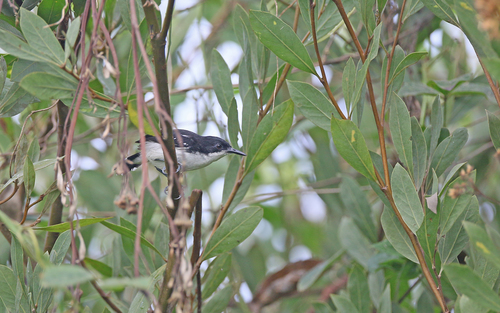 Black-and-white Antbird
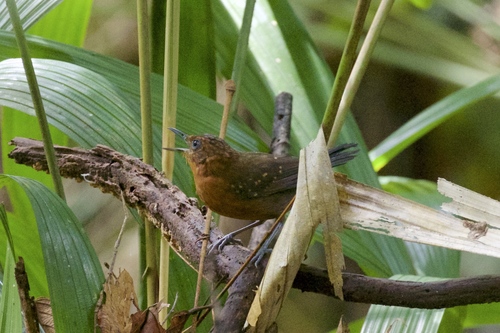 Slate-coloured Antbird
In short
The most reliable field mark between Black-and-white Antbird and Slate-coloured Antbird is overall body color and size: Black-and-white Antbird is distinctly smaller and sharply patterned in black and white, while Slate-coloured Antbird is larger and much more uniformly slate-gray (male) or rufous/olive (female). In all ages, Black-and-white Antbird shows a striking black-and-white contrast on the head and underparts, whereas Slate-coloured Antbird lacks this crisp patterning. Females are especially easy to separate: Black-and-white Antbird females are black-and-white with some buff below, while Slate-coloured Antbird females are rufous below with a chestnut crown and olive-brown upperparts. Both species have some white on the wing coverts, but the overall impression and structure are quite different.
Identification tips
- Size and structure: Black-and-white Antbird is much smaller and more compact, with a shorter, more graduated tail. Slate-coloured Antbird is bulkier and longer-tailed. Use this when you have a good view of proportions.
- Male plumage: Black-and-white Antbird males are sharply black above and white below, with a clear contrast. Slate-coloured Antbird males are uniformly slate gray above and below, lacking any white on the underparts.
- Female plumage: Black-and-white Antbird females are black-and-white with some buff below, never rufous. Slate-coloured Antbird females are rufous below, with a chestnut crown and olive-brown upperparts—very different from any Black-and-white Antbird.
- Wing covert pattern: Both species have some white on the wing coverts, but in Black-and-white Antbird it's sparse and subtle, while in Slate-coloured Antbird females it's broad and ochraceous buff, and in males it's small white spots. In the field, the female Slate-coloured's pale-tipped coverts are much more obvious.
- Tail pattern: Both have white-tipped tail feathers, but Black-and-white Antbird's tail is shorter and more graduated, while Slate-coloured's is longer and more even.
- Bill: Black-and-white Antbird has a long, slender, black bill. Slate-coloured Antbird males have a black bill, but females show a gray maxilla and black mandible. This is subtle and may not be visible in the field.
- Leg color: Both have grayish legs, but Slate-coloured Antbird's are described as leaden to bluish gray, which may be slightly paler than Black-and-white's gray.
- Habitat and foraging height: Black-and-white Antbird is usually in dense vine tangles 1–4 m above ground, rarely on the ground. Slate-coloured Antbird is mostly on or near the ground, often in leaf litter or low branches.
- Behavior: Black-and-white Antbird forages actively in pairs or family groups, never in mixed-species flocks. Slate-coloured Antbird is more solitary or in small groups, sometimes at army ant swarms.
- Voice: If you hear an accelerating, descending series of hollow, piping notes (often a duet), it's Black-and-white Antbird. Slate-coloured Antbird's vocalizations are less well described here.
- Geographic range: Both overlap widely in the western Amazon, but Black-and-white Antbird is also found in Bolivia.
- Context: If you see a small, sharply marked black-and-white antbird in dense vines above the ground, it's almost certainly Black-and-white. If it's larger, gray or rufous, and on the ground or at an ant swarm, it's Slate-coloured.
- Pitfalls: Beware of assuming any antbird with white on the wing coverts is Black-and-white; check the overall body color and size. Female Slate-coloured Antbird's rufous and olive tones are never matched by Black-and-white Antbird.
- Age/sex confusion: No distinctive juvenile wing patterns are described, but the female and immature Slate-coloured Antbird's rufous and ochraceous tones are always a giveaway.
- When in doubt: Focus on overall size, body color (especially underparts), and foraging height/context for the most reliable separation.
Size
Black-and-white Antbird is much smaller and lighter, measuring 10–12.2 cm in length and weighing about 12.5 g [wikidata]. Slate-coloured Antbird is noticeably larger, at 14.5–15.5 cm and 19–28.5 g [wikipedia]. In the field, this size difference is quite apparent if you have a good view or see them near each other. Black-and-white Antbird also appears more compact with a shorter, more graduated tail, while Slate-coloured Antbird is bulkier and longer-tailed.
Plumage
-
Juvenile/immature wing pattern: No detailed age-specific upperwing pattern is described for either species, but both have some white on the wing coverts. In Black-and-white Antbird (all ages), the white is sparse and limited to tips of the coverts, set against otherwise black wings. In Slate-coloured Antbird, males have small white spots at the tips of the wing coverts on otherwise blackish gray wings, while females have wide ochraceous buff tips on the coverts against olive-brown wings. This means that in flight or perched, the female Slate-coloured Antbird's wing coverts are much more conspicuously pale-tipped than the subtle white on Black-and-white Antbird.
-
Adult males: Black-and-white Antbird males are strikingly black above (face, crown, nape, upperparts) with a white throat and underparts, sometimes with buff on the flanks and belly. Wings are black with sparse white tips, and the tail is black with white tips. Slate-coloured Antbird males are uniformly dark bluish gray or slate gray, with blackish gray wings and tail, and small white spots at the tips of the wing coverts. Underparts are also slate gray, lacking any white.
-
Adult females: Black-and-white Antbird females resemble males but have white spots on the lores and more buff on the belly and undertail coverts. Slate-coloured Antbird females are dramatically different: they have a dark chestnut crown with thin rufous streaks, olive-brown back and wings with wide ochraceous buff tips on the coverts, a slate gray tail, and orangish rufous or rufous face and underparts. This rufous coloration is never shown by Black-and-white Antbird.
-
Tail: Both species have some white at the tail tips, but Black-and-white Antbird's tail is shorter and more graduated, while Slate-coloured Antbird's is longer and more even.
-
Bill and legs: Black-and-white Antbird has a long, slender, black bill and gray legs; Slate-coloured Antbird males have a black bill, females have a gray maxilla and black mandible, and both sexes have leaden to bluish gray legs.
Behaviour
Black-and-white Antbird forages actively in pairs or family groups, rarely singly, and never joins mixed-species flocks. It prefers vine tangles and dense understory, usually 1–4 m above ground but sometimes higher, and often lunges or sallies after prey from a perch. Slate-coloured Antbird forages alone, in pairs, or small family groups, mostly within 1 m of the ground, and sometimes joins army ant swarms. It hops along the ground and low branches, picking prey from leaf litter or low vegetation. Black-and-white Antbird is more arboreal and active in the mid-understory, while Slate-coloured Antbird is more terrestrial and ground-oriented.
Habitat
Both species occur in the western Amazon (Brazil, Colombia, Ecuador, Peru), but Black-and-white Antbird is also found in Bolivia. Black-and-white Antbird is closely associated with Cecropia woods and vine tangles in the understory, often in dense, tangled vegetation. Slate-coloured Antbird is more typical of lowland forest floor and lower understory, often near the ground and sometimes at army ant swarms. If you see a small, black-and-white antbird in dense vines above the ground, it's likely Black-and-white; a larger, gray or rufous antbird on or near the ground is likely Slate-coloured.
Voice
Black-and-white Antbird's song is an accelerating, descending series of hollow, piping notes, often sung as a duet with the female's voice higher pitched. Calls include hollow piping notes, a rapid musical rattle, and short notes like 'peu' and 'tuk-et'. Slate-coloured Antbird's vocalizations are not detailed in the notes, so voice is not a reliable separator unless you know the Black-and-white's distinctive piping song.
Black-and-white Antbird · Slate-coloured Antbird · My Tricky Birds