

Belcher's Gull vs Black-tailed Gull
Larus belcheri versus Larus crassirostris
Play a quiz with Belcher's Gull and Black-tailed Gull
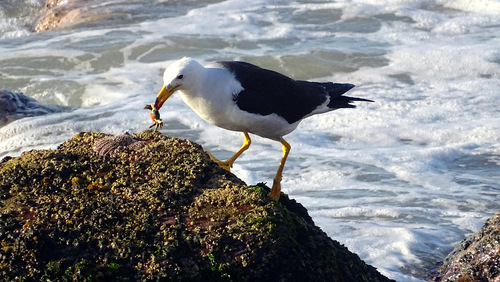 Belcher's Gull
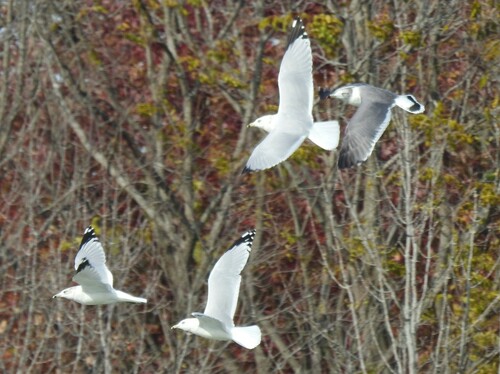 Black-tailed Gull
In short
The most reliable field mark to separate Belcher's Gull from Black-tailed Gull is the tail pattern: adult Belcher's shows a broad black subterminal band on an otherwise white tail, while Black-tailed Gull has a black tail with a white terminal edge. In flight, this tail pattern is often visible even at a distance. Both species have yellow legs and a yellow bill with red and black markings at the tip, but subtle differences in mantle color, head pattern (especially outside breeding season), and size can help. Immature plumages are challenging, but the tail and wing patterns remain the best clues. Habitat and range are also strong separators, as these species do not overlap naturally.
Identification tips
- Tail pattern in flight (all ages): Look for a broad black subterminal band on a mostly white tail (Belcher's) versus a black tail with a white terminal edge (Black-tailed). This is the single most useful field mark.
- Mantle and back color (adults): Belcher's has a darker, greyish-black mantle and back, while Black-tailed Gull's mantle is not described as particularly dark. Compare if both are present.
- Bill tip pattern (adults and immatures): Belcher's has a yellow bill with a distinct red and black tip in all plumages except fresh juvenile; Black-tailed Gull also has a yellow bill with red and black at the end, but the pattern may be less sharply defined. Use with caution in immatures.
- Head pattern in non-breeding season: Belcher's develops a dark brown head with a white eye-ring, while Black-tailed Gull's head remains white year-round. This is a strong seasonal clue.
- Leg color: Both species have yellow legs, so this is not a separator.
- Eye color: Belcher's has a black eye; Black-tailed Gull's eye color is not specified but is not a primary mark.
- Juvenile/immature upperwing pattern: Not fully described for Black-tailed, but if you see a mottled brown and white bird with a strong black tail band, Belcher's is more likely. Use tail pattern as primary.
- Size and structure: Belcher's is slightly larger and heavier, but this is not reliable unless both species are together.
- Behavior: If you see a gull pestering cormorants for food, Belcher's is more likely. Black-tailed is more likely to follow boats and act tame around humans.
- Vocalization: A cat-like 'mew' call is diagnostic for Black-tailed Gull.
- Habitat and range: Belcher's is only on the Pacific coast of South America; Black-tailed is only in East Asia. Out-of-range records are exceptional.
- Colony size/context: Black-tailed Gull often nests in very large, dense colonies, especially in Japan and Korea. Belcher's colonies are smaller (up to 100 pairs).
- Seasonal context: If you see a dark-headed gull with a white eye-ring outside the breeding season, suspect Belcher's. If the head is always white, suspect Black-tailed.
- Association with cormorants: Belcher's is often seen with Guanay cormorants, sometimes stealing food.
- Check for vagrancy: If you are outside the normal range of either species, double-check all field marks and consider the possibility of a rare vagrant, but default to the expected species.
Size
Both are medium-sized gulls, but Belcher's Gull is slightly larger in length (48–54 cm) compared to Black-tailed Gull (46 cm), though Black-tailed Gull has a slightly broader wingspan (126–128 cm vs. about 120 cm for Belcher's). Black-tailed Gull's average body mass is around 556.5 g. In the field, size difference is subtle and not a reliable separator unless both species are side by side. Sexes are similar in both, though male Black-tailed Gulls are slightly larger than females.
Plumage
- Juvenile and immature plumages: Both species take several years to reach adult plumage (Belcher's in three, Black-tailed in four). Juvenile Belcher's is mottled brown and white, while Black-tailed Gull's immature plumage is not described in detail here, but both will lack the clean adult tail pattern. However, the presence of a strong black tail band (Belcher's) versus a more extensively black tail with a white tip (Black-tailed) can still be helpful in older immatures.
- Adult breeding plumage: Belcher's has a white head, very pale grey neck, white underparts, and a dark greyish-black mantle and back. The tail is white with a broad black subterminal band and a white trailing edge. Black-tailed Gull has a similar white head and underparts, but the tail is black with a white terminal edge. Both have yellow legs and a yellow bill with a red and black spot at the tip, but Belcher's bill tip is more distinctly red and black, while Black-tailed's is red and black at the end.
- Non-breeding plumage: Belcher's develops a dark brown head with a white eye-ring, while Black-tailed Gull retains a white head.
Behaviour
Both species are omnivorous and opportunistic, feeding on fish, molluscs, crustaceans, and carrion. Belcher's Gull is noted for pestering cormorants for regurgitated prey, while Black-tailed Gull often follows ships and fishing fleets and is very tame in some areas. Both nest colonially, but Black-tailed Gull is especially known for large, dense colonies at traditional sites in Japan and Korea. In the field, behavior is not a strong separator unless you observe Belcher's unique kleptoparasitic habits with cormorants.
Habitat
Belcher's Gull is strictly coastal along the Pacific of South America, favoring rocky shores, bays, and offshore islands, rarely venturing far inland. Black-tailed Gull is native to East Asian shorelines, breeding on islands and coasts of Japan, Korea, and nearby regions, and is very rare outside this range. If you are outside these regions, vagrancy is possible but extremely unlikely. Habitat alone can often rule out confusion unless observing a vagrant.
Voice
Black-tailed Gull is famous for its cat-like 'mew' call, which is distinctive and frequently heard, especially at colonies. Belcher's Gull's vocalizations are not described in detail here, but are not noted as cat-like. If you hear a repeated, nasal mewing, Black-tailed Gull is likely.