

Bay-capped Wren-Spinetail vs White-throated Cacholote
Spartonoica maluroides versus Pseudoseisura gutturalis
Play a quiz with Bay-capped Wren-Spinetail and White-throated Cacholote
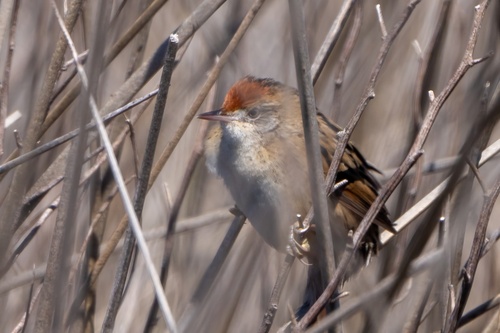 Bay-capped Wren-Spinetail
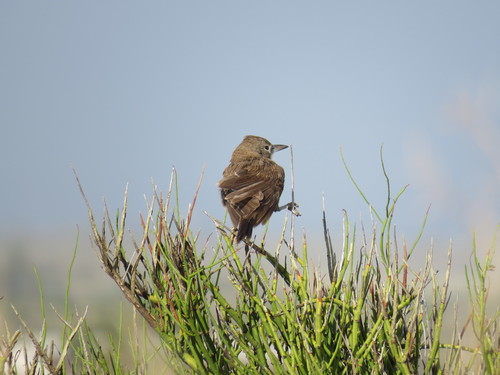 White-throated Cacholote
In short
The most reliable way to separate Bay-capped Wren-Spinetail from White-throated Cacholote is by size and structure: the cacholote is vastly larger and bulkier, with a prominent crest and heavy bill, while the wren-spinetail is small, slim, and lacks a crest. In plumage, the wren-spinetail shows a rufous crown and bold black streaks on the nape and upper back, contrasted with the cacholote's uniform dark brownish-gray upperparts and striking white throat. In flight or perched, the cacholote's size and robust jizz are unmistakable, while the wren-spinetail is delicate and often seen low in marsh vegetation. Habitat also helps: cacholote favors dry woodlands and scrub, while wren-spinetail is restricted to marshes.
Identification tips
- Size is the first check: White-throated Cacholote is over six times heavier and nearly twice as long as Bay-capped Wren-Spinetail. If the bird appears large, robust, and heavy-billed, it's the cacholote; if it's small and slim, it's the wren-spinetail.
- Crested vs. uncrested: Cacholote has a small but obvious crest, visible both when perched and sometimes in flight. Wren-spinetail lacks any crest.
- Crown color: Wren-spinetail shows a distinctive rufous crown, contrasting with its sandy-brown face and bold whitish supercilium. Cacholote's crown is the same dark brownish-gray as its back, with no rufous or strong contrast.
- Facial pattern: Wren-spinetail has a whitish supercilium and sandy brown face; cacholote has a white eyering and lores but otherwise a dark brownish-gray face.
- Upperparts: Wren-spinetail's upperparts are sandy to olive-brown with bold black streaks on the nape and upper back—look for these streaks in good light. Cacholote is uniform dark brownish-gray above, lacking streaks.
- Wing and tail: Wren-spinetail's wings are brown with cinnamon at the base of the flight feathers, and the tail is graduated and pointed, with some black on the central feathers. Cacholote's wings and tail are dark fuscous gray, with paler edges and a less pointed, more robust tail.
- Underparts: Wren-spinetail is whitish below with a buff or cinnamon wash on the breast and flanks. Cacholote has a white chin and throat bordered by black at the lower throat, with the rest of the underparts pale brownish-gray and a frosty look from grayish-white feather tips.
- Juvenile confusion: Juvenile cacholotes may show some light mottling or barring below, but never the bold streaks or rufous crown of the wren-spinetail. There are no distinctive juvenile wing patterns in either species.
- Bill structure: Cacholote's bill is thick, strong, and heavy—noticeably larger than the fine, slender bill of the wren-spinetail.
- Leg color: Wren-spinetail has light tan legs and feet; cacholote's are gray.
- Behavior: Wren-spinetail is secretive, foraging low in marshes, rarely perching in the open. Cacholote is bolder, often perching atop shrubs or trees in dry habitats.
- Habitat: Marshes (wren-spinetail) vs. dry woodlands and scrub (cacholote) is a strong separator. If you see a small bird in a marsh, it's almost never a cacholote.
- Voice: If you hear a long, insect-like buzz, it's likely the wren-spinetail. Cacholote's vocalizations are not described here, but are unlikely to be confused with an insect-like buzz.
- Geographic overlap: Both species occur in Argentina, but their habitat preferences rarely overlap. Always consider context.
- Sexes similar: Both species have sexes alike in plumage, so all field marks apply to both males and females.
Size
White-throated Cacholote is dramatically larger, weighing about 71 g and measuring 22–23 cm in length, making it one of the largest furnariids. In contrast, Bay-capped Wren-Spinetail is a small, lightweight bird at only 11 g and 13–14.5 cm long. This size gap is obvious in the field, even at a distance. The cacholote's body is robust, with a thick bill and strong legs, while the wren-spinetail is slim and delicate.
Plumage
- Juvenile/immature upperwing pattern: No distinctive age-specific upperwing or flight pattern is described for either species; both lack bold panels or contrasting edges that would stand out in flight at any age.
- Adult plumage: Bay-capped Wren-Spinetail has a rufous crown, bold black streaks on the nape and upper back, sandy brown to olive-brown upperparts, and a whitish supercilium. Its wings are brown with cinnamon at the base of the flight feathers, and the tail is graduated and pointed. Underparts are whitish with buff or cinnamon on the breast and flanks. In contrast, White-throated Cacholote is uniform dark brownish-gray above, with a small crest, white eyering, and a striking white chin and throat bordered by black at the lower throat. The cacholote's underparts are paler brownish-gray with frosty grayish-white feather tips, and the tail is dark fuscous gray with paler edges. Juvenile cacholotes may show some light mottling or barring below, but not enough to resemble the wren-spinetail's pattern.
Behaviour
Bay-capped Wren-Spinetail is typically seen foraging alone, moving nimbly through dense marsh grasses and sedges, often low to the ground. Its movements are quick and mouse-like. White-throated Cacholote, on the other hand, is a much more conspicuous bird, often perching in the open atop shrubs or small trees in dry habitats. It may be seen in pairs or small groups, and its behavior is bolder and less secretive than the wren-spinetail.
Habitat
Bay-capped Wren-Spinetail is strictly a marsh specialist, found in reedbeds and sedges in freshwater, brackish, or saltwater marshes from southern Brazil through Uruguay to northern Argentina. White-throated Cacholote is endemic to Argentina and prefers dry woodlands, scrub, and arid habitats, avoiding marshes. If you find a small, active bird in dense marsh vegetation, it's almost certainly a wren-spinetail; a large, crested bird in dry, open country is the cacholote.
Voice
The wren-spinetail's primary song is described as a grasshopper-like buzz, long and insect-like. There is no detailed vocal description for the cacholote here, but the two are unlikely to be confused by voice given the cacholote's larger size and likely louder, more varied calls typical of the genus.
Bay-capped Wren-Spinetail · White-throated Cacholote · My Tricky Birds