

Band-tailed Pigeon vs Rufous Turtle Dove
Patagioenas fasciata versus Streptopelia orientalis
Play a quiz with Band-tailed Pigeon and Rufous Turtle Dove
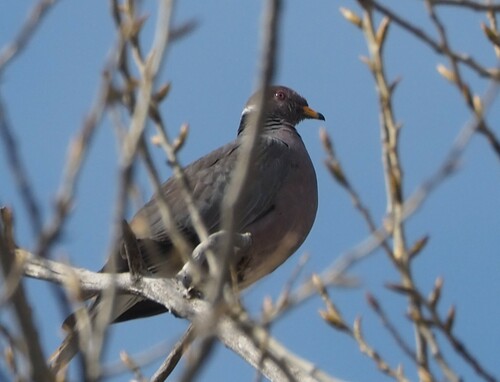 Band-tailed Pigeon
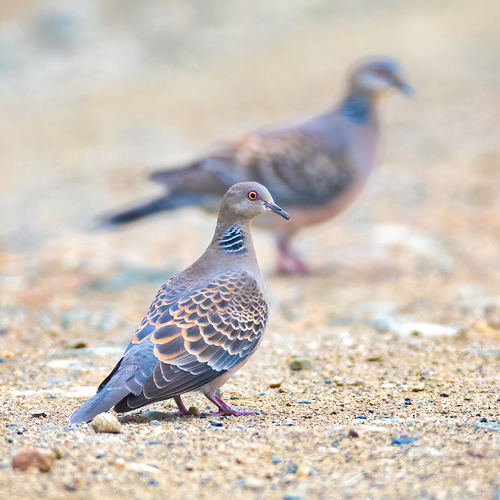 Rufous Turtle Dove
In short
The most reliable field mark to separate Band-tailed Pigeon from Rufous (Oriental) Turtle Dove is the combination of overall structure and key plumage features: Band-tailed Pigeon is a large, thickset pigeon with a plain gray body, a thin white collar on the nape, and a broad, pale-tipped tail with a dark subterminal band. In contrast, Rufous Turtle Dove is slimmer, with a scaly pattern on the wing coverts, a black-and-white striped patch on the neck, and a wedge-shaped tail with variable but often paler tips. Juvenile Band-tailed Pigeons lack the white collar and show a scaly back, which can cause confusion, but the dove’s more rufous tones and distinctive neck patch are strong clues. Bill and leg color (yellow in Band-tailed, dark in Turtle Dove) can clinch the ID at close range.
Identification tips
- Overall size and shape: Band-tailed Pigeon is bulkier and longer than Rufous Turtle Dove, with a thicker neck and deeper chest. If the bird looks hefty and large, favor Band-tailed.
- Tail shape and pattern: Band-tailed Pigeon has a broad, rounded tail with a wide, pale tip and a dark subterminal band; Rufous Turtle Dove’s tail is wedge-shaped with a variable pale tip (white or gray) and less distinct banding. This is especially visible in flight or when the tail is spread.
- Neck markings: Adult Band-tailed Pigeon shows a thin, complete white collar on the nape, bordered by green iridescence. Rufous Turtle Dove has a black-and-white striped patch on the side of the neck, not a full collar, and lacks green iridescence.
- Wing coverts: Rufous Turtle Dove of all ages shows dark-centered, rufous-edged wing coverts, giving a strong scaly effect. Juvenile Band-tailed Pigeon can look scaly above, but the effect is paler, less rufous, and not as sharply defined or extensive as in the dove.
- Bill and feet color: Band-tailed Pigeon has a yellow bill and feet (with some subspecies showing a black tip to the bill), while Rufous Turtle Dove has a darker bill and feet. This is a clincher at close range.
- Breast color: Band-tailed Pigeon’s breast is gray with a faint pinkish cast (especially in males); Rufous Turtle Dove’s breast is less pink and more neutral.
- Head and face: Band-tailed Pigeon has a plain gray head; Rufous Turtle Dove’s head is more rufous, especially in some subspecies, and lacks the plainness of the pigeon.
- Eye ring: Rufous Turtle Dove lacks a bare patch of skin around the eye, while some related turtle doves have it. Band-tailed Pigeon does not have a prominent bare eye ring either, so this is not a strong separator between these two.
- Flight style: Band-tailed Pigeon flies with strong, direct wingbeats and appears heavy; Rufous Turtle Dove’s flight is more relaxed and direct, with a slimmer profile.
- Juvenile confusion: Juvenile Band-tailed Pigeon can be mistaken for Rufous Turtle Dove due to scaly upperparts, but check for the absence of a strong rufous tone and the lack of a black-and-white neck patch.
- Sex/age effects: The pinkish breast of Band-tailed Pigeon is most pronounced in adult males; females and juveniles are duller. Rufous Turtle Dove’s scaly wing coverts are present in all ages and sexes.
- Context: If in the Americas, especially western North America, Band-tailed Pigeon is vastly more likely; Rufous Turtle Dove is rare there. In Asia, especially open woodlands, Rufous Turtle Dove is expected.
- Subspecies variation: Some Rufous Turtle Dove subspecies (e.g., erythrocephala) have a reddish-brown head with no gray on the forehead or crown; Band-tailed Pigeon never shows this.
- Tail in flight: Band-tailed Pigeon’s pale tail tip and dark band are visible from below in flight; Rufous Turtle Dove’s tail shows a wedge shape and less contrast in the tail banding.
- Habitat clues: Band-tailed Pigeon is often seen in association with oaks or fruiting trees in North America; Rufous Turtle Dove is more generalist in wooded Asian habitats.
Size
Band-tailed Pigeon is notably larger and bulkier, measuring 33–40 cm in length and weighing 226–460 g, with a wingspan around 66 cm [wikipedia]. Rufous Turtle Dove is slightly smaller, about the size of a Eurasian Collared Dove, and appears more slender and less heavy-bodied. While both are large pigeons/doves, the Band-tailed’s size and thickset build stand out, especially in direct comparison. Sexes overlap in size for both, but Band-tailed Pigeon averages heavier overall.
Plumage
- Juvenile/immature birds: Juvenile Band-tailed Pigeons show pale feather edges above, creating a scaly look, and lack the white nape collar and neck iridescence. This scaly effect can superficially resemble the Rufous Turtle Dove’s wing coverts, which are always dark-centered with rufous edges, giving a strong scaly appearance in all ages. However, the dove’s scaly pattern is more extensive and richer in color, especially on the wing coverts, and is present in adults as well.
- Adults: Band-tailed Pigeon adults are plain gray overall, with a faint pinkish cast on the breast (stronger in males), a thin white collar on the nape, green neck iridescence, and a broad, pale tail tip with a dark subterminal band. Rufous Turtle Dove adults have a black-and-white striped patch on the side of the neck (not a full collar), a less pink breast, and a wedge-shaped tail with variable pale tips (white or gray, depending on subspecies), and a more rufous-brown, scaly appearance to the wing coverts. The dove lacks the green neck iridescence and the full white collar of the pigeon.
- Tail: Band-tailed Pigeon’s tail is broad and rounded with a pale tip and a distinct dark band at the base of the pale area. Rufous Turtle Dove’s tail is wedge-shaped, with the terminal band color (white or gray) and amount of black in the outer tail feathers varying by subspecies, but never showing the same broad pale tip with a dark subterminal band as Band-tailed.
Behaviour
Band-tailed Pigeon often appears heavy and deliberate in flight, with strong, direct wingbeats and a thick-based, pointed wing shape. It perches upright and can look quite large and chunky. Rufous Turtle Dove has a more relaxed, direct flight, and appears slimmer and more agile both in flight and when perched. In display, the dove may flap noisily and glide with outspread tail, a behavior not described for Band-tailed Pigeon.
Habitat
Band-tailed Pigeon is native to the Americas and is most often found in forests, especially those with oaks or fruiting trees, and sometimes in suburban areas with suitable food sources. Rufous Turtle Dove is native to Asia and occupies a wide range of wooded habitats, from open woodlands to forest edges, and is more likely to be seen in a variety of wooded or semi-open habitats across its range. While both can use woodland, Band-tailed is more tied to North American oak and conifer forests, and Rufous Turtle Dove is more Asian in context.