

Band-tailed Fruiteater vs Golden-breasted Fruiteater
Pipreola intermedia versus Pipreola aureopectus
Play a quiz with Band-tailed Fruiteater and Golden-breasted Fruiteater
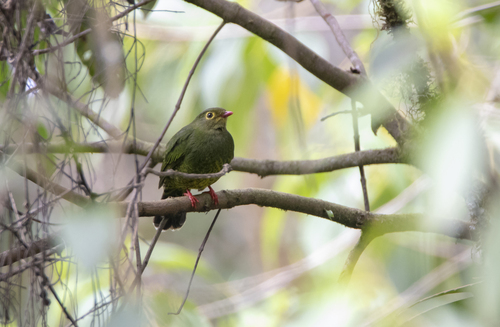 Band-tailed Fruiteater
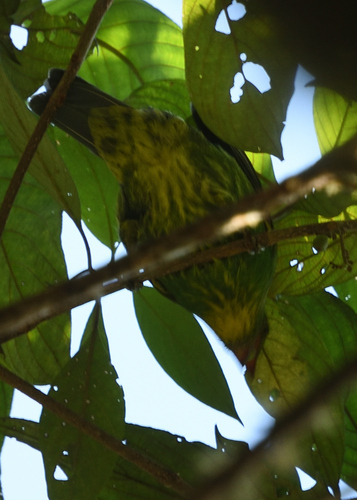 Golden-breasted Fruiteater
In short
The most reliable field mark to separate Band-tailed Fruiteater from Golden-breasted Fruiteater is the presence of a distinct black band near the tip of the tail in Band-tailed (all ages), which Golden-breasted completely lacks. Adult male Band-tailed also shows a black head and upper breast with a thin yellow collar, while Golden-breasted males have a green head and a bright yellow throat and breast. Females are trickier: Band-tailed females have a green head and yellow underparts with black scalloping, whereas Golden-breasted females are green below with yellow streaks. Both species have white-tipped tertials, but the tail pattern and underpart coloration are the best clues. Range is a strong context clue: Band-tailed occurs in Peru and Bolivia, Golden-breasted in Colombia and Venezuela.
Identification tips
- Tail pattern (all ages): Band-tailed Fruiteater always shows a distinct black band near the tip of the tail with white tips to the tail feathers. Golden-breasted Fruiteater's tail is plain green with no black band or white tips. This is the single most reliable field mark, especially in flight or when the tail is fanned.
- Adult male head and breast: Band-tailed male has an entirely black head and upper breast with a thin yellow collar (except on the nape). Golden-breasted male has a green head and a bright yellow throat and breast, with no black or collar.
- Female underparts: Female Band-tailed has yellow underparts with black scalloping, while female Golden-breasted is green below with yellow streaks. This can be subtle, but the presence of yellow with black marks (Band-tailed) versus green with yellow streaks (Golden-breasted) is helpful.
- Flank color: Band-tailed (both sexes) has green flanks with black scalloping; Golden-breasted male has green flanks blending into the yellow breast, and female is green with yellow streaks.
- Yellow collar: Band-tailed male (especially subspecies signata) shows a thin to bold yellow collar at the base of the black head and upper breast, absent in Golden-breasted except for a yellow neck band in some subspecies (P. a. decora), but this is on the sides, not a full collar.
- Tertial tips: Both species have white-tipped tertials, so this is not a separator.
- Bill and iris color: Band-tailed has a crimson bill (sometimes with a black culmen) and brown iris; Golden-breasted has an orange or orange-red bill and orange-yellow iris. These are subtle and not always visible in the field.
- Leg color: Band-tailed has red or orange-red legs and feet; Golden-breasted has greenish gray legs and feet. Again, subtle and not always visible.
- Size: Band-tailed is slightly larger and bulkier, but the difference is minor and should not be used as a primary field mark.
- Range: Band-tailed occurs in Peru and Bolivia; Golden-breasted is found only in Colombia and Venezuela. If you know your location, this is a strong separator.
- Habitat: Both inhabit humid montane forests, so habitat alone is not diagnostic unless paired with range.
- Behavior: Golden-breasted is more likely to join mixed-species flocks; Band-tailed is not specifically noted for this, but behavior is not a strong separator.
- Voice: Only Band-tailed's song is described; if you hear a series of very high notes followed by a thin, descending whistle, it may indicate Band-tailed, but absence of vocalization is not helpful.
- Subspecies variation: Be aware that Band-tailed subspecies signata can have a much bolder yellow collar and less black on the underparts, while Golden-breasted subspecies decora and festiva can show more yellow on the neck or underparts, potentially confusing the picture. Always check the tail pattern for confirmation.
- Quiz pitfalls: Immature or female birds in flight may be especially confusing. Focus on the tail pattern (black band and white tips for Band-tailed, plain green for Golden-breasted) and underpart coloration (scalloped yellow for Band-tailed, streaked green/yellow for Golden-breasted) for the best chance at a correct ID.
Size
Band-tailed Fruiteater is slightly larger, measuring 18.5–19.5 cm in length and weighing about 50 g, while Golden-breasted Fruiteater is 16.5–17.5 cm long and weighs 46–50 g. The difference is subtle in the field, but Band-tailed generally appears a bit bulkier and longer-tailed, especially when perched. Both are compact, short-tailed cotingas, but the size gap is minor and best used as a supporting clue.
Plumage
For all ages and sexes, Band-tailed Fruiteater shows a diagnostic black band near the tip of the tail, with white tips to the tail feathers; Golden-breasted Fruiteater's tail is plain green with no black band or white tips. On the wing, both species have white-tipped tertials, so this is not a separator. Adult male Band-tailed has a striking black head and upper breast with a thin yellow collar (except on the nape), green upperparts, and yellow underparts with black scalloping; Golden-breasted male has a green head and upperparts, a bright yellow throat and breast, and green flanks that blend into the yellow. Female Band-tailed is green-headed with yellow underparts and black scalloping, while female Golden-breasted is green below with yellow streaks. Subspecies variation exists: some Band-tailed (P. i. signata) have a bolder yellow collar and less black on the underparts, while some Golden-breasted subspecies show a yellow neck band (P. a. decora) or more yellow below (P. a. festiva).
Behaviour
Both species are primarily frugivorous and forage in the mid-levels of montane forest, often in pairs. Golden-breasted Fruiteater is noted for joining mixed-species flocks, while Band-tailed is not specifically mentioned doing so. Both are generally unobtrusive and perch quietly, but behavior is not a strong separator.
Habitat
Band-tailed Fruiteater is found in humid montane forests on the eastern slopes of the Andes in Peru and Bolivia, at elevations mostly between 1,500 and 3,000 m. Golden-breasted Fruiteater inhabits similar montane forests but is restricted to Colombia and Venezuela, generally at similar elevations. There is no range overlap: location is a strong separator.
Voice
Band-tailed Fruiteater's song is a series of very high notes followed by a thin, descending whistle ("ti-ti-ti teeeeeeew") and its call is a series of high "ti" or "tswee" notes. No detailed vocal description is available for Golden-breasted Fruiteater, so voice is not a reliable separator.
Band-tailed Fruiteater · Golden-breasted Fruiteater · My Tricky Birds