

band-tailed fruiteater vs golden-breasted fruiteater
Pipreola intermedia versus Pipreola aureopectus
Jogue um quiz com band-tailed fruiteater e golden-breasted fruiteater
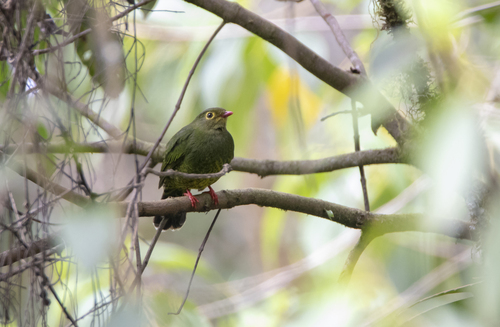 band-tailed fruiteater
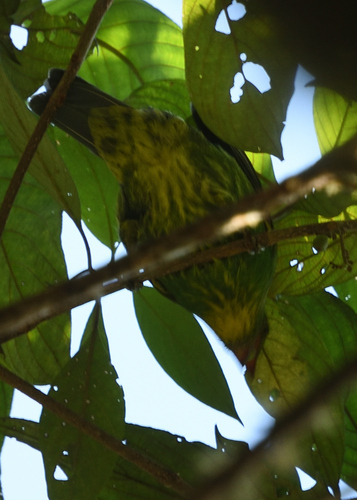 golden-breasted fruiteater
Em resumo
A marca de campo mais confiável para separar o band-tailed fruiteater do golden-breasted fruiteater é a presença de uma faixa preta distinta perto da ponta da cauda no band-tailed (todas as idades), que o golden-breasted não possui. O macho adulto do band-tailed também apresenta uma cabeça preta e peito superior preto com um fino colar amarelo, enquanto os machos golden-breasted têm cabeça verde e garganta e peito amarelo brilhante. As fêmeas são mais complicadas: as fêmeas do band-tailed têm cabeça verde e partes inferiores amarelas com escamação preta, enquanto as fêmeas do golden-breasted são verdes embaixo com listras amarelas. Ambas as espécies têm tertiais com pontas brancas, mas o padrão da cauda e a coloração das partes inferiores são as melhores pistas. A distribuição é uma forte pista contextual: o band-tailed ocorre no Peru e na Bolívia, enquanto o golden-breasted é encontrado na Colômbia e na Venezuela.
Dicas de identificação
- Padrão da cauda (todas as idades): O band-tailed fruiteater sempre mostra uma faixa preta distinta perto da ponta da cauda com pontas brancas nas penas da cauda. A cauda do golden-breasted fruiteater é verde simples, sem faixa preta ou pontas brancas. Esta é a marca de campo mais confiável, especialmente em voo ou quando a cauda está aberta.
- Cabeça e peito do macho adulto: O macho band-tailed tem a cabeça e o peito superior totalmente pretos com um fino colar amarelo (exceto na nuca). O macho golden-breasted tem cabeça verde e garganta e peito amarelo brilhante, sem preto ou colar.
- Partes inferiores da fêmea: A fêmea do band-tailed tem partes inferiores amarelas com escamação preta, enquanto a fêmea do golden-breasted é verde embaixo com listras amarelas. Isso pode ser sutil, mas a presença de amarelo com marcas pretas (band-tailed) em comparação com verde com listras amarelas (golden-breasted) é útil.
- Cor da flanco: O band-tailed (ambos os sexos) tem flancos verdes com escamação preta; o macho golden-breasted tem flancos verdes que se misturam ao peito amarelo, e a fêmea é verde com listras amarelas.
- Colar amarelo: O macho band-tailed (especialmente a subespécie signata) mostra um colar amarelo fino a ousado na base da cabeça preta e do peito superior, ausente no golden-breasted, exceto por um colar amarelo em algumas subespécies (P. a. decora), mas isso está nas laterais, não é um colar completo.
- Pontas das tertiais: Ambas as espécies têm tertiais com pontas brancas, então isso não é um separador.
- Cor do bico e íris: O band-tailed tem um bico carmesim (às vezes com um culmen preto) e íris marrom; o golden-breasted tem um bico laranja ou laranja-avermelhado e íris laranja-amarelada. Esses são sutis e nem sempre visíveis em campo.
- Cor das pernas: O band-tailed tem pernas e pés vermelhos ou laranja-avermelhados; o golden-breasted tem pernas e pés cinza-esverdeados. Novamente, sutis e nem sempre visíveis.
- Tamanho: O band-tailed é ligeiramente maior e mais robusto, mas a diferença é menor e não deve ser usada como uma marca de campo primária.
- Distribuição: O band-tailed ocorre no Peru e na Bolívia; o golden-breasted é encontrado apenas na Colômbia e na Venezuela. Se você conhece sua localização, isso é um forte separador.
- Habitat: Ambas habitam florestas montanas úmidas, então o habitat sozinho não é diagnóstico, a menos que combinado com a distribuição.
- Comportamento: O golden-breasted é mais propenso a se juntar a bandos de espécies mistas; o band-tailed não é especificamente mencionado por isso, mas o comportamento não é um forte separador.
- Voz: Apenas a canção do band-tailed é descrita; se você ouvir uma série de notas muito altas seguidas por um assobio fino e descendente, isso pode indicar band-tailed, mas a ausência de vocalização não é útil.
- Variação de subespécies: Esteja ciente de que a subespécie signata do band-tailed pode ter um colar amarelo muito mais ousado e menos preto nas partes inferiores, enquanto as subespécies decora e festiva do golden-breasted podem mostrar mais amarelo no pescoço ou nas partes inferiores, potencialmente confundindo a imagem. Sempre verifique o padrão da cauda para confirmação.
- Armadilhas do questionário: Pássaros imaturos ou fêmeas em voo podem ser especialmente confusos. Concentre-se no padrão da cauda (faixa preta e pontas brancas para band-tailed, verde simples para golden-breasted) e na coloração das partes inferiores (amarelo escamado para band-tailed, verde/amarelo listrado para golden-breasted) para a melhor chance de uma identificação correta.
Tamanho
O band-tailed fruiteater é ligeiramente maior, medindo 18,5–19,5 cm de comprimento e pesando cerca de 50 g, enquanto o golden-breasted fruiteater mede 16,5–17,5 cm de comprimento e pesa 46–50 g. A diferença é sutil em campo, mas o band-tailed geralmente parece um pouco mais robusto e com cauda mais longa, especialmente quando empoleirado. Ambos são cotingas compactas e de cauda curta, mas a diferença de tamanho é menor e melhor utilizada como uma pista de apoio.
Plumagem
Para todas as idades e sexos, o band-tailed fruiteater mostra uma faixa preta diagnóstica perto da ponta da cauda, com pontas brancas nas penas da cauda; a cauda do golden-breasted fruiteater é verde simples, sem faixa preta ou pontas brancas. Na asa, ambas as espécies têm tertiais com pontas brancas, então isso não é um separador. O macho adulto do band-tailed tem uma cabeça preta marcante e peito superior preto com um fino colar amarelo (exceto na nuca), partes superiores verdes e partes inferiores amarelas com escamação preta; o macho golden-breasted tem cabeça e partes superiores verdes, uma garganta e peito amarelo brilhante, e flancos verdes que se misturam ao amarelo. A fêmea do band-tailed é verde na cabeça com partes inferiores amarelas e escamação preta, enquanto a fêmea do golden-breasted é verde embaixo com listras amarelas. Existe variação de subespécies: alguns band-tailed (P. i. signata) têm um colar amarelo mais ousado e menos preto nas partes inferiores, enquanto algumas subespécies do golden-breasted mostram um colar amarelo no pescoço (P. a. decora) ou mais amarelo embaixo (P. a. festiva).
Comportamento
Ambas as espécies são principalmente frugívoras e forrageiam nos níveis médios da floresta montana, muitas vezes em pares. O golden-breasted fruiteater é notado por se juntar a bandos de espécies mistas, enquanto o band-tailed não é especificamente mencionado fazendo isso. Ambos são geralmente discretos e empoleiram-se silenciosamente, mas o comportamento não é um forte separador.
Habitat
O band-tailed fruiteater é encontrado em florestas montanas úmidas nas encostas orientais dos Andes no Peru e na Bolívia, em altitudes geralmente entre 1.500 e 3.000 m. O golden-breasted fruiteater habita florestas montanas semelhantes, mas é restrito à Colômbia e à Venezuela, geralmente em altitudes semelhantes. Não há sobreposição de distribuição: a localização é um forte separador.
Voz
A canção do band-tailed fruiteater é uma série de notas muito altas seguidas por um assobio fino e descendente ("ti-ti-ti teeeeeeew") e seu chamado é uma série de notas altas "ti" ou "tswee". Nenhuma descrição vocal detalhada está disponível para o golden-breasted fruiteater, então a voz não é um separador confiável.
band-tailed fruiteater · golden-breasted fruiteater · Minhas aves difíceis