

Baikal Teal vs Silver Teal
Sibirionetta formosa versus Spatula versicolor
Play a quiz with Baikal Teal and Silver Teal
 Baikal Teal
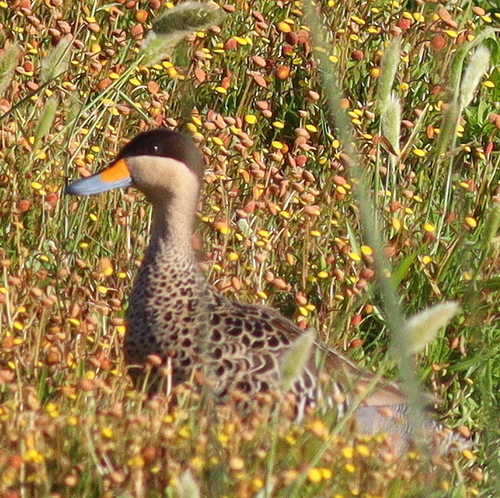 Silver Teal
In short
The most reliable field mark between Baikal Teal and Silver Teal is the Baikal Teal's distinctive face pattern: even in females and juveniles, look for a pale spot at the base of the bill and a pale throat line angling back to the eye, which Silver Teal lacks. In flight or at rest, Baikal Teal (especially females and juveniles) show a longer tail and a more intricate, multi-toned face, while Silver Teal is capped black with a blue bill tipped yellow and lacks strong facial contrasts. Both species have a green speculum, but the bordering and face pattern are key. Juvenile and female Baikal Teal can be confused with Silver Teal, but careful attention to face and throat markings will separate them.
Identification tips
- Face pattern is key: Baikal Teal (female/juvenile) shows a pale spot at the base of the bill and a white throat line angling back to the eye—Silver Teal never shows this.
- Eyebrow and crown: Baikal Teal has a pale eyebrow bordered by a darker crown; Silver Teal has a black cap extending below the eyes, with no pale eyebrow.
- Bill color: Silver Teal has a bluish bill with a yellow tip, while Baikal Teal's bill is dark and lacks a yellow tip.
- Speculum border: Both have a green speculum, but Baikal Teal's inner border is cinnamon-cream and indistinct, while Silver Teal's is sharply bordered with white.
- Underwing in flight: Baikal Teal has a darker leading edge to the underwing (all ages); Silver Teal does not have this feature.
- Tail length: Baikal Teal is longer-tailed, especially obvious in swimming or flying birds.
- Adult male Baikal Teal (breeding): Unmistakable with green nape, yellow and black face, and spotted breast—Silver Teal never shows these colors.
- Eclipse male Baikal Teal: Resembles female but is richer rufous; still shows the pale loral spot and throat line.
- Female Silver Teal: Duller than male but still capped, and lacks any pale loral spot or throat line.
- Juvenile Baikal Teal: Always shows pale loral spot and pale throat line, even when otherwise similar to Silver Teal.
- Body size: Baikal Teal is heavier and slightly longer; in mixed flocks, look for the longer, more attenuated body and tail.
- Habitat context: In native ranges, Baikal Teal is East Asian, Silver Teal is South American; vagrants or captive birds may occur elsewhere.
- Bridle marking confusion: Some Baikal Teal (especially juvenile males) may show 'bridle' facial markings—still look for the pale loral spot and throat line.
- Breast spotting: Baikal Teal (male) has a spotted breast; Silver Teal does not.
- Face contrast: Silver Teal's face is more uniformly dark-capped, while Baikal Teal's is intricately patterned with pale and dark contrasts.
Size
Baikal Teal is slightly larger and heavier than Silver Teal, with a length of 39–43 cm and an average weight of 500 g, compared to Silver Teal's 410 g [wikidata]. Baikal Teal also has a noticeably longer tail, which is a useful field clue when birds are swimming or in flight. Both are small dabbling ducks, but Baikal Teal tends to look a bit longer-bodied and more attenuated at the rear.
Plumage
- Juvenile and Female Baikal Teal: Both sexes and ages show a pale spot at the base of the bill, a white throat line that angles back to the eye, and a distinct pale eyebrow bordered by a darker crown. The underwing is similar to Green-winged Teal but with a darker leading edge; the green speculum has an indistinct cinnamon-cream inner border. Juveniles resemble females but always show the pale loral spot.
- Silver Teal: Has a black cap extending below the eyes, a bluish bill with a yellow tip, and a green speculum with a clear white border. The face lacks the Baikal Teal's pale loral spot and throat line. Female Silver Teal is duller but still capped and lacks the Baikal Teal's intricate face pattern.
- Adult Male Baikal Teal (breeding): Striking green nape, yellow and black auriculars, dark crown, and spotted light brown breast—unmistakable compared to Silver Teal. In eclipse, Baikal Teal males resemble females but are richer rufous.
- Flight views: Both species show a green speculum, but Baikal Teal's is bordered less distinctly and the underwing has a darker leading edge, while Silver Teal's speculum is bordered with white.
Behaviour
Both are dabbling ducks and may be seen feeding in shallow water or loafing among reeds. Baikal Teal may appear more elongated and longer-tailed when swimming or in flight. No major behavioral differences are noted in the sources.
Habitat
Baikal Teal breeds in eastern Russia and winters in East Asia, while Silver Teal is a South American breeder. In the field, Baikal Teal is highly unlikely in South America and vice versa, but in captivity or vagrant situations, habitat overlap is possible in wetland or reedbed settings. Both prefer shallow freshwater habitats with emergent vegetation.