

Bahama Yellowthroat vs Common Yellowthroat
Geothlypis rostrata versus Geothlypis trichas
Play a quiz with Bahama Yellowthroat and Common Yellowthroat
 Bahama Yellowthroat
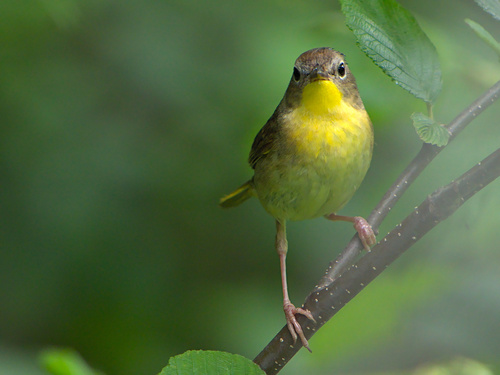 Common Yellowthroat
In short
The most reliable field mark between Bahama Yellowthroat and Common Yellowthroat is overall size and bill thickness: Bahama Yellowthroat is noticeably larger and has a heavier, more robust bill, while Common Yellowthroat is smaller and more delicate-billed. Adult males of both species sport a black facial mask, but Bahama Yellowthroat’s mask is broader and more extensive, with a grayer, more olive-tinged crown and nape, and more uniform yellow underparts. Females and immatures are trickier, but Bahama Yellowthroat females show a plainer, browner crown and a heavier bill, while Common Yellowthroat females are smaller, with paler underparts and a more delicate face. Habitat can help: Bahama Yellowthroat prefers drier uplands, while Common Yellowthroat is found in wetter, marshy areas. Movements are also a clue—Bahama Yellowthroat moves more slowly and deliberately than the often skulking, quick Common Yellowthroat.
Identification tips
- Size and bill structure: Bahama Yellowthroat is distinctly larger and bulkier, with a noticeably heavier, stouter bill. This is often visible even at a distance or when birds are side by side. Common Yellowthroat is smaller and more delicate overall.
- Adult male mask: Bahama Yellowthroat males have a broad, extensive black mask that wraps from the forehead around the eye to the side of the neck, bordered by a thin grayish-white line. Common Yellowthroat males have a narrower mask, bordered above by white or gray, and the mask does not extend as far back.
- Crown and nape color (adult males): Bahama Yellowthroat shows a medium gray hindcrown and nape with a yellowish olive tinge, while Common Yellowthroat males have a more uniform olive crown without the gray contrast.
- Underparts color: Bahama Yellowthroat has more uniform yellow underparts, with only a faint olive wash on the flanks. Common Yellowthroat has yellow on the throat and chest but white on the belly, creating a more two-toned look.
- Female and immature face: Bahama Yellowthroat females have a plain brownish crown, thin grayish-white supercilium, and grayish ear coverts, with a heavier bill. Common Yellowthroat females and immatures are plainer, smaller, and have paler underparts, with a more delicate face and no mask.
- First-year males: Common Yellowthroat first-year males may show a faint black mask, but it is never as broad or bold as in Bahama Yellowthroat males.
- Leg and iris color: Both species have dark irises and dusky pinkish legs, so these features are not helpful for separation.
- Subspecies variation: Bahama Yellowthroat subspecies may show differences in mask border color (e.g., yellow in G. r. coryi) and overall brightness, but all are larger and heavier-billed than Common Yellowthroat.
- Behavior: Bahama Yellowthroat moves more slowly and deliberately, often perching in the open for longer. Common Yellowthroat is quick, restless, and skulking, rarely staying still for long.
- Habitat: In the Bahamas, Bahama Yellowthroat is found in drier uplands, while Common Yellowthroat prefers wetter, marshy areas. Habitat preference is a strong clue when both species are present.
- Vocalizations: Bahama Yellowthroat’s song is slower and richer, while Common Yellowthroat’s is sharper and more rapid. The Bahama Yellowthroat’s 'tuck' call is less harsh than the Common Yellowthroat’s 'jip'.
- Geographic context: Bahama Yellowthroat is endemic to the Bahamas and is resident, while Common Yellowthroat is a migrant and winter visitor to the islands. Season and location can provide important context for identification.
- Jizz in flight: No distinctive upperwing or flight pattern differences are described, so rely on size, structure, and behavior when birds are in motion.
- Mixed flocks: If both species are present, look for the larger, heavier-billed bird with more uniform yellow underparts (Bahama Yellowthroat) versus the smaller, paler-bellied Common Yellowthroat.
- Pitfalls: Females and immatures of both species are subtle and can be very similar. Use size, bill structure, and habitat as your best clues when plumage is not definitive.
Size
Bahama Yellowthroat is distinctly larger, at about 15 cm in length and 15.1–17.3 g in mass [wikipedia], compared to the smaller Common Yellowthroat (no precise numbers in the provided notes, but described as smaller and more delicate-billed). The Bahama Yellowthroat’s bill is noticeably heavier and stouter, a structural feature that stands out in direct comparison. Both species are small warblers, but this size and bill difference is often apparent with good views or in mixed flocks.
Plumage
No age-specific upperwing or flight pattern differences are described for either species, so focus is on facial and body plumage.
- Adult males: Both have a black facial mask, but Bahama Yellowthroat’s mask is broader, extending from the forehead around the eye to the side of the neck, and is bordered by a thin grayish-white line. Its hindcrown and nape are medium gray with a yellowish olive tinge, and the upperparts, wings, and tail are yellowish olive-green. Underparts are a rich, uniform yellow with only a faint olive wash on the flanks. Common Yellowthroat males have a narrower black mask, bordered above with white or gray, and their underparts are yellow on the throat and chest but white on the belly, with less uniformity.
- Females: Bahama Yellowthroat females have a plain, brownish crown, a thin grayish-white supercilium, and grayish ear coverts, with yellowish olive-green upperparts and yellow underparts. Common Yellowthroat females lack the black mask, have paler underparts, and are generally plainer, with a more delicate face and less contrast between crown and face. Immature Common Yellowthroats resemble adult females, with first-year males showing only a faint mask.
- Subspecies: Bahama Yellowthroat subspecies vary in mask border color and brightness, but all are larger and more robust than any Common Yellowthroat.
Behaviour
Bahama Yellowthroat tends to move more slowly and deliberately through vegetation, often appearing less restless than Common Yellowthroat. Common Yellowthroat is known for its quick, skulking movements in dense, low vegetation, frequently flicking its tail and changing position rapidly. These behavioral differences can be subtle but are useful when watching birds for extended periods.
Habitat
Bahama Yellowthroat is typically found in drier upland habitats within the Bahamas, often in brushy or scrubby areas away from water. In contrast, Common Yellowthroat strongly favors wetter, marshy environments, including reed beds, wet meadows, and the edges of ponds and streams. In the Bahamas, Common Yellowthroat is a winter visitor and is usually found in wetter habitats than the resident Bahama Yellowthroat.
Voice
Both species have similar songs, but Bahama Yellowthroat’s song is described as slower and richer ('wichety wichety wichit'), while Common Yellowthroat’s song is sharper and more rapid ('twichety twichety twichety twich'). The Bahama Yellowthroat’s call is a sharp 'tuck' that is less harsh than the Common Yellowthroat’s soft 'jip'. Bahama Yellowthroat also gives a dry rattle and a quiet 'whisper-song' with trills and spluttering notes, which may be less familiar to those used to Common Yellowthroat vocalizations.