

Australian Shelduck vs Paradise Shelduck
Tadorna tadornoides versus Tadorna variegata
Play a quiz with Australian Shelduck and Paradise Shelduck
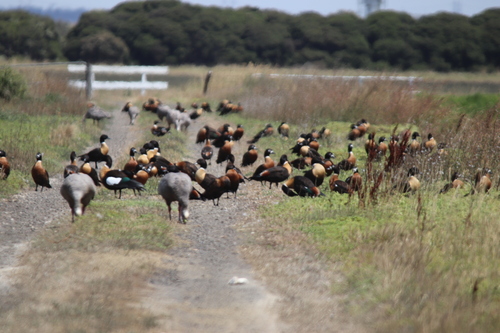 Australian Shelduck
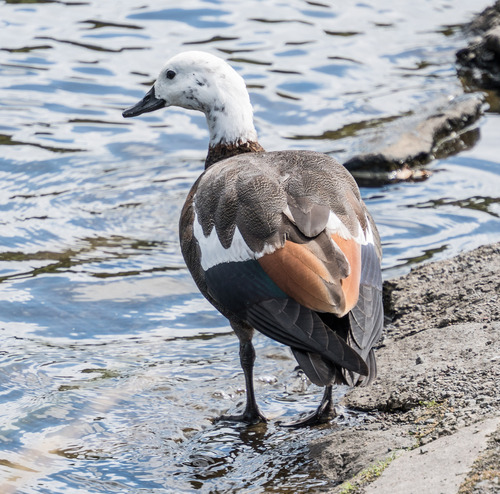 Paradise Shelduck
In short
The most reliable field mark between Australian Shelduck and Paradise Shelduck is the head and breast pattern of adults: Australian Shelduck males have a dark green head with a white neck collar and a rich chestnut breast, while Paradise Shelduck males have a blue-black head with no collar and a barred, mostly dark body. Adult Paradise Shelduck females are unmistakable with their entirely white head and chestnut body, a combination never shown by Australian Shelduck. In flight, both species show white in the wings and a green speculum, but the extent and placement of white differ. Juveniles of both species are similar when downy, but as they mature, Paradise Shelduck females quickly develop a white head, while Australian Shelduck juveniles remain duller and lack the adult's crisp patterns. Size is broadly similar, but Paradise Shelduck averages slightly heavier.
Identification tips
- Adult female Paradise Shelduck is unique: Look for an entirely white head and neck with a chestnut body—this is never shown by Australian Shelduck of any age or sex.
- Adult male head and collar: Australian Shelduck males have a dark green head with a crisp white neck collar and a chestnut breast. Paradise Shelduck males have a blue-black head with no collar and a barred, mostly dark body.
- White around the eye: Australian Shelduck females have white around the eyes but not a full white head. Paradise Shelduck females have a full white head and neck.
- Breast color: Australian Shelduck males have a rich chestnut breast band, while Paradise Shelduck males have a dark grey breast flecked with pale yellow, lacking a solid chestnut band.
- Juvenile separation: Downy young of both species are similar, but as Paradise Shelduck females mature, they quickly develop a white head. Juvenile Australian Shelduck males are duller than adults and lack the white collar; juvenile females have more white on the head but never a full white head.
- Upperwing pattern in flight: Both show white in the wings and a green speculum, but Paradise Shelduck has more extensive white upperwing coverts, while Australian Shelduck's white is more restricted. This is subtle and best used with other marks.
- Bill and leg color: Both have dark bills and legs; not a useful separator.
- Body size and structure: Both are large, robust ducks with similar structure. Paradise Shelduck averages slightly heavier, but this is not reliable without direct comparison.
- Vocalizations: Australian Shelduck males honk deeply; females give a high 'zeek'. Paradise Shelduck females also have high-pitched calls, but differences are not always clear in the field.
- Habitat and range: Australian Shelduck is native to Australia, Paradise Shelduck to New Zealand. If seen outside these ranges, consider vagrancy but prioritize plumage marks.
- Crèche behavior: Large groups of downy young are more typical of Australian Shelduck, but not diagnostic.
- Threat and distraction displays: Paradise Shelduck is more likely to show elaborate threat or broken wing displays if disturbed near young.
- Sexual dimorphism: Paradise Shelduck shows stronger sexual dimorphism (white-headed female vs. dark-headed male), while Australian Shelduck sexes are more similar, with females only showing white around the eye.
- Molt and age effects: Paradise Shelduck female's chestnut body shade varies with age and molt, but the white head is consistent after the first molt.
- Pitfalls: Immature females of both species can be confusing; focus on extent of white on the head and presence/absence of a neck collar for best results.
Size
Both species are large, goose-like ducks, but Paradise Shelduck is on average heavier (male mean 1,549.5 g vs. 1,425 g for Australian Shelduck) and is described as the largest Tadorna. Length overlaps (Australian Shelduck: 56–72 cm; Paradise Shelduck: 63–71 cm), so size alone is unreliable in the field. Both have broad wings and a robust build. Females of both species are smaller than males, but this is subtle without direct comparison.
Plumage
-
Juveniles and Downy Young: Both species' downy young are white with a brown crown and brown stripes from crown to tail, making them hard to separate at this stage. As juveniles mature, Australian Shelduck males are duller than adults and lack the white collar, while juvenile females have more white, especially around the head, but not a full white head. Paradise Shelduck juvenile males resemble adult males, but juvenile females show a white patch at the base of the bill and rapidly develop a white head after fledging.
-
Adult Males: Australian Shelduck males have a dark green head, crisp white neck collar, and a rich chestnut breast, with black body and chestnut/black wings showing a green speculum and some white in flight. Paradise Shelduck males have a blue-black head and neck, no collar, a barred black body, and a dark grey breast flecked with pale yellow. Their wings have contrasting white upper-coverts and black remiges, with a green speculum and rusty tertials.
-
Adult Females: Australian Shelduck females are similar to males but smaller, with white around the eyes (not a full white head). Paradise Shelduck females are distinctive with an entirely white head and neck, dark or light chestnut body (depending on age/molt), and a dark grey back flecked with pale yellow. This white head is unique among these two species.
-
Flight: Both species show white in the wings and a green speculum, but Paradise Shelduck's white is more extensive on the upperwing coverts, while Australian Shelduck shows white patches but not as much on the coverts. In both, the chestnut and black wing pattern is visible, but the head and neck pattern remain the best separator.
Behaviour
Both species are largely terrestrial and often graze, but Paradise Shelduck is noted for strong pair bonds and territorial defense, with elaborate threat and distraction displays (e.g., broken wing display). Australian Shelduck also forms large crèches of young, sometimes up to 100 birds. Both are strong fliers and swim well, but Paradise Shelduck's threat and distraction behaviors are more frequently described.
Habitat
Australian Shelduck is native to Australia and prefers open wetlands, lakes, and sometimes coastal areas. Paradise Shelduck is endemic to New Zealand and uses a wide range of open habitats, including farmland, lakes, and rivers. Overlap is rare except as vagrants, so location is a strong clue except in exceptional cases.
Voice
Australian Shelduck males give a deep, goose-like honk, while females have a high-pitched, penetrating 'zeek, zeek'. Paradise Shelduck females also give high-pitched calls, especially when alarmed, while males call rapidly in threat displays. Both sexes of Paradise Shelduck are vocal, especially during territorial or threat interactions. The differences are subtle and not always diagnostic in the field.