

Asian Desert Warbler vs Rüppell's Warbler
Curruca nana versus Curruca ruppeli
Play a quiz with Asian Desert Warbler and Rüppell's Warbler
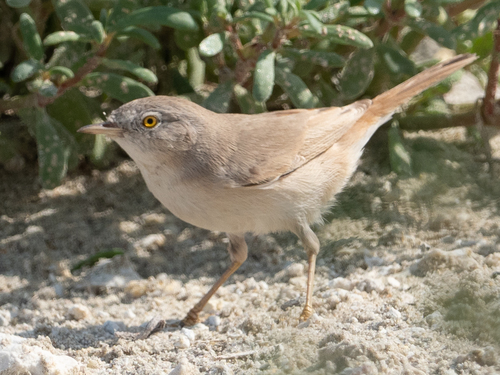 Asian Desert Warbler
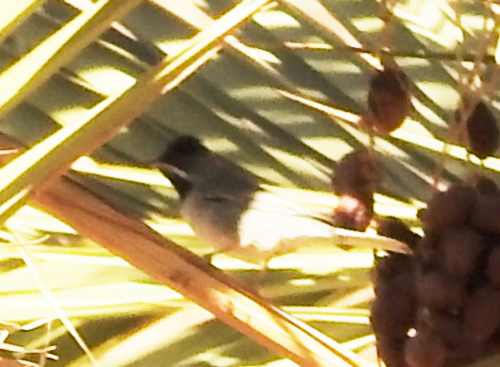 Rüppell's Warbler
In short
The most reliable field mark separating Asian Desert Warbler from Rüppell's Warbler is the presence of a yellow iris and yellowish bill and legs in Asian Desert Warbler, versus the red eye and brown legs of Rüppell's Warbler. Adult male Rüppell's Warbler is also unmistakable with its black head and throat, divided by a sharp white malar stripe, while Asian Desert Warbler is always plain-faced and pale. Females and immatures of both species are trickier, but Asian Desert Warbler remains paler, sandier, and more uniform, lacking any strong facial pattern. Structure and size are similar, but Asian Desert Warbler is slightly smaller and rounder. Habitat can help: Asian Desert Warbler is a bird of open, arid steppe or desert with scattered bushes, while Rüppell's prefers Mediterranean scrub. Vocalizations differ, but are less likely to be diagnostic in a brief encounter.
Identification tips
- Iris color: Asian Desert Warbler always has a yellow iris, even in immatures; Rüppell's Warbler has a red eye in all plumages. This is a key mark at close range.
- Bill and leg color: Asian Desert Warbler shows yellowish bill and legs, while Rüppell's has brown legs and a darker bill. Check bare parts in good light.
- Adult male Rüppell's: Look for a black head and throat with a sharp white malar stripe ('moustache'); Asian Desert Warbler never shows this pattern.
- Facial pattern (female/immature): Female and immature Rüppell's have a grey head (not black), pale throat, and a subtle but present malar stripe; Asian Desert Warbler is always plain-faced, with no strong contrast or stripe.
- Upperparts color: Asian Desert Warbler is pale grey-brown and sandy, blending with desert backgrounds; Rüppell's is plainer grey with a brownish tinge, especially in females.
- Underparts: Both are pale below, but Asian Desert Warbler is more uniformly whitish, while Rüppell's may show a slight contrast between paler underparts and greyish flanks.
- Overall contrast: Asian Desert Warbler is very uniform and lacks strong contrasts; Rüppell's, even in female/immature, shows more facial pattern and contrast.
- Structure: Asian Desert Warbler is slightly more compact and round-bodied; Rüppell's is slim and slightly longer, but this is subtle and unreliable alone.
- Feeding behavior: Asian Desert Warbler often feeds on the ground in open areas, while Rüppell's sticks to bushes and scrub.
- Habitat: Asian Desert Warbler is found in open, arid steppe or desert with scattered bushes; Rüppell's is in Mediterranean scrub. Use habitat as a strong context clue.
- Song: Asian Desert Warbler's song is a musical jingle with harsh notes, often in flight; Rüppell's is a slower, deeper rattle. Use if heard well.
- Sexual dimorphism: Only Rüppell's Warbler shows strong male/female differences; Asian Desert Warbler sexes are nearly identical.
- Wing pattern: No distinctive juvenile or immature wing patterns are described for either species, so rely on other marks for young birds.
- Seasonal context: Asian Desert Warbler is a long-distance migrant between central Asia and northeast Africa/Arabia; Rüppell's breeds in southeast Europe and winters in northeast Africa. Out of range, consider vagrancy.
- Pitfalls: Female Rüppell's can appear plain, but always check for red eye and subtle malar stripe; Asian Desert Warbler never shows these. In poor light, beware of leg and bill color misjudgment.
Size
Asian Desert Warbler is the second-smallest Curruca warbler, measuring 11.5–12.5 cm in length [wikipedia]. Rüppell's Warbler is similar in size, but is described as slimmer than the Sardinian Warbler; no precise measurement is given here, but both are small, slim warblers. In the field, Asian Desert Warbler may appear slightly more compact and round-bodied, while Rüppell's is a touch longer and slimmer. Size alone is not reliable for separation.
Plumage
No age-specific upperwing or flight pattern differences are documented for these two species. For adults, Asian Desert Warbler is pale grey-brown above with browner wings and tail, and whitish below; the overall impression is very plain and sandy. Both sexes look similar, with little contrast or facial pattern, and a yellow iris. Rüppell's Warbler adult male is distinctive: plain grey back, black head and throat separated by a sharp white malar streak, red eyes, and brown legs. Females and immatures of Rüppell's have a grey (not black) head, pale throat, and a grey back with a brownish tinge; they retain the red eye and brown legs, and show more contrast in the face than Asian Desert Warbler. Asian Desert Warbler never shows a black head or strong malar stripe, and always has yellowish bare parts. Juvenile/immature-specific upperwing marks are not described for either species.
Behaviour
Asian Desert Warbler often feeds on the ground, which is unusual for warblers and can be a useful behavioral clue. Rüppell's Warbler behaves more like a typical Curruca, foraging in low bushes and scrub. Both can be active and skittish, but Asian Desert Warbler's ground-feeding habit is notable in open habitats.
Habitat
Asian Desert Warbler breeds and winters in arid, open desert or dry steppe with scattered bushes, often far from dense vegetation. Rüppell's Warbler is a bird of Mediterranean scrub, breeding in Greece, Turkey, and nearby islands, and wintering in northeast Africa. If the bird is in true desert or steppe, Asian Desert Warbler is far more likely; in dense, bushy Mediterranean scrub, Rüppell's is expected. Overlap is minimal except on migration.
Voice
Asian Desert Warbler's song is a distinctive jingle, often delivered in flight, with a mix of clear and harsh notes. Rüppell's Warbler's song is a slower, deeper rattle, less musical than the Asian Desert Warbler. Songs are quite different, but both can be variable and are not always heard in the field. Calls are not described in the notes provided.